Carla Rita Palmerino – författare
Visar alla böcker från författaren Carla Rita Palmerino. Handla med fri frakt och snabb leverans.
5 produkter
5 produkter
578 kr
Skickas inom 10-15 vardagar
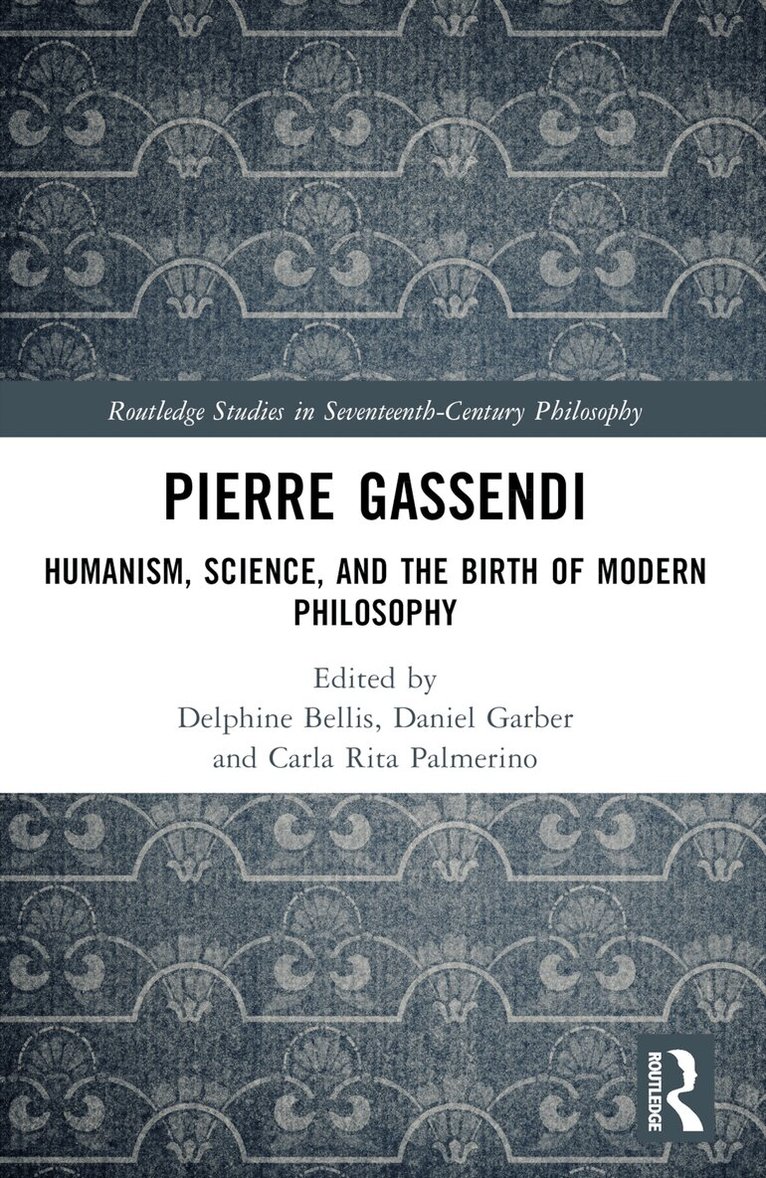
Pierre Gassendi (1592–1655) was a major figure in seventeenth-century philosophy and science and his works contributed to shaping Western intellectual identity. Among “new philosophers,” he was considered Descartes’s main rival, and he belonged to the first rank of those attempting to carve out an alternative to Aristotelian philosophy. In his writings, he promoted a revival of atomism and Epicureanism within a Christian framework, and advocated an empiricist and probabilistic epistemology which was to have a major impact on later thinkers such as Locke and Newton. He is moreover important for his astronomical work, for his defense of Galileo’s mechanics and cosmology, and for his activity as a biographer. Given the importance of Gassendi for the history of science and philosophy, it is surprising to see that he has been largely ignored in the Anglophone world. This collection of essays constitutes the first book on Gassendi in the English language that covers his biography, bibliography, and all aspects of his work. The book is divided into three parts. Part I offers a reconstruction of the genesis of Gassendi’s Epicurean project, an overview of his biography, and analyses of Gassendi’s early attacks on Aristotle, of his advocacy of Epicurean philosophy, and his relation to the skeptical tradition and to Cicero’s thought. Part II addresses Gassendi as a participant in seventeenth-century philosophical and scientific debates, focusing especially on his controversies with Descartes and Fludd. Part III explores Gassendi’s contributions to logic, theories of space and time, mechanics, astronomy, cosmology, and the study of living beings, and presents the reception of Gassendi’s thought in England. This book is an essential resource for scholars and upper-level students of early modern philosophy, intellectual history, and the history of science who want to get acquainted with Pierre Gassendi as a major philosopher and intellectual figure of the early modern period.
1 909 kr
Skickas inom 10-15 vardagar
Pierre Gassendi (1592–1655) was a major figure in seventeenth-century philosophy and science and his works contributed to shaping Western intellectual identity. Among “new philosophers,” he was considered Descartes’s main rival, and he belonged to the first rank of those attempting to carve out an alternative to Aristotelian philosophy. In his writings, he promoted a revival of atomism and Epicureanism within a Christian framework, and advocated an empiricist and probabilistic epistemology which was to have a major impact on later thinkers such as Locke and Newton. He is moreover important for his astronomical work, for his defense of Galileo’s mechanics and cosmology, and for his activity as a biographer. Given the importance of Gassendi for the history of science and philosophy, it is surprising to see that he has been largely ignored in the Anglophone world. This collection of essays constitutes the first book on Gassendi in the English language that covers his biography, bibliography, and all aspects of his work. The book is divided into three parts. Part I offers a reconstruction of the genesis of Gassendi’s Epicurean project, an overview of his biography, and analyses of Gassendi’s early attacks on Aristotle, of his advocacy of Epicurean philosophy, and his relation to the skeptical tradition and to Cicero’s thought. Part II addresses Gassendi as a participant in seventeenth-century philosophical and scientific debates, focusing especially on his controversies with Descartes and Fludd. Part III explores Gassendi’s contributions to logic, theories of space and time, mechanics, astronomy, cosmology, and the study of living beings, and presents the reception of Gassendi’s thought in England. This book is an essential resource for scholars and upper-level students of early modern philosophy, intellectual history, and the history of science who want to get acquainted with Pierre Gassendi as a major philosopher and intellectual figure of the early modern period.
Del 239 - Boston Studies in the Philosophy and History of Science
Reception of the Galilean Science of Motion in Seventeenth-Century Europe
Inbunden, Engelska, 2004
1 062 kr
Skickas inom 10-15 vardagar
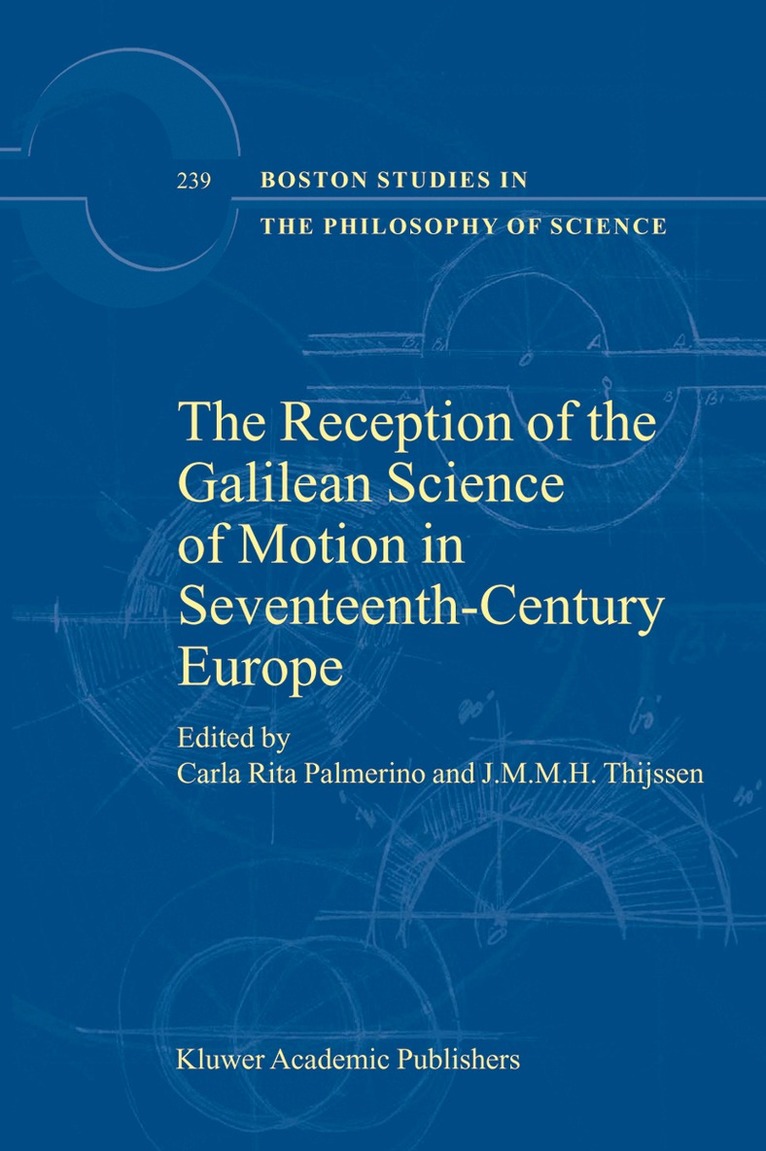
This book has evolved out of a colloquium entitled "The Reception of the Galilean Science of Motion;' held at Amsterdam on 5-7 July 2000. It was our intention as the organizers to bring together historians of science interested in Galileo's science of motion, its ramifications in seventeenth-century Europe, and its impact on what Anneliese Maier and E. J. Dijksterhuis have labeled the "mechanization of the world picture. " Funding for the conference was provided by the Royal Netherlands Academy of Arts and Sciences, which honored our proposal for an Academy Colloquium. We should also like to thank Ap de Wit, Martine Wagenaar, and Ine van den Heuvel from the Royal Academy for the careful and reliable administrative organization of the colloquium. Through a generous grant (no. 200-22-295), the Netherlands Organization for Scientific Research ( NWO) allowed the Center for Medieval and Renaissance Natural Philosophy at Nijmegen University to act as the colloquium's second sponsor. All papers that were read at the colloquium have been strongly modified for publication.It is hoped that the resulting articles display even more coherence and unity than the colloquium did, while at the same time retaining something of its spirit and diversity. In addition to the authors whose articles are published here, the following scholars also participated in the discussions: Constance Blackwell, Hans Bots, Henk Braakhuis, Wiep van Bunge, Dirk-Jan Dekker, Fokko-Jan Dijksterhuis, Juliette van den Elsen, Fran'Tois de Gandt, Christoph Luthy, Olaf Pluta, Thomas Settle, Theo Verbeek, and Liesbeth de Wreede.
Del 48 - Studies in History and Philosophy of Science
Space, Imagination and the Cosmos from Antiquity to the Early Modern Period
Inbunden, Engelska, 2019
1 062 kr
Skickas inom 10-15 vardagar
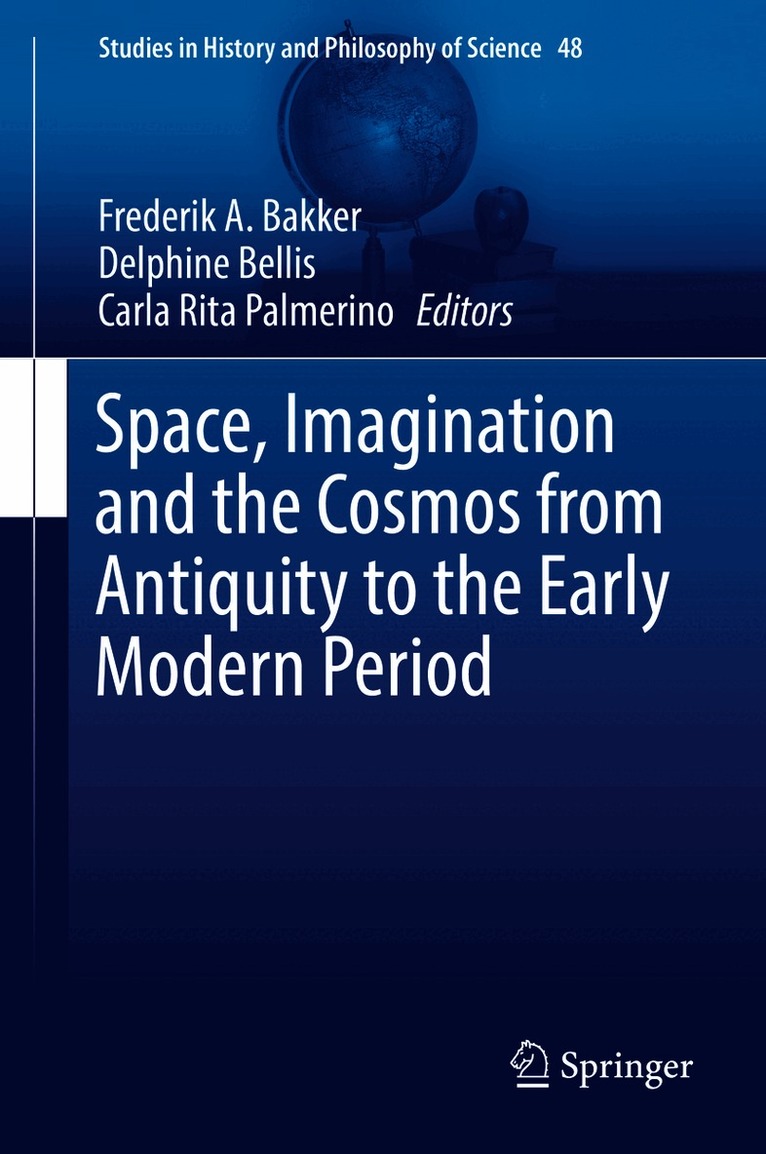
This volume provides a much needed, historically accurate narrative of the development of theories of space up to the beginning of the eighteenth century. It studies conceptions of space that were implicitly or explicitly entailed by ancient, medieval and early modern representations of the cosmos. The authors reassess Alexandre Koyré’s groundbreaking work From the Closed World to the Infinite Universe (1957) and they trace the permanence of arguments to be found throughout the Middle Ages and beyond. By adopting a long timescale, this book sheds new light on the continuity between various cosmological representations and their impact on the ontology and epistemology of space.Readers may explore the work of a variety of authors including Aristotle, Epicurus, Henry of Ghent, John Duns Scotus, John Wyclif, Peter Auriol, Nicholas Bonet, Francisco Suárez, Francesco Patrizi, Giordano Bruno, Libert Froidmont, Marin Mersenne, Pierre Gassendi, Gottfried Wilhelm Leibnizand Samuel Clarke. We see how reflections on space, imagination and the cosmos were the product of a plurality of philosophical traditions that found themselves confronted with, and enriched by, various scientific and theological challenges which induced multiple conceptual adaptations and innovations.This volume is a useful resource for historians of philosophy, those with an interest in the history of science, and particularly those seeking to understand the historical background of the philosophy of space.
Del 239 - Boston Studies in the Philosophy and History of Science
Reception of the Galilean Science of Motion in Seventeenth-Century Europe
Häftad, Engelska, 2010
1 062 kr
Skickas inom 10-15 vardagar
This book has evolved out of a colloquium entitled "The Reception of the Galilean Science of Motion;' held at Amsterdam on 5-7 July 2000. It was our intention as the organizers to bring together historians of science interested in Galileo's science of motion, its ramifications in seventeenth-century Europe, and its impact on what Anneliese Maier and E. J. Dijksterhuis have labeled the "mechanization of the world picture. " Funding for the conference was provided by the Royal Netherlands Academy of Arts and Sciences, which honored our proposal for an Academy Colloquium. We should also like to thank Ap de Wit, Martine Wagenaar, and Ine van den Heuvel from the Royal Academy for the careful and reliable administrative organization of the colloquium. Through a generous grant (no. 200-22-295), the Netherlands Organization for Scientific Research ( NWO) allowed the Center for Medieval and Renaissance Natural Philosophy at Nijmegen University to act as the colloquium's second sponsor. All papers that were read at the colloquium have been strongly modified for publication.It is hoped that the resulting articles display even more coherence and unity than the colloquium did, while at the same time retaining something of its spirit and diversity. In addition to the authors whose articles are published here, the following scholars also participated in the discussions: Constance Blackwell, Hans Bots, Henk Braakhuis, Wiep van Bunge, Dirk-Jan Dekker, Fokko-Jan Dijksterhuis, Juliette van den Elsen, Fran'Tois de Gandt, Christoph Luthy, Olaf Pluta, Thomas Settle, Theo Verbeek, and Liesbeth de Wreede.