Carlos Rodríguez-Rellán - Böcker
Visar alla böcker från författaren Carlos Rodríguez-Rellán. Handla med fri frakt och snabb leverans.
2 produkter
2 produkter
Del 5 - Proceedings of the UISPP World Congress
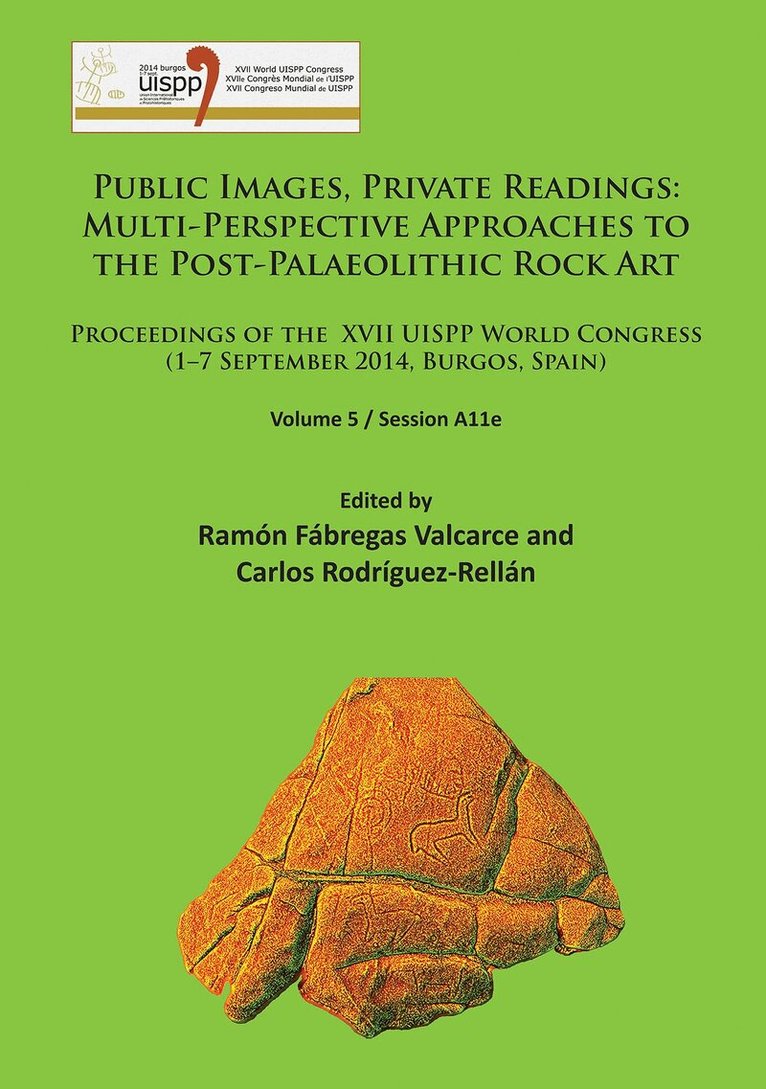
Public Images, Private Readings: Multi-Perspective Approaches to the Post-Palaeolithic Rock Art
Proceedings of the XVII UISPP World Congress (1–7 September 2014, Burgos, Spain) Volume 5 / Session A11e
Häftad, Engelska, 2016
325 kr
Skickas
A significant number of Holocene societies throughout the world have resorted at one time or another to the making of paints or carvings on different places (tombs, rock-shelters or caves, openair outcrops). The aim of the session A11e. Public images, private readings: multi-perspective approaches to the post-Palaeolithic rock art, which was held within the XVII World UISPP Congress (Burgos, September 1-7 2014), was to put together the experiences of specialists from different areas of the Iberian Peninsula and the World. The approaches ranged from the archaeological definition of the artistic phenomena and their socioeconomic background to those concerning themselves with the symbolic and ritual nature of those practices, including the definition of the audience to which the graphic manifestations were addressed and the potential role of the latter in the making up of social identities and the enforcement of territorial claims. More empirical issues, such as new recording methodologies and data management or even dating were also considered during this session.
Taste for Green
A global perspective on ancient jade, turquoise and variscite exchange
Inbunden, Engelska, 2019
873 kr
Tillfälligt slut
Often along vast expanses, ancient societies traded certain commodities that were considered valuable either for functional or symbolic reasons – or, rather, a mixture of both factors. A Taste for Green addresses latest research into the acquisition of jade, turquoise or variscite, all of which share a characteristic greenish colour and an engaging appearance once they are polished in the shape of axes or assorted adornments. Papers explore how, in addition to constituting economic transactions, the transfess of these materials were also statements of social liaisons, personal capacities, and relation to places or to unseen forces. The volume centres on two study areas, Western Europe and México/Southwest US, which are far apart not just in geographical terms but also with regard to their chronology and socioeconomic features. While some North and Mesoamerican groups range from relatively complex farming societies up to state-like organisations during the 1st and 2nd millennia AD, the European counterparts are comparatively simpler polities spanning the 5th–3rd millennia BC. By contrasting the archaeological evidence from diverse areas we may gain insights into the role that production/movement of these green stones played in their respective political and ritual economies. Also, we think it useful to compare the scientific approaches applied to this question in different parts of the globe, specially Asia.