Carmen M. Reinhart – författare
257 kr
Skickas inom 5-8 vardagar
128 kr
Läs direkt efter köp
The European currency crises of 1992-93, the Mexican crisis of 1994-95, and especially the Asian/global crisis of 1997-98, have all contributed to a heightened interest in the early warning signals of financial crises. This pathbreaking study presents a comprehensive battery of empirical tests on the performance of alternative early warning indicators for emerging-market economies that should prove useful in the construction of a more effective global warning system.Not only are the authors able to draw conclusions about which specific indicators have sent the most reliable early warning signals of currency and banking crises in emerging economies, they also test the out-of-sample performance of the model during the Asian crisis and find that it does a good job of identifying the most vulnerable economies. In addition, they show how the early warning system can be used to construct a "composite" crisis indicator to weigh the importance of alternative channels of cross-country "contagion" of crises, and to generate information about the recovery path from crises.This timely study comes on the eve of impending changes at the International Monetary Fund as that institution reexamines how it reacts to financial crises. Moreover, the study provides "... a wealth of valuable elements for anyone investigating and forecasting adverse developments in emerging markets as well as industrial countries," according to Ewoud Schuitemaker, vice president of the economics department at ABN AMRO Bank.
128 kr
Läs direkt efter köp
This book presents evidence that public debts in the advanced economies have surged in recent years to levels not recorded since the end of World War II, surpassing the heights reached during the First World War and the Great Depression. At the same time, private debt levels, particularly those of financial institutions and households, are in uncharted territory and are (in varying degrees) a contingent liability of the public sector in many countries. Historically, high leverage episodes have been associated with slower economic growth and a higher incidence of default or, more generally, restructuring of public and private debts.A more subtle form of debt restructuring in the guise of "financial repression" (which had its heyday during the tightly regulated Bretton Woods system) also importantly facilitated sharper and more rapid debt reduction than would have otherwise been the case from the late 1940s to the 1970s. It is conjectured here that the pressing needs of governments to reduce debt rollover risks and curb rising interest expenditures in light of the substantial debt overhang (combined with the widespread "official aversion" to explicit restructuring) are leading to a revival of financial repression—including more directed lending to government by captive domestic audiences (such as pension funds), explicit or implicit caps on interest rates, and tighter regulation on cross-border capital movements.
331 kr
Skickas inom 5-8 vardagar
321 kr
Skickas inom 5-8 vardagar
166 kr
Skickas inom 5-8 vardagar
161 kr
Skickas inom 5-8 vardagar
260 kr
Skickas inom 3-6 vardagar
260 kr
Skickas inom 3-6 vardagar
276 kr
Läs direkt efter köp
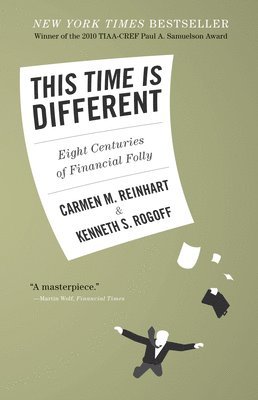
The acclaimed New York Times bestselling history of financial crisesThroughout history, rich and poor countries alike have been lending, borrowing, crashing, and recovering their way through an extraordinary range of financial crises. Each time, the experts have chimed, “this time is different”—claiming that the old rules of valuation no longer apply and that the new situation bears little similarity to past disasters. With this breakthrough study, leading economists Carmen Reinhart and Kenneth Rogoff definitively prove them wrong.Covering sixty-six countries across five continents and eight centuries, This Time Is Different presents a comprehensive look at the varieties of financial crises—including government defaults, banking panics, and inflationary spikes—from medieval currency debasements to the subprime mortgage catastrophe. Reinhart and Rogoff provocatively argue that financial combustions are universal rites of passage for emerging and established market nations.A remarkable history of financial folly, This Time Is Different will influence financial and economic thinking and policy for decades to come.
42 kr
Läs direkt efter köp
We''ve been assured that the recession is over, but the country and the economy continue to feel the effects of the 2008 financial crisis, and people are still searching for answers about what caused it, what it has wrought, and how we can recover. This selection from the best-selling book This Time Is Different—the definitive history of financial crises, including the recent subprime meltdown—answers these questions and more.Princeton Shorts are brief selections excerpted from influential Princeton University Press publications produced exclusively in eBook format. They are selected with the firm belief that while the original work remains an important and enduring product, sometimes we can all benefit from a quick take on a topic worthy of a longer book.In a world where every second counts, how better to stay up-to speed on current events and digest the kernels of wisdom found in the great works of the past? Princeton Shorts enables you to be an instant expert in a world where information is everywhere but quality is at a premium. The Second Great Contraction does just that.
91 kr
Läs direkt efter köp
170 kr
Tillfälligt slut