Carole Rakodi - Böcker
Visar alla böcker från författaren Carole Rakodi. Handla med fri frakt och snabb leverans.
8 produkter
8 produkter
647 kr
Skickas inom 10-15 vardagar
This book analyses how religion is entangled in people’s lives in Sub-Saharan Africa and southern Asia. It provides an introduction to the teachings, practices and values promoted by the main religious traditions in these regions and an overview of the evidence on what religion means to people in terms of their beliefs and religious practices and how it influences their values, attitudes and day-to-day relationships with others, especially their families. Over the course of the book Carole Rakodi explores similarities and differences between and within religious traditions and identifies some of the key factors that influence and explain the roles played by religion in people’s personal lives and social relationships. A separate companion volume will go on to focus on the social and political roles and relationships of religious groups and organisations.This book will be of great interest to academics and students working in a range of disciplines, especially sociology, religious studies and development studies but also anthropology, geography and area studies.
Religion, Religious Organisations and Development
Scrutinising religious perceptions and organisations
Inbunden, Engelska, 2013
2 030 kr
Skickas inom 10-15 vardagar
This collection adds to a burgeoning literature concerned with the roles played by religions in development. The authors do not assume that religion and religious organisations can be ‘used’ to achieve development objectives, or that religiously inspired development work is more holistic, transformative and authentic. Instead, they subject such assumptions to critical and (as far as possible) objective scrutiny, focusing on how adherents of several religious traditions and a variety of organisations affiliated with different religions perceive the idea of development and attempt to contribute to its objectives. Geographically, chapters in the volume encompass Africa, South Asia and the Asia-Pacific.Four of the papers have an international focus: providing a preliminary framework for analysing the role of religion in development, considering the roles played by faith-inspired organisations in two regions (the Asia Pacific and Sub-Saharan Africa) and analysing transnational Muslim NGOs. The individual case studies focus on nine countries (India, Kenya, Pakistan, Nigeria, Tanzania, Sudan, Malawi, Sri Lanka, South Africa), consider four religions (Islam, Hinduism, Christianity, Buddhism), and can be grouped under four themes: they consider religion, wellbeing and inequality; the roles of religious NGOs in development; whether and how religious organisations influence, respond to or resist social change; and whether religious service providers reach the poor. Finally, practice notes show how three religious development organisations try to put their principles into practice.This book was published as a special double issue of Development in Practice.
Religious Organisations in Sub-Saharan Africa and South Asia
Connections to Society and the State
Häftad, Engelska, 2025
633 kr
Skickas inom 10-15 vardagar
This book explores the links between religion, states, social welfare and social change in Sub-Saharan Africa and South Asia. Building on the author’s previous analysis of how religious beliefs, practices and values influence social behaviour and relationships, especially within families, this book focuses on the organisational characteristics of religions and societies.The book considers how Muslim, Christian, Hindu and Buddhist organisations working in different contexts express the religious values of charity and compassion in practical activities to improve social welfare. Drawing on extensive empirical research, the book maps the organisations involved, identifying the factors that explain their choice of activities, sources of funding and modes of organisation, and highlighting similarities and differences between the religious traditions. It considers the involvement of religious actors in school-level education, as well as in international humanitarian relief and reconstruction, and addresses the claim that religious organisations have distinctive features that give them comparative advantages. Finally, the book reviews research on the roles of religious values and organisations in resisting or promoting social change, focusing on women’s movements, especially their campaigns for changes in family law, and the quest for social and legal recognition for sexual and gender minorities.The book’s wide coverage of two subcontinents in the Global South and several important religious traditions will be of interest to researchers and students in the fields of sociology, international development, religious studies, anthropology and area studies, as well as to those engaged in policy and action who are looking to improve their understanding of the complex social, cultural, political and religious contexts in which they work.
Religion, Religious Organisations and Development
Scrutinising religious perceptions and organisations
Häftad, Engelska, 2024
579 kr
Skickas inom 10-15 vardagar
This collection adds to a burgeoning literature concerned with the roles played by religions in development. The authors do not assume that religion and religious organisations can be ‘used’ to achieve development objectives, or that religiously inspired development work is more holistic, transformative and authentic. Instead, they subject such assumptions to critical and (as far as possible) objective scrutiny, focusing on how adherents of several religious traditions and a variety of organisations affiliated with different religions perceive the idea of development and attempt to contribute to its objectives. Geographically, chapters in the volume encompass Africa, South Asia and the Asia-Pacific.Four of the papers have an international focus: providing a preliminary framework for analysing the role of religion in development, considering the roles played by faith-inspired organisations in two regions (the Asia Pacific and Sub-Saharan Africa) and analysing transnational Muslim NGOs. The individual case studies focus on nine countries (India, Kenya, Pakistan, Nigeria, Tanzania, Sudan, Malawi, Sri Lanka, South Africa), consider four religions (Islam, Hinduism, Christianity, Buddhism), and can be grouped under four themes: they consider religion, wellbeing and inequality; the roles of religious NGOs in development; whether and how religious organisations influence, respond to or resist social change; and whether religious service providers reach the poor. Finally, practice notes show how three religious development organisations try to put their principles into practice.This book was published as a special double issue of Development in Practice.
Religious Organisations in Sub-Saharan Africa and South Asia
Connections to Society and the State
Inbunden, Engelska, 2024
2 098 kr
Skickas inom 10-15 vardagar
This book explores the links between religion, states, social welfare and social change in Sub-Saharan Africa and South Asia. Building on the author’s previous analysis of how religious beliefs, practices and values influence social behaviour and relationships, especially within families, this book focuses on the organisational characteristics of religions and societies.The book considers how Muslim, Christian, Hindu and Buddhist organisations working in different contexts express the religious values of charity and compassion in practical activities to improve social welfare. Drawing on extensive empirical research, the book maps the organisations involved, identifying the factors that explain their choice of activities, sources of funding and modes of organisation, and highlighting similarities and differences between the religious traditions. It considers the involvement of religious actors in school-level education, as well as in international humanitarian relief and reconstruction, and addresses the claim that religious organisations have distinctive features that give them comparative advantages. Finally, the book reviews research on the roles of religious values and organisations in resisting or promoting social change, focusing on women’s movements, especially their campaigns for changes in family law, and the quest for social and legal recognition for sexual and gender minorities.The book’s wide coverage of two subcontinents in the Global South and several important religious traditions will be of interest to researchers and students in the fields of sociology, international development, religious studies, anthropology and area studies, as well as to those engaged in policy and action who are looking to improve their understanding of the complex social, cultural, political and religious contexts in which they work.
2 098 kr
Skickas inom 10-15 vardagar
This book analyses how religion is entangled in people’s lives in Sub-Saharan Africa and southern Asia. It provides an introduction to the teachings, practices and values promoted by the main religious traditions in these regions and an overview of the evidence on what religion means to people in terms of their beliefs and religious practices and how it influences their values, attitudes and day-to-day relationships with others, especially their families. Over the course of the book Carole Rakodi explores similarities and differences between and within religious traditions and identifies some of the key factors that influence and explain the roles played by religion in people’s personal lives and social relationships. A separate companion volume will go on to focus on the social and political roles and relationships of religious groups and organisations.This book will be of great interest to academics and students working in a range of disciplines, especially sociology, religious studies and development studies but also anthropology, geography and area studies.
Building Sustainable Urban Settlements
Approaches and case studies in the developing world
Häftad, Engelska, 2002
299 kr
Tillfälligt slut
906 kr
Skickas inom 10-15 vardagar
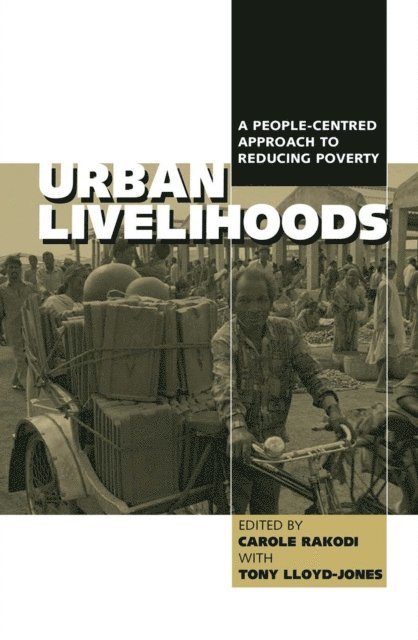
One of the most promising approaches to poverty reduction in developing countries is to encourage sustainable livelihoods for the poor. This takes account of their opportunities and assets and the sources of their vulnerability. Based on recent and extensive research, this volume thoroughly assesses the value of the livelihoods approach to urban poverty. The book reviews the situation and strategies of the urban poor and identifies the policies and practical programmes that work best. Lasting improvements depend not just on economic development, but on political commitment and structures that are responsive to the claims and needs of different groups of poor people.