Caroline R. Pryor - Böcker
Visar alla böcker från författaren Caroline R. Pryor. Handla med fri frakt och snabb leverans.
8 produkter
8 produkter
The School Leader's Guide to Understanding Attitude and Influencing Behavior
Working With Teachers, Parents, Students, and the Community
Inbunden, Engelska, 2005
1 101 kr
Skickas inom 3-6 vardagar
"Educational administrators will find the book to be an easily applicable tool for solving many of the dilemmas they face in their schools." Theron Schutte, Middle School Principal Boone Community School District, IA "The book provides a theoretical base for practical application of strategies that will strengthen beliefs and attitudes that support behaviors that can move a school toward the fulfillment of its educational mission."David Erlandson, ProfessorTexas A&M University"This book keeps its promises: it is truly a guide for action that will be used by educators, especially educational change agents. Each of the authors comes out of an unusual blend of theoretical sophistication and practical experience that make this book a stimulating intellectual read and a solid manual for practice."Steven Tozer, Professor of Education University of IllinoisWhy do people behave as they do? What makes them take a stand on a specific issue? Solving school problems and making policy decisions require that we anticipate how people will feel about an issue or how they will behave. School leaders must understand the values, attitudes, and beliefs brought to different situations. The School Leader's Guide to Understanding Attitude and Influencing Behavior makes it possible for educators to scientifically understand and influence the attitudes and behaviors of diverse constituencies, both inside and outside the school. Using the Model of Reasoned Action (MORA) enables readers to understand how people form attitudes and make decisions about a wide variety of future behaviors. Armed with this information, educators can change attitudes and influence behavior of teachers, staff, parents, and the community. This excellent resource includes: Examples of attitude scales A sample questionnaire A checklist of steps through an attitude-behavior study Tables to organize and report data Data analysis presented in an easily-applied manner When you must know how best to influence the attitudes or behaviors of others, this remarkable book will show you. Make a positive difference in your school or district!
The School Leader's Guide to Understanding Attitude and Influencing Behavior
Working With Teachers, Parents, Students, and the Community
Häftad, Engelska, 2005
564 kr
Skickas inom 3-6 vardagar
"Educational administrators will find the book to be an easily applicable tool for solving many of the dilemmas they face in their schools." Theron Schutte, Middle School Principal Boone Community School District, IA "The book provides a theoretical base for practical application of strategies that will strengthen beliefs and attitudes that support behaviors that can move a school toward the fulfillment of its educational mission."David Erlandson, ProfessorTexas A&M University"This book keeps its promises: it is truly a guide for action that will be used by educators, especially educational change agents. Each of the authors comes out of an unusual blend of theoretical sophistication and practical experience that make this book a stimulating intellectual read and a solid manual for practice."Steven Tozer, Professor of Education University of IllinoisWhy do people behave as they do? What makes them take a stand on a specific issue? Solving school problems and making policy decisions require that we anticipate how people will feel about an issue or how they will behave. School leaders must understand the values, attitudes, and beliefs brought to different situations. The School Leader's Guide to Understanding Attitude and Influencing Behavior makes it possible for educators to scientifically understand and influence the attitudes and behaviors of diverse constituencies, both inside and outside the school. Using the Model of Reasoned Action (MORA) enables readers to understand how people form attitudes and make decisions about a wide variety of future behaviors. Armed with this information, educators can change attitudes and influence behavior of teachers, staff, parents, and the community. This excellent resource includes: Examples of attitude scales A sample questionnaire A checklist of steps through an attitude-behavior study Tables to organize and report data Data analysis presented in an easily-applied manner When you must know how best to influence the attitudes or behaviors of others, this remarkable book will show you. Make a positive difference in your school or district!
Del 4 - Teaching Critical Themes in American History
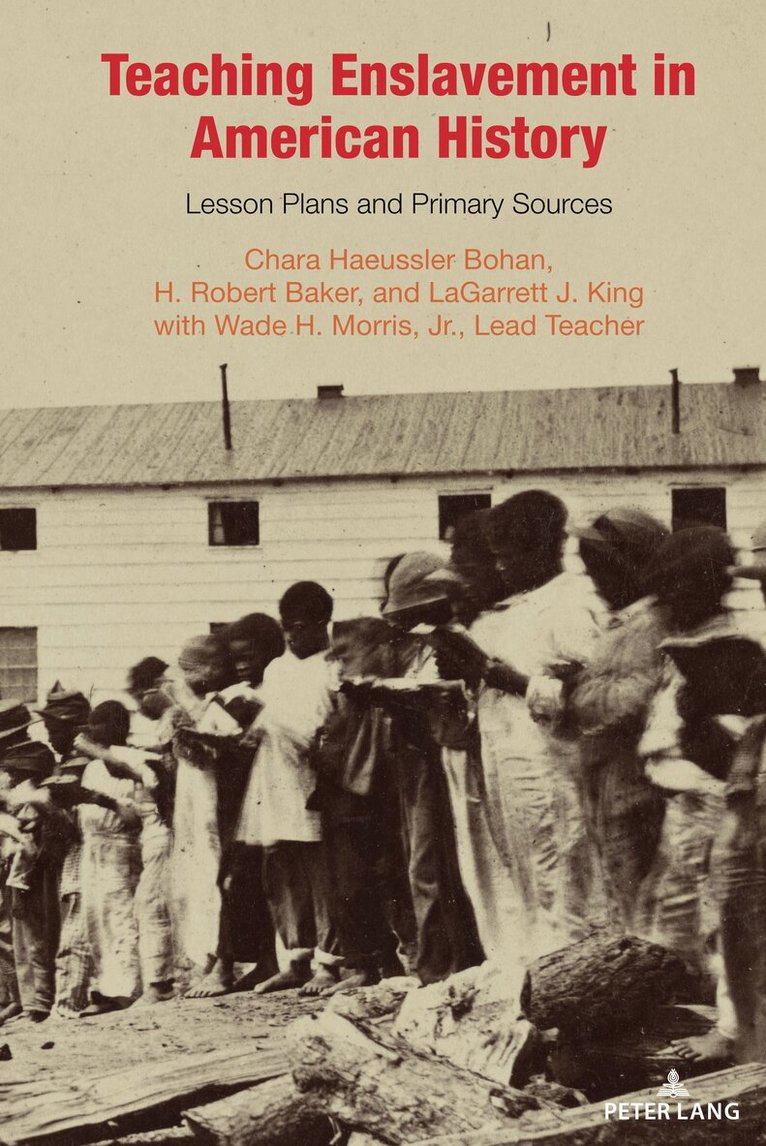
Teaching Enslavement in American History
Lesson Plans and Primary Sources
Inbunden, Engelska, 2022
1 121 kr
Skickas inom 5-8 vardagar
Teaching Enslavement in American History provides classroom teachers with the resources necessary to navigate one of the most difficult topics in any history course. This volume is the product of a collaboration between three university professors and a team of experienced middle and high school teachers. Its nine chapters include the context for topics like the middle passage, the Constitution’s position on enslavement, African cultural retention, and resistance to enslavement. The resources include 18 lesson plans and dozens of short primary and secondary sources modeled on document-based questions and the inquiry design model. Real teaching requires courage, a deep understanding of the complexity of the subject matter, and skillful use of primary sources. Rather than teaching students what to think, Teaching Enslavement in American History pushes students to learn how to think: empirical argumentation, source evaluation, understanding of change-over-time, and analysis of historical context. The lessons in this book ask students to read, analyze, and contextualize a variety of primary sources, to identify the limitations of these sources and to articulate historical contradiction where it occurs. At the heart of this book is the belief that historical consciousness leads to societal change. Teaching about enslavement is not merely about teaching a curriculum, it is about molding citizens who will lead our democracy in its journey to become a more perfect union.
Del 4 - Teaching Critical Themes in American History
Teaching Enslavement in American History
Lesson Plans and Primary Sources
Häftad, Engelska, 2022
436 kr
Skickas inom 5-8 vardagar
Teaching Enslavement in American History provides classroom teachers with the resources necessary to navigate one of the most difficult topics in any history course. This volume is the product of a collaboration between three university professors and a team of experienced middle and high school teachers. Its nine chapters include the context for topics like the middle passage, the Constitution’s position on enslavement, African cultural retention, and resistance to enslavement. The resources include 18 lesson plans and dozens of short primary and secondary sources modeled on document-based questions and the inquiry design model. Real teaching requires courage, a deep understanding of the complexity of the subject matter, and skillful use of primary sources. Rather than teaching students what to think, Teaching Enslavement in American History pushes students to learn how to think: empirical argumentation, source evaluation, understanding of change-over-time, and analysis of historical context. The lessons in this book ask students to read, analyze, and contextualize a variety of primary sources, to identify the limitations of these sources and to articulate historical contradiction where it occurs. At the heart of this book is the belief that historical consciousness leads to societal change. Teaching about enslavement is not merely about teaching a curriculum, it is about molding citizens who will lead our democracy in its journey to become a more perfect union.
Society, Culture, and STEM
A Model for Student Engagement and Teacher Collaboration
Inbunden, Engelska, 2024
955 kr
Skickas inom 10-15 vardagar
Too often students are asked to participate in rather generic classroom activities, such as worksheets, essays, and rote memorization, which may not capture cultural interest or experience. In Society, Culture, and STEM: A Model for Student Engagement and Teacher Collaboration, teachers will learn a team-based approach to incorporating local and international cultural perspectives and experiences into a curriculum of STEM subjects. This book presents a six-phase process, Pryor-Kang Socio-cultural STEM Curriculum Development Model, for designing a socio-cultural STEM curriculum that is integrative, expansive, personal, and achievement-oriented. The Model focuses on a teacher-student-community outreach process, ongoing evaluation, solicitation of feedback, and continuous improvement through curriculum redesign or reconfiguration. In this process, a selected set of curriculum goals, interdisciplinary content learning standards, and resources are coordinated purposefully to capture multiple perspectives and needs. This book provides a newly developed pathway to enhancing STEM learning experiences!
Society, Culture, and STEM
A Model for Student Engagement and Teacher Collaboration
Häftad, Engelska, 2025
396 kr
Skickas inom 10-15 vardagar
Too often students are asked to participate in rather generic classroom activities, such as worksheets, essays, and rote memorization, which may not capture cultural interest or experience. In Society, Culture, and STEM: A Model for Student Engagement and Teacher Collaboration, teachers will learn a team-based approach to incorporating local and international cultural perspectives and experiences into a curriculum of STEM subjects. This book presents a six-phase process, Pryor-Kang Socio-cultural STEM Curriculum Development Model, for designing a socio-cultural STEM curriculum that is integrative, expansive, personal, and achievement-oriented. The Model focuses on a teacher-student-community outreach process, ongoing evaluation, solicitation of feedback, and continuous improvement through curriculum redesign or reconfiguration. In this process, a selected set of curriculum goals, interdisciplinary content learning standards, and resources are coordinated purposefully to capture multiple perspectives and needs. This book provides a newly developed pathway to enhancing STEM learning experiences!
656 kr
Skickas inom 10-15 vardagar
Democratic Practices in Education: Implications for Teacher Education presents the findings of eleven teacher educators as they examine the meaning of democracy and its application to classroom practice. There is a shared belief among all contributors to this volume: that incorporating democratic practice into teacher education is an essential requirement to introducing democratic practices in K-12 classrooms. The contributors also believe that a democratic society requires education that's compatible with democracy. Topics of discussion include: · The principles underlying democracy · Implications for equity, and access of at-risk minority students· Efforts to introduce democratic practice into teacher preparation, and the positive results derived from those efforts · The application of character education to democratic practicesKey principles:·Importance of rights·Nature of authority·Equality·Student input into teacher educationDemocratic Practices in Education will provoke debate and stimulate interest, understanding, and competence in the development of democratic practices at all levels of schooling for teachers and teacher educators.
377 kr
Skickas inom 7-10 vardagar
Writing a Philosophy Statement: An Educator's Workbook, Second Edition provides a step-by-step process for writing a clear and concise philosophy of education statement based on a reader's beliefs about their approaches to teaching. This unique book provides information about five key philosophical approaches to teaching, using a range of activities for preservice and experienced teachers to examine classroom dilemmas. The workbook explores a variety of philosophical stances, including: Five philosophical approaches to teaching Strategies for identifying your approach to teaching Strategies for applying your approach in a written philosophy of education statement Practical uses for your philosophy statement Example Professional Development Activities include Case Studies; Check Lists; Sample Philosophy Statements; Tips and Tools for Writing a Philosophy Statement; and Using your Statement in Job Interviews and Graduate School Applications. A key feature of this book is the highly researched two-dimensional Philosophy of Education Scale, helpful in identifying an individual's most and least likely approaches to teaching. The Scale includes a range of teaching practices that can prompt readers' deep understanding of the sources that impact their approach decisions. This book offers educational leaders a much-needed pathway for collaborative communication about how teachers can impact school climate, change and attainment. Writing a Philosophy Statement is an essential tool for undergraduate and graduate students of education who are preparing for a career in teaching and for the academic rigors that they will encounter. Perfect for courses such as: Introduction to Education; Analysis of Instruction; Curriculum and Instruction; Research on Curriculum and Instruction; School Practice and Change; Philosophy of Education; Leadership and Change; Leadership and Collaboration; Principles of Leadership; Foundations of Education; History of Education; Senior Seminar; Student Teaching; Field Experience; and Methods of Instruction