Carsten Baumgarten – författare
Visar alla böcker från författaren Carsten Baumgarten. Handla med fri frakt och snabb leverans.
5 produkter
5 produkter
E-bok
PDF, Tyska, 2013507 kr
Läs direkt efter köp
Häftad, Tyska, 2000
510 kr
Skickas inom 10-15 vardagar
Das Buch Fluid- und Wärmetransport - Strömungslehre ist Teil des zweibändigen Werkes und behandelt die Grundlagen der Fluiddynamik. Der Umfang entspricht dem Stoff einer einsemestrigen Vorlesung. Einzelne Kapitel werden durch Aufgaben ergänzt, im Anhang befindet sich eine Sammlung mit den wichtigsten Formeln der Strömungslehre. Das Buch ist damit als Lehrbuch wie auch als Nachschlagewerk für den in der Praxis stehenden Ingenieur geeignet.
Inbunden, Engelska, 2006
1 623 kr
Skickas inom 10-15 vardagar
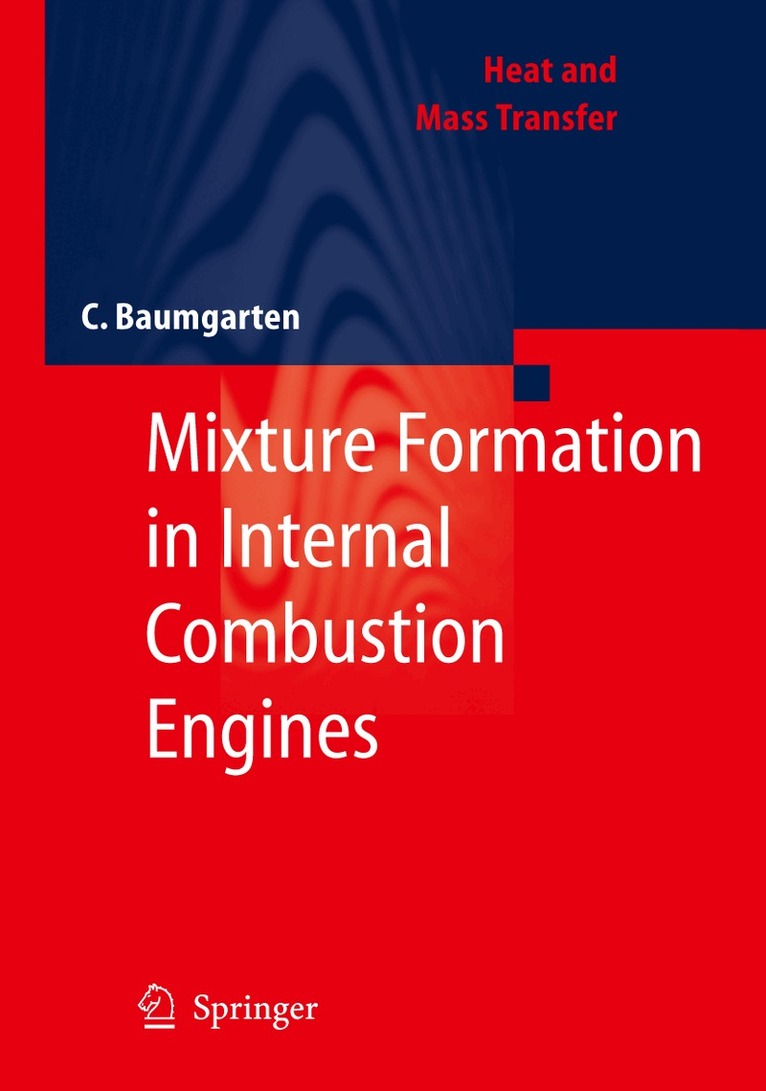
A systematic control of mixture formation with modern high-pressure injection systems enables us to achieve considerable improvements of the combustion pr- ess in terms of reduced fuel consumption and engine-out raw emissions. However, because of the growing number of free parameters due to more flexible injection systems, variable valve trains, the application of different combustion concepts within different regions of the engine map, etc., the prediction of spray and m- ture formation becomes increasingly complex. For this reason, the optimization of the in-cylinder processes using 3D computational fluid dynamics (CFD) becomes increasingly important. In these CFD codes, the detailed modeling of spray and mixture formation is a prerequisite for the correct calculation of the subsequent processes like ignition, combustion and formation of emissions. Although such simulation tools can be viewed as standard tools today, the predictive quality of the sub-models is c- stantly enhanced by a more accurate and detailed modeling of the relevant pr- esses, and by the inclusion of new important mechanisms and effects that come along with the development of new injection systems and have not been cons- ered so far. In this book the most widely used mathematical models for the simulation of spray and mixture formation in 3D CFD calculations are described and discussed. In order to give the reader an introduction into the complex processes, the book starts with a description of the fundamental mechanisms and categories of fuel - jection, spray break-up, and mixture formation in internal combustion engines.
E-bok
PDF, Engelska, 20061 977 kr
Läs direkt efter köp
A systematic control of mixture formation with modern high-pressure injection systems enables us to achieve considerable improvements of the combustion pr- ess in terms of reduced fuel consumption and engine-out raw emissions. However, because of the growing number of free parameters due to more flexible injection systems, variable valve trains, the application of different combustion concepts within different regions of the engine map, etc., the prediction of spray and m- ture formation becomes increasingly complex. For this reason, the optimization of the in-cylinder processes using 3D computational fluid dynamics (CFD) becomes increasingly important. In these CFD codes, the detailed modeling of spray and mixture formation is a prerequisite for the correct calculation of the subsequent processes like ignition, combustion and formation of emissions. Although such simulation tools can be viewed as standard tools today, the predictive quality of the sub-models is c- stantly enhanced by a more accurate and detailed modeling of the relevant pr- esses, and by the inclusion of new important mechanisms and effects that come along with the development of new injection systems and have not been cons- ered so far. In this book the most widely used mathematical models for the simulation of spray and mixture formation in 3D CFD calculations are described and discussed. In order to give the reader an introduction into the complex processes, the book starts with a description of the fundamental mechanisms and categories of fuel - jection, spray break-up, and mixture formation in internal combustion engines.
Häftad, Engelska, 2010
1 623 kr
Skickas inom 10-15 vardagar
A systematic control of mixture formation with modern high-pressure injection systems enables us to achieve considerable improvements of the combustion pr- ess in terms of reduced fuel consumption and engine-out raw emissions. However, because of the growing number of free parameters due to more flexible injection systems, variable valve trains, the application of different combustion concepts within different regions of the engine map, etc., the prediction of spray and m- ture formation becomes increasingly complex. For this reason, the optimization of the in-cylinder processes using 3D computational fluid dynamics (CFD) becomes increasingly important. In these CFD codes, the detailed modeling of spray and mixture formation is a prerequisite for the correct calculation of the subsequent processes like ignition, combustion and formation of emissions. Although such simulation tools can be viewed as standard tools today, the predictive quality of the sub-models is c- stantly enhanced by a more accurate and detailed modeling of the relevant pr- esses, and by the inclusion of new important mechanisms and effects that come along with the development of new injection systems and have not been cons- ered so far. In this book the most widely used mathematical models for the simulation of spray and mixture formation in 3D CFD calculations are described and discussed. In order to give the reader an introduction into the complex processes, the book starts with a description of the fundamental mechanisms and categories of fuel - jection, spray break-up, and mixture formation in internal combustion engines.