Catherine D. Wolfram – författare
Visar alla böcker från författaren Catherine D. Wolfram. Handla med fri frakt och snabb leverans.
5 produkter
5 produkter
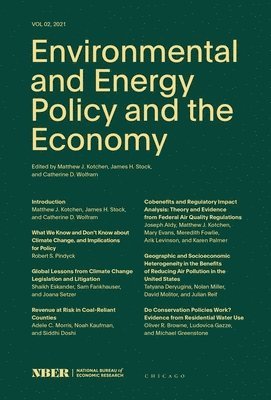
Häftad, Engelska, 2021
522 kr
Skickas inom 5-8 vardagar
This volume presents six new papers on environmental and energy economics and related policy issues. Robert Pindyck provides a systematic overview of what is known, and remains unknown, about climate change, along with the implications of uncertainty for climate policy. Shaikh Eskander, Sam Fankhauser, and Joana Setzer offer insights from a comprehensive data set on climate change legislation and litigation across all countries of the world over the past thirty years. Adele Morris, Noah Kaufman, and Siddhi Doshi shine a light on how expected trends in the coal industry will create significant challenges for the local public finance of coal-reliant communities. Joseph Aldy and his collaborators analyze the treatment of co-benefits in benefit-cost analyses of federal clean air regulations. Tatyana Deryugina and her co-authors report on the geographic and socioeconomic heterogeneity in the benefits of reducing particulate matter air pollution. Finally, Oliver Browne, Ludovica Gazze, and Michael Greenstone use detailed data on residential water consumption to evaluate the relative impacts of conservation policies based on prices, restrictions, and public persuasion.
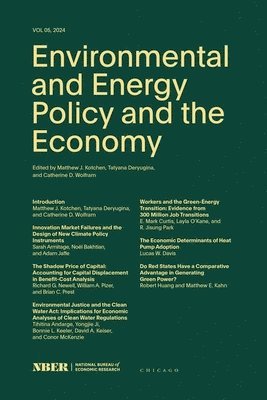
Häftad, Engelska, 2024
715 kr
Skickas inom 11-20 vardagar
Rigorous, careful, and nonpartisan research with a high policy impact on environmental and energy economics.Environmental and Energy Policy and the Economy focuses on the effective and efficient management of environmental and energy challenges. Research papers offer new evidence on the intended and unintended consequences, the market and nonmarket effects, and the incentive and distributional impacts of policy initiatives and market developments.This volume presents six new papers on environmental and energy economics and policy. Sarah Armitage, Noël Bakhtian, and Adam Jaffe review the literature on innovation market failures with an eye towards developing insights on the implementation of such policies in the climate and energy context. Richard Newell, William Pizer, and Brian Prest discuss alternative ways of accounting for capital displacement in benefit-cost analysis. Tihitina Andarge, Yongjie Ji, Bonnie Keeler, David Keiser, and Conor McKenzie provide new estimates of the distribution of environmental benefits and burdens of the Clean Water Act. E. Mark Curtis, Layla O’Kane, and Jisung Park examine the employment transitions into and out of sectors most likely affected by decarbonization. Lucas Davis provides a detailed analysis of heat pump adoption in the United States, showing that it may be one of the few energy-efficiency technologies for which subsidy take-up does not favor high-income households. Finally, Robert Huang and Matthew Kahn contribute to the political economy of U.S. energy policy, showing that many Republican-leaning states have a comparative advantage at generating some types of green power.
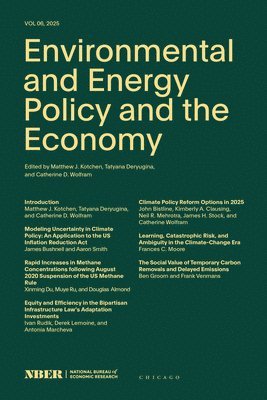
Häftad, Engelska, 2025
507 kr
Skickas inom 5-8 vardagar
Rigorous, careful, and nonpartisan research with a high policy impact on environmental and energy economics.Environmental and Energy Policy and the Economy focuses on the effective and efficient management of environmental and energy challenges. Research papers offer new evidence on the intended and unintended consequences, the market and nonmarket effects, and the incentive and distributional impacts of policy initiatives and market developments.This volume presents six new papers on environmental and energy economics and policy. James Bushnell and Aaron Smith illustrate a new way of modeling uncertainty for the purpose of understanding climate policy effects in the US electricity sector. Xinming Du, Muye Ru, and Douglas Almond estimate the effect of a federal requirement for oil and gas firms to detect and repair methane leaks, showing that the removal of the regulation in 2020 prompted an increase in emissions. Ivan Rudik, Derek Lemoine, and Antonia Marcheva explore equity and efficiency tradeoffs in climate adaptation funding as part of the 2021 US Bipartisan Infrastructure Law. John Bistline, Kimberly A. Clausing, Neil R. Mehrotra, James H. Stock, and Catherine Wolfram outline a range of different US climate policy options for near-term implementation. Frances C. Moore considers the potential economic consequences of accounting for non-stationarity in the distribution of weather because of climate change. Finally, Ben Groom and Frank Venmans discuss different ways of quantifying the social value of temporary reductions in atmospheric carbon, with implications for carbon offset markets.
Häftad, Engelska, 2026
648 kr
Kommande
Rigorous, careful, and nonpartisan research with a high policy impact on environmental and energy economics.Environmental and Energy Policy and the Economy focuses on the effective and efficient management of environmental and energy challenges. Research papers offer new evidence on the intended and unintended consequences, the market and nonmarket effects, and the incentive and distributional impacts of policy initiatives and market developments.This volume presents six new papers on environmental and energy economics and policy. Judson Boomhower and Meredith Fowlie illustrate the distributional consequences of improving risk pricing efficiency in wildfire insurance markets. Claire Brunel and Arik Levinson develop a conceptual framework for understanding the economic and environmental consequences of taxes on imports of goods based on their carbon content. Karen Clay, Danae Hernandez-Cortes, Akshaya Jha, Joshua Lewis, Noah Miller, and Edson Severnini study the long-run distributional implications of US power plant sitings over more than a century. Todd Gerarden, Mar Reguant, and Daniel Xu provide a comprehensive overview of industrial policy in the renewable energy sector, with comparisons across the US, EU, and China. Jamie Hansen-Lewis and Michelle Marcus show how failure to account for behavioral responses can affect policy predictions regarding maritime emissions. Finally, Richard Sweeney and Joseph Wilske estimate the externalities associated with correlated intermittency in electricity generation from US wind power investments.
E-bok
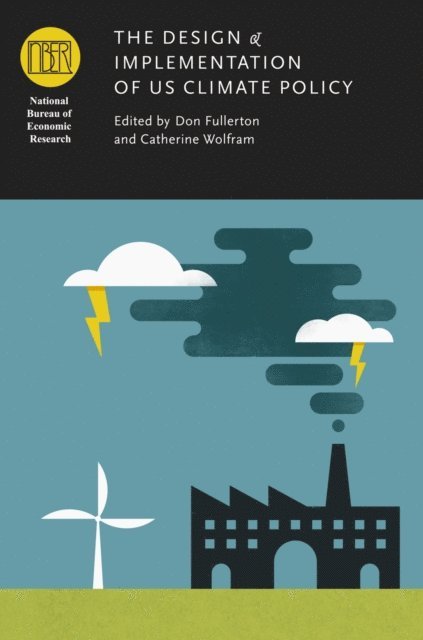
Engelska, 20122 432 kr
Läs direkt efter köp
Economic research on climate change has been crucial in advancing our understanding of the consequences associated with global warming as well as the costs and benefits of the various policies that might reduce emissions of greenhouse gases. As nations work to develop climate policies, economic insights into their design and implementation are ever more important. With a balance between theoretical and empirical approaches, The Design and Implementation of US Climate Policy looks at the possible effects of various climate policies on a range of economic outcomes. The studies that comprise the volume examine topics that include the coordination—or lack thereof—between the federal and state governments, implications of monitoring and enforcing climate policy, and the specific consequences of various climate policies for the agricultural, automotive, and buildings sectors.