Catherine Goldstein – författare
Visar alla böcker från författaren Catherine Goldstein. Handla med fri frakt och snabb leverans.
7 produkter
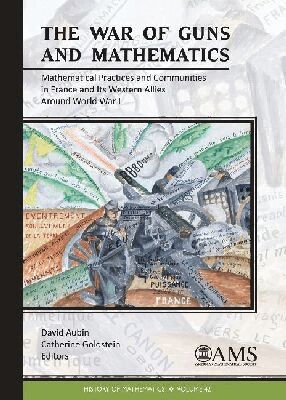
War of Guns and Mathematics
Mathematical Practices and Communities in France and Its Western Allies Around World War I
Av David Aubin, Catherine Goldstein
Inbunden, 2014
1509 kr
Lägg i varukorg
For a long time, World War I has been shortchanged by the historiography of science. Until recently, World War II was usually considered as the defining event for the formation of the modern relationship between science and society. In this context, the effects of the First World War, by contrast, …
Crelle Bicentennial Edition
Av Catherine Goldstein, Daniel Huybrechts m. fl.
Inbunden, 2026
2535 kr
Kommande
The "Journal für die Reine und Angewandte Mathematik" or "Crelle’s Journal" is the oldest mathematical journal in existence. To celebrate its 200th anniversary, this book republishes eight influential articles, one for each 25-year period. Each paper is followed by an extended commentary discussing …
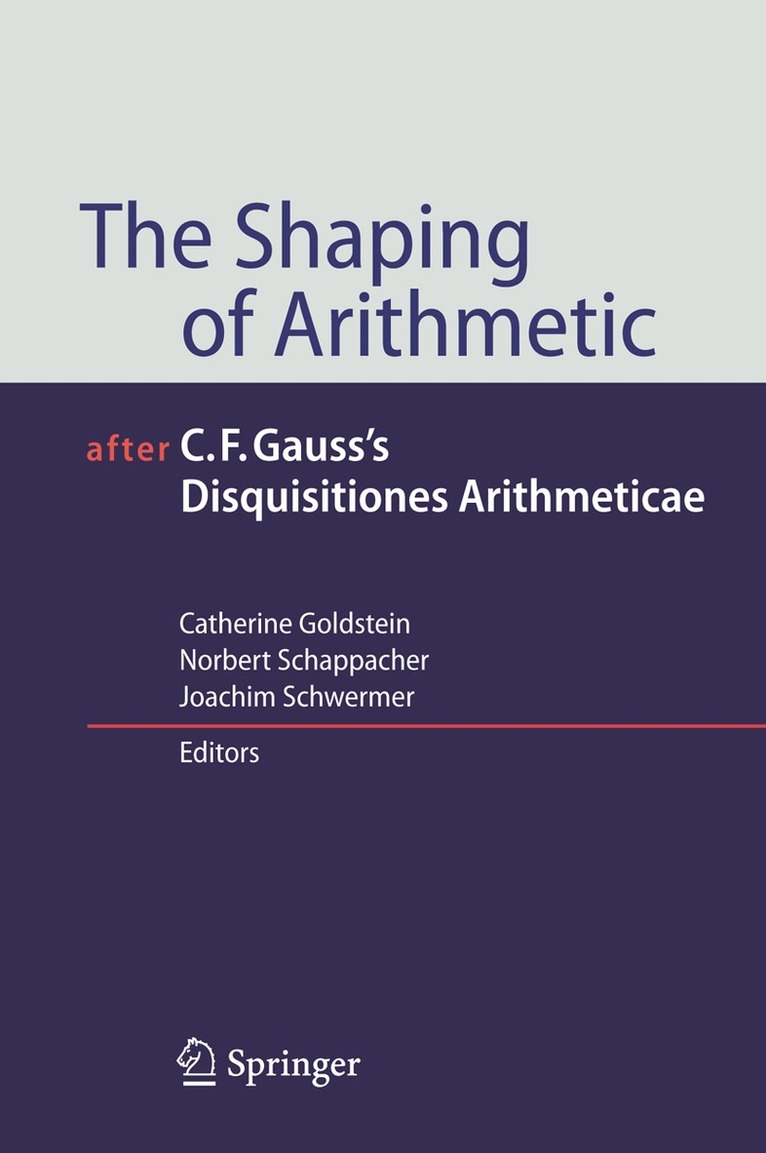
Shaping of Arithmetic after C.F. Gauss's Disquisitiones Arithmeticae
Av Catherine Goldstein, Norbert Schappacher m. fl.
Inbunden, 2007
1098 kr
Lägg i varukorg
The cultural historian Theodore Merz called it “that great book with seven seals,” the mathematician Leopold Kronecker, “the book of all books.” Already one century after its publication, C.F. Gauss's Disquisitiones Arithmeticae (1801) had acquired an almost mythical reputation, standing as an …
Shaping of Arithmetic after C.F. Gauss's Disquisitiones Arithmeticae
Av Joachim Schwermer, Norbert Schappacher m. fl.
E-bok, 2007
1459 kr
Lägg i varukorg
Since its publication, C.F. Gauss''s Disquisitiones Arithmeticae (1801) has acquired an almost mythical reputation, standing as an ideal of exposition in notation, problems and methods; as a model of organisation and theory building; and as a source of mathematical inspiration. Eighteen authors - …
Shaping of Arithmetic after C.F. Gauss's Disquisitiones Arithmeticae
Av Catherine Goldstein, Norbert Schappacher m. fl.
Häftad, 2010
1098 kr
Lägg i varukorg
The cultural historian Theodore Merz called it “that great book with seven seals,” the mathematician Leopold Kronecker, “the book of all books.” Already one century after its publication, C.F. Gauss's Disquisitiones Arithmeticae (1801) had acquired an almost mythical reputation, standing as an …