Catherine Weaver – författare
Visar alla böcker från författaren Catherine Weaver. Handla med fri frakt och snabb leverans.
11 produkter
International Political Economy
Debating the Past, Present and Future
Av Nicola Phillips, Catherine Weaver
Inbunden, 2010
2743 kr
Lägg i varukorg
The book gathers together a set of lively, provocative essays by leading voices in International Political Economy to debate the evolution of the field, its current state and its future directions. Prompted by recent commentaries on the existence of a ‘transatlantic divide’ in IPE between an …
International Political Economy
Debating the Past, Present and Future
Av Nicola Phillips, Catherine Weaver
Häftad, 2010
909 kr
Lägg i varukorg
The book gathers together a set of lively, provocative essays by leading voices in International Political Economy to debate the evolution of the field, its current state and its future directions. Prompted by recent commentaries on the existence of a ‘transatlantic divide’ in IPE between an …
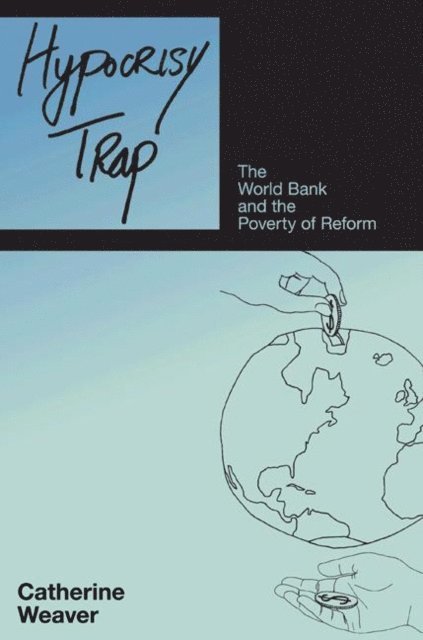
Hypocrisy Trap
The World Bank and the Poverty of Reform
Häftad, 2008
395 kr
Lägg i varukorg
As the preeminent international development agency for the past sixty years, the World Bank has attracted equal amounts of criticism and praise. Critics are especially quick to decry the World Bank's hypocrisy--the pervasive gaps between the organization's talk, decisions, and actions. In the wake …
Handbook of Global Economic Governance
Players, Power and Paradigms
Av Manuela Moschella, Catherine Weaver
E-bok, 2013
901 kr
Lägg i varukorg
Since the summer of 2007, the world scenario has been dominated by the US sub-prime mortgage crisis and its repercussions on global financial markets and economic growth. As banks around the world wrote down their losses and governments intervened to rescue domestic financial institutions, …
Handbook of Global Economic Governance
Players, Power and Paradigms
Av Manuela Moschella, Catherine Weaver
E-bok, 2013
881 kr
Lägg i varukorg
Since the summer of 2007, the world scenario has been dominated by the US sub-prime mortgage crisis and its repercussions on global financial markets and economic growth. As banks around the world wrote down their losses and governments intervened to rescue domestic financial institutions, …
International Political Economy
Debating the Past, Present and Future
Av Catherine Weaver, Nicola Phillips
E-bok, 2010
1074 kr
Lägg i varukorg
The book gathers together a set of lively, provocative essays by leading voices in International Political Economy to debate the evolution of the field, its current state and its future directions. Prompted by recent commentaries on the existence of a ‘transatlantic divide’ in IPE between an …
International Political Economy
Debating the Past, Present and Future
Av Catherine Weaver, Nicola Phillips
E-bok, 2010
1040 kr
Lägg i varukorg
The book gathers together a set of lively, provocative essays by leading voices in International Political Economy to debate the evolution of the field, its current state and its future directions. Prompted by recent commentaries on the existence of a ‘transatlantic divide’ in IPE between an …
Hypocrisy Trap
The World Bank and the Poverty of Reform
E-bok, 2008
500 kr
Lägg i varukorg
As the preeminent international development agency for the past sixty years, the World Bank has attracted equal amounts of criticism and praise. Critics are especially quick to decry the World Bank''s hypocrisy--the pervasive gaps between the organization''s talk, decisions, and actions. In the …
Handbook of Global Economic Governance
Players, Power and Paradigms
Av Manuela Moschella, Catherine Weaver
Inbunden, 2013
3380 kr
Lägg i varukorg
Since mid-2007, the world scenario has been dominated by the US sub-prime mortgage crisis and its repercussions on global financial markets and economic growth. As banks around the world wrote down their losses and governments intervened to rescue domestic financial institutions, financial distress …
Offshoots: Humanity Twigged
Third Flatiron Anthologies, #13
Av Elizabeth Spencer Spragins, Esteban Raposo m. fl.
E-bok
45 kr
Lägg i varukorg