Cesar E. Silva – författare
Visar alla böcker från författaren Cesar E. Silva. Handla med fri frakt och snabb leverans.
3 produkter
3 produkter
3 185 kr
Skickas inom 10-15 vardagar
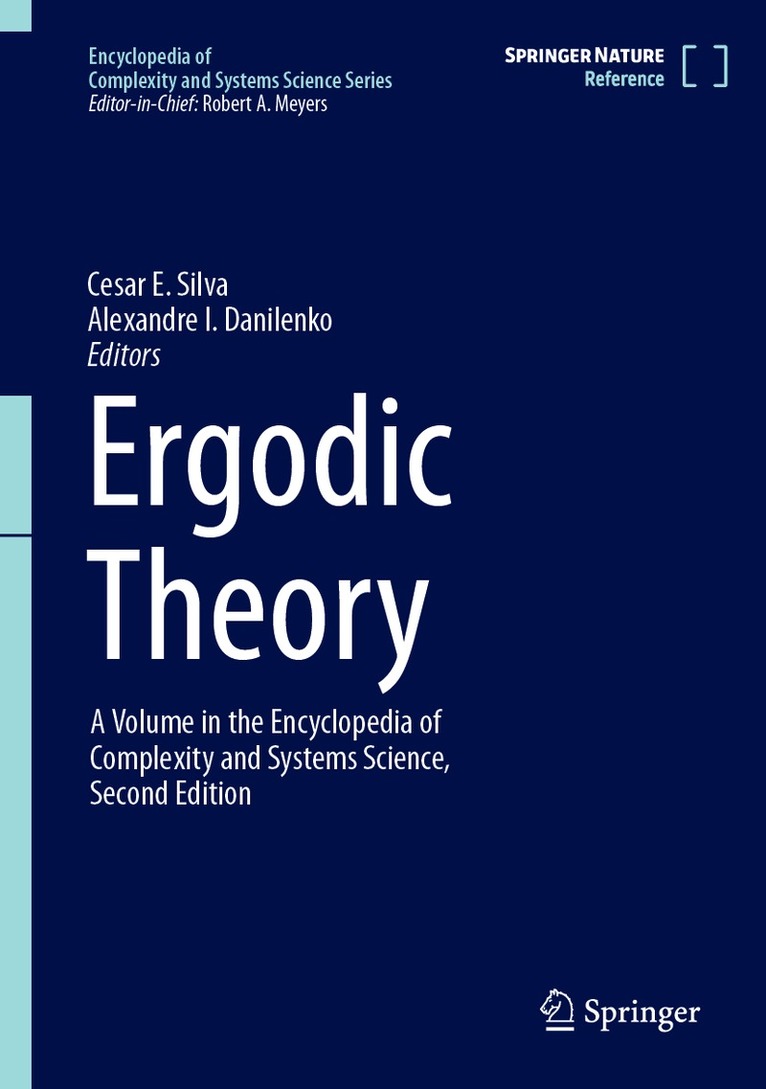
This volume in the Encyclopedia of Complexity and Systems Science, Second Edition, covers recent developments in classical areas of ergodic theory, including the asymptotic properties of measurable dynamical systems, spectral theory, entropy, ergodic theorems, joinings, isomorphism theory, recurrence, nonsingular systems.
Ergodic Theory, Dynamical Systems, and the Continuing Influence of John C. Oxtoby
Häftad, Engelska, 2017
1 478 kr
Skickas inom 5-8 vardagar
This volume contains the proceedings of three conferences in Ergodic Theory and Symbolic Dynamics: the Oxtoby Centennial Conference, held from October 30-31, 2010, at Bryn Mawr College; the Williams Ergodic Theory Conference, held from July 27-29, 2012, at Williams College; and the AMS Special Session on Ergodic Theory and Symbolic Dynamics, held from January 17-18, 2014, in Baltimore, MD.This volume contains articles covering a variety of topics in measurable, symbolic and complex dynamics. It also includes a survey article on the life and work of John Oxtoby, providing a source of information about the many ways Oxtoby's work influenced mathematical thought in this and other fields.
1 134 kr
Skickas inom 5-8 vardagar
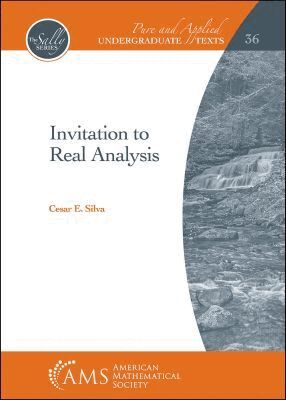
This book is an introduction to real analysis for a one-semester course aimed at students who have completed the calculus sequence and preferably one other course, such as linear algebra. It does not assume any specific knowledge and starts with all that is needed from sets, logic, and induction. Then there is a careful introduction to the real numbers with an emphasis on developing proof-writing skills. It continues with a logical development of the notions of sequences, open and closed sets (including compactness and the Cantor set), continuity, differentiation, integration, and series of numbers and functions.A theme in the book is to give more than one proof for interesting facts; this illustrates how different ideas interact and it makes connections among the facts that are being learned. Metric spaces are introduced early in the book, but there are instructions on how to avoid metric spaces for the instructor who wishes to do so. There are questions that check the readers' understanding of the material, with solutions provided at the end. Topics that could be optional or assigned for independent reading include the Cantor function, nowhere differentiable functions, the Gamma function, and the Weierstrass theorem on approximation by continuous functions.