Chaitram Singh - Böcker
Visar alla böcker från författaren Chaitram Singh. Handla med fri frakt och snabb leverans.
5 produkter
5 produkter
1 009 kr
Skickas inom 10-15 vardagar
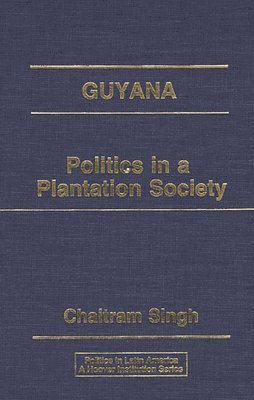
This volume examines the politics and government of Guyana from World War II to the present. Professor Singh ably describes the downfall of a nation which, when it became independent in 1966, had good prospects, ample resources, and a relatively educated population. He examines how a liberal democracy succumbed to authoritarian tendencies, resulting in a defacto one-party state. Next, the author demonstrates how economic development became a casualty of over-centralilzed political and economic decision making. He argues that the persistence of underdevelopment in ex-colonies such as Guyana is traceable to domestic causes.This volume examines the politics and government of Guyana from World War II to the present. Professor Singh ably describes the downfall of a nation which, when it became independent in 1966, had good prospects, ample resources, and a relatively educated population. He examines how a liberal democracy succumbed to authoritarian tendencies, resulting in a defacto one-party state. Next, the author demonstrates how economic development became a casualty of over-centralilzed political and economic decision making. He argues that the persistence of underdevelopment in ex-colonies such as Guyana is traceable to domestic causes.
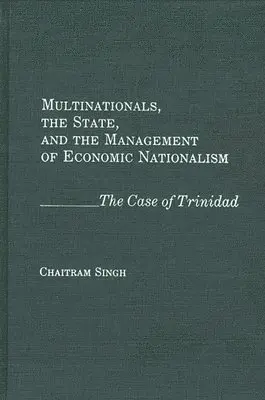
Multinationals, the State, and the Management of Economic Nationalism
The Case of Trinidad
Inbunden, Engelska, 1989
833 kr
Skickas inom 10-15 vardagar
Although the role of multinational corporations (MNCs) in developing countries has been the subject of intense academic interest, few studies have attempted a systematic examination of relations between small mineral-producing Third World countries and the MNCs involved in the extraction of these mineral resources. This book fills that gap by analyzing the opportunities available to a developing country with a limited mineral resource base to improve its bargaining position with the MNCs. Trinidad, a small petroleum producer whose industry has always been dominated by multinationals, is used throughout as an illustrative case study. A major contribution to the international business and international relations literature, this volume both adds an important dimension to the literature on multinational-host country relations and offers an in-depth analysis of the politics of a major Caribbean nation.The book begins with an introductory chapter that explores the two schools of thought -- the Marxists dependency and the bargaining perspectives -- regarding the role of multinationals in small mineral producing countries. The following chapters utilize a bargaining approach to examine the relationship between the Trinidadian government and foreign investors in the oil industry during the past 30 years. Singh concludes that nationalization is not the best answer for small mineral producers like Trinidad, because he host country's size makes undue dependence on the foreign investor likely for the duration of the concession agreement. In addition, Singh points out, the ability of the host government to achieve its managerial, technical, and capital goals vis-a-vis the foreign investor depends directly upon the government's ability to manage its domestic policies. Two appendices that profile officials interviewed during the course of the study, a bibliography, and an index for easy reference complete the study.
372 kr
Skickas inom 5-8 vardagar
283 kr
Skickas inom 5-8 vardagar
248 kr
Skickas inom 5-8 vardagar