Chandrakanta – författare
Visar alla böcker från författaren Chandrakanta. Handla med fri frakt och snabb leverans.
6 produkter
6 produkter
Inbunden, Engelska, 2024
1 512 kr
Skickas inom 5-8 vardagar
Various natural and man-made hazards are nowadays increasingly considered as disasters, particularly by individual and communities are lacking in awareness and where a system as a whole has no adequate management mechanism. Consequently, the world is facing serious negative outcome in form of loss of life, injury, disability, loss of property, infrastructure, and economic disruption followed by psycho-social disorders. Other than this, disasters adversely affect wildlife and environment in long terms. Developing countries are worst sufferers as these regions are poorly prepared for potential hazards at one hand and are exposed to disasters due to the complexity of (socio-cultural, economic and physical) vulnerability. Government, World communities, NGOs are recognizing the problems and are trying to build resilient communities to reduce disaster impact at various levels.Year 1990-99 was observed as the decade for natural disaster reduction by United Nations (UN) and United Nations International Strategy for Disaster Reduction (UNISDR) was established to support and coordinate this movement. Year 2015 has been very important in the history as three global agreements have been signed by global communities (Sustainable development goals, Paris agreement and Sendai framework for DRR). Where, SDGs are extension of MDGs to make the planet more sustainable. It proposed 17 goals and 15 years’ time frame adopted in the year 2015. SDGs target various social, cultural, economic, challenges followed by wildlife, environmental protection through knowledge share and technological innovation among all member countries. In December 2015, UNFCCC reached a landmark agreement to combat climate change and to accelerate and intensify the actions and investments needed for a sustainable low carbon future known as Paris agreement. Sendai Framework 2015 is voluntary, non-binding agreement which recognizes that the state has the primary role to reduce disasterrisk but that responsibility should be shared with other stakeholders including local government, the private sector and other stakeholders. This framework focuses on the pre-disaster management rather than post disaster relief and recovery. This book is an insight into the various issues related to the emerging disasters (both natural and man-made), vulnerable communities, and government initiatives taken with a geographical focus on India. This volume contains selected chapters written by faculty and research scholars. This book is an empirical work on disasters vulnerabilities and management which will benefit researchers, academicians, professional, practitioners and policy makers.
E-bok
Engelska, 20241 891 kr
Läs direkt efter köp
Various natural and man-made hazards are nowadays increasingly considered as disasters, particularly by individual and communities are lacking in awareness and where a system as a whole has no adequate management mechanism. Consequently, the world is facing serious negative outcome in form of loss of life, injury, disability, loss of property, infrastructure, and economic disruption followed by psycho-social disorders. Other than this, disasters adversely affect wildlife and environment in long terms. Developing countries are worst sufferers as these regions are poorly prepared for potential hazards at one hand and are exposed to disasters due to the complexity of (socio-cultural, economic and physical) vulnerability. Government, World communities, NGOs are recognizing the problems and are trying to build resilient communities to reduce disaster impact at various levels.Year 1990-99 was observed as the decade for natural disaster reduction by United Nations (UN) and United Nations International Strategy for Disaster Reduction (UNISDR) was established to support and coordinate this movement. Year 2015 has been very important in the history as three global agreements have been signed by global communities (Sustainable development goals, Paris agreement and Sendai framework for DRR). Where, SDGs are extension of MDGs to make the planet more sustainable. It proposed 17 goals and 15 years’ time frame adopted in the year 2015. SDGs target various social, cultural, economic, challenges followed by wildlife, environmental protection through knowledge share and technological innovation among all member countries. In December 2015, UNFCCC reached a landmark agreement to combat climate change and to accelerate and intensify the actions and investments needed for a sustainable low carbon future known as Paris agreement. Sendai Framework 2015 is voluntary, non-binding agreement which recognizes that the state has the primary role to reduce disasterrisk but that responsibility should be shared with other stakeholders including local government, the private sector and other stakeholders. This framework focuses on the pre-disaster management rather than post disaster relief and recovery. This book is an insight into the various issues related to the emerging disasters (both natural and man-made), vulnerable communities, and government initiatives taken with a geographical focus on India. This volume contains selected chapters written by faculty and research scholars. This book is an empirical work on disasters vulnerabilities and management which will benefit researchers, academicians, professional, practitioners and policy makers.
Häftad, Engelska, 2025
1 512 kr
Skickas inom 10-15 vardagar
Various natural and man-made hazards are nowadays increasingly considered as disasters, particularly by individual and communities are lacking in awareness and where a system as a whole has no adequate management mechanism. Consequently, the world is facing serious negative outcome in form of loss of life, injury, disability, loss of property, infrastructure, and economic disruption followed by psycho-social disorders. Other than this, disasters adversely affect wildlife and environment in long terms. Developing countries are worst sufferers as these regions are poorly prepared for potential hazards at one hand and are exposed to disasters due to the complexity of (socio-cultural, economic and physical) vulnerability. Government, World communities, NGOs are recognizing the problems and are trying to build resilient communities to reduce disaster impact at various levels.Year 1990-99 was observed as the decade for natural disaster reduction by United Nations (UN) and United Nations International Strategy for Disaster Reduction (UNISDR) was established to support and coordinate this movement. Year 2015 has been very important in the history as three global agreements have been signed by global communities (Sustainable development goals, Paris agreement and Sendai framework for DRR). Where, SDGs are extension of MDGs to make the planet more sustainable. It proposed 17 goals and 15 years’ time frame adopted in the year 2015. SDGs target various social, cultural, economic, challenges followed by wildlife, environmental protection through knowledge share and technological innovation among all member countries. In December 2015, UNFCCC reached a landmark agreement to combat climate change and to accelerate and intensify the actions and investments needed for a sustainable low carbon future known as Paris agreement. Sendai Framework 2015 is voluntary, non-binding agreement which recognizes that the state has the primary role to reduce disasterrisk but that responsibility should be shared with other stakeholders including local government, the private sector and other stakeholders. This framework focuses on the pre-disaster management rather than post disaster relief and recovery. This book is an insight into the various issues related to the emerging disasters (both natural and man-made), vulnerable communities, and government initiatives taken with a geographical focus on India. This volume contains selected chapters written by faculty and research scholars. This book is an empirical work on disasters vulnerabilities and management which will benefit researchers, academicians, professional, practitioners and policy makers.
Inbunden, Engelska, 2019
1 728 kr
Skickas inom 10-15 vardagar
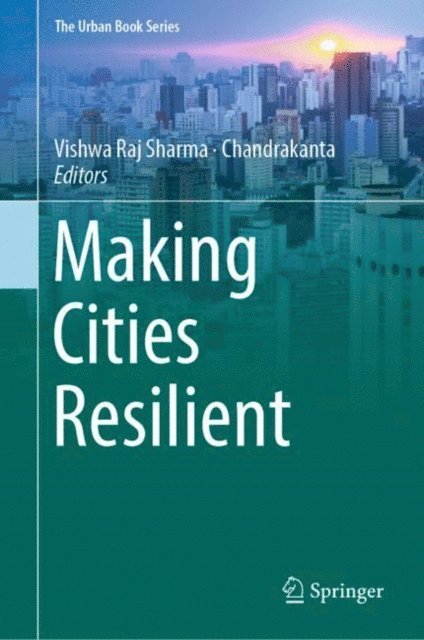
As the world has transformed, so have cities. Today, cities are home to 54 percent of the world’s population, and by the middle of this century that figure will likely rise to 66 percent. According to the United Nations (UN) Habitat I (1972), Habitat II (1996) and Habitat III (2016) summits, cities are facing many serious challenges, including growing inequality, security concerns and the worsening impacts of climate change. Uncontrolled urbanization has led to many problems (haphazard growth of areas, emergence of slums, inadequate water and power supply, poor sanitation, shortage of transport and other civic amenities, shrinking green spaces, pollution, crime, and urban disaster risks such as fire, flood, road and industrial accidents, etc.). Worldwide, communities at the international, national and local level are continuously working to improve human habitats. In order to make our planet more sustainable, the UN has moved from the Millennium Development Goals (MDG) to the Sustainable Development Goals (SDG). Among the latter, the aim of SDG 11 is to “…make cities and human settlements inclusive, safe, resilient and sustainable.” In light of these challenges, various terms have emerged to help understand urban issues. Visualizing the problem, the United Nations program “Making Cities Resilient” is focused on mitigating the disaster risk in urban areas. This book analyzes terms such as: sustainable, resilient, livable, inclusive, smart and world class city, which have emerged in the process of combating urban challenges in today’s world. The book addresses emerging concepts for cities, challenges and potentials, urban environments, health and planning/policies. Covering 14 large cities in India, as well as case studies from Japan, Singapore, Thailand, Malaysia, Poland and Sweden, it provides a regional dimension to and micro-level perspective on urban issues.
E-bok
Engelska, 20192 207 kr
Läs direkt efter köp
As the world has transformed, so have cities. Today, cities are home to 54 percent of the world’s population, and by the middle of this century that figure will likely rise to 66 percent. According to the United Nations (UN) Habitat I (1972), Habitat II (1996) and Habitat III (2016) summits, cities are facing many serious challenges, including growing inequality, security concerns and the worsening impacts of climate change. Uncontrolled urbanization has led to many problems (haphazard growth of areas, emergence of slums, inadequate water and power supply, poor sanitation, shortage of transport and other civic amenities, shrinking green spaces, pollution, crime, and urban disaster risks such as fire, flood, road and industrial accidents, etc.). Worldwide, communities at the international, national and local level are continuously working to improve human habitats. In order to make our planet more sustainable, the UN has moved from the Millennium Development Goals (MDG) to the Sustainable Development Goals (SDG). Among the latter, the aim of SDG 11 is to “…make cities and human settlements inclusive, safe, resilient and sustainable.” In light of these challenges, various terms have emerged to help understand urban issues. Visualizing the problem, the United Nations program “Making Cities Resilient” is focused on mitigating the disaster risk in urban areas. This book analyzes terms such as: sustainable, resilient, livable, inclusive, smart and world class city, which have emerged in the process of combating urban challenges in today’s world. The book addresses emerging concepts for cities, challenges and potentials, urban environments, health and planning/policies. Covering 14 large cities in India, as well as case studies from Japan, Singapore, Thailand, Malaysia, Poland and Sweden, it provides a regional dimension to and micro-level perspective on urban issues.
Häftad, Hindi, 2021
213 kr
Skickas inom 5-8 vardagar