Charles A. S. Hall – författare
3 356 kr
Skickas inom 5-8 vardagar
1 100 kr
Läs direkt efter köp
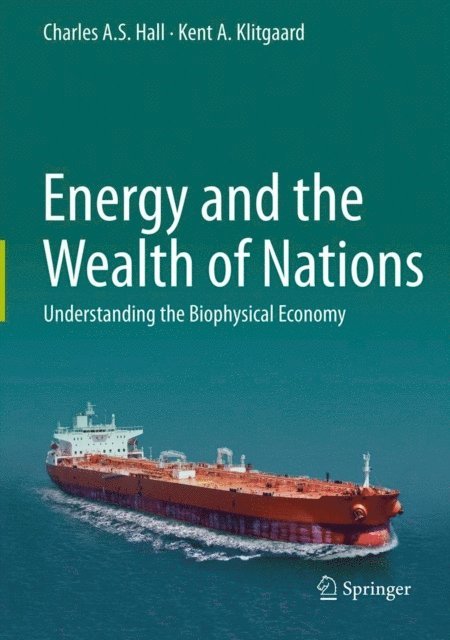
For the past 150 years, economics has been treated as a social science in which economies are modeled as a circular flow of income between producers and consumers. In this “perpetual motion” of interactions between firms that produce and households that consume, little or no accounting is given of the flow of energy and materials from the environment and back again. In the standard economic model, energy and matter are completely recycled in these transactions, and economic activity is seemingly exempt from the Second Law of Thermodynamics. As we enter the second half of the age of oil, and as energy supplies and the environmental impacts of energy production and consumption become major issues on the world stage, this exemption appears illusory at best.
In Energy and the Wealth of Nations, concepts such as energy return on investment (EROI) provide powerful insights into the real balance sheets that drive our “petroleum economy.” Hall and Klitgaard explore the relation between energy and the wealth explosion of the 20th century, the failure of markets to recognize or efficiently allocate diminishing resources, the economic consequences of peak oil, the EROI for finding and exploiting new oil fields, and whether alternative energy technologies such as wind and solar power meet the minimum EROI requirements needed to run our society as we know it. This book is an essential read for all scientists and economists who have recognized the urgent need for a more scientific, unified approach to economics in an energy-constrained world, and serves as an ideal teaching text for the growing number of courses, such as the authors’ own, on the role of energy in society.
548 kr
Skickas inom 10-15 vardagar
687 kr
Läs direkt efter köp
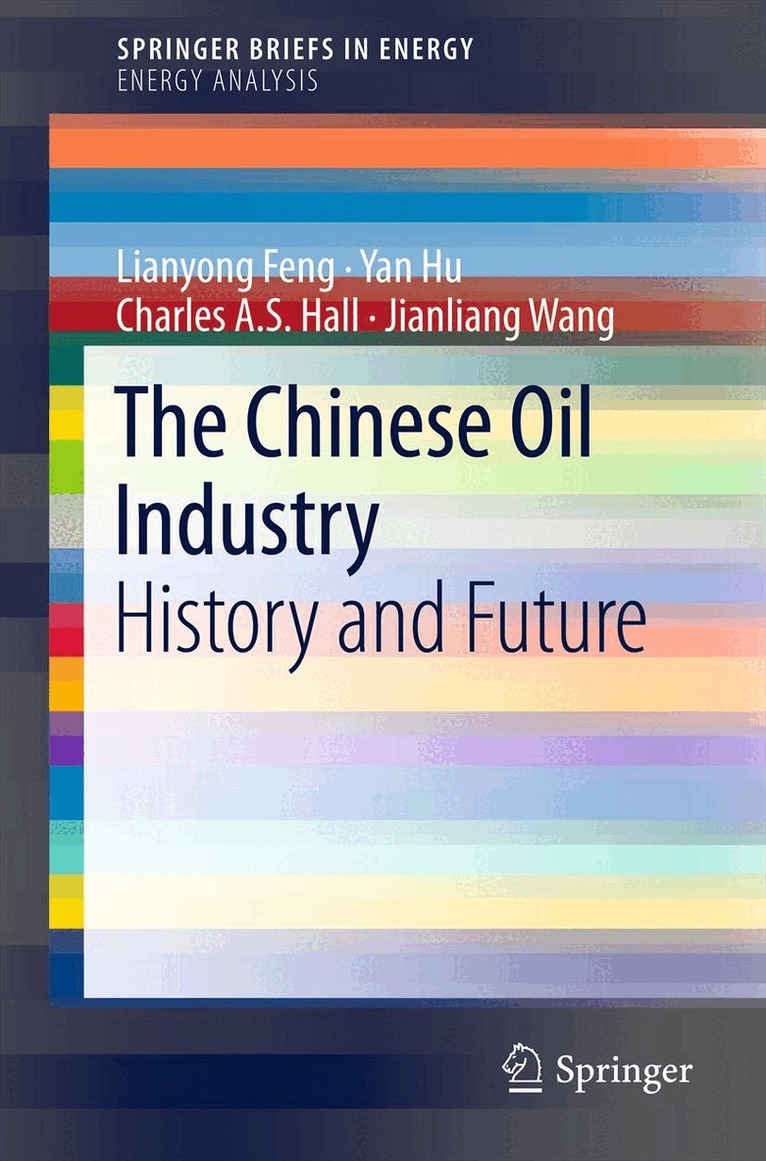
The Chinese Oil Industry: History and Future presents a wealth of tables and figures with new data on Chinese fossil fuel production and consumption, together with a peak oil model to forecast future trends in energy supply and demand. Energy experts in China and the United States provide you with a unique overview of the entire Chinese oil industry. The authors discuss trends in production and consumption of global significance through to the middle of the 21st century, including the energy returned on energy invested (EROI) for China’s oil and gas.
The role of oil in the industrialization of China is described as are four phases in the history of the Chinese oil industry. Detailed coverage of resources and exploration, pipeline development, refining and marketing, petroleum and natural gas pricing policies, and international cooperation is followed by consideration of conservation, renewable energy, and environmental impact. The authors also address the importance of coal and the probable future of coal production.- Offers a comprehensive view of the Chinese oil industry
- Presents new and previously unpublished data
- Covers history and future trends in production and consumption
- Introduces a new peak oil model for China
- Discusses EROI trend of oil and natural gas and its consequences for the Chinese economy
- Written from an objective viewpoint by leading energy experts
710 kr
Skickas inom 10-15 vardagar
847 kr
Läs direkt efter köp
The Energy Return on Energy Invested (EROI or EROEI) is the amount of energy acquired from a particular energy source divided by the energy expended, or invested, in obtaining that energy. EROI is an essential and seemingly simple measure of the usable energy or “energy profit” from the exploitation of an energy source, but it is not so easy to determine all of the energy expenditures that should be included in the calculation. Because EROI values are generally low for renewable energy sources, differences in these estimates can lead to sharply divergent conclusions about the viability of these energy technologies. This book presents the first complete energy analysis of a large-scale, real-world deployment of photovoltaic (PV) collection systems representing 3.5 GW of installed, grid-connected solar plants in Spain. The analysis includes all of the factors that limit and adjust the real electricity output through one full-year cycle, and all of the fossil fuel inputs required to achieve these results. The authors’ comprehensive analysis of energy inputs, which assigns energy cost estimates to all financial expenditures, yields EROI values that are less than half of those claimed by other investigators and by the solar industry. Sensitivity analysis is used to test various assumptions in deriving these EROI estimates. The results imply that the EROI of current, large-scale PV systems may be too low to seamlessly support an energy and economic transition away from fossil fuels. Given the pervasiveness of fossil fuel subsidies in the modern economy, a key conclusion is that all components of the system that brings solar power to the consumer, from manufacturing to product maintenance and life cycle, must be improved in terms of energy efficiency. The materials science of solar conversion efficiency is only one such component. Sunny Spain represented an ideal case study as the country had the highest penetration of solar PV energyat 2.3 percent of total national demand as well as state-of-the-art expertise in solar power including grid management of intermittent, modern renewable systems. This book, written by a uniquely qualified author team consisting of the chief engineer for several major photovoltaic projects in Spain and the world’s leading expert on the concept and application of EROI, provides a comprehensive understanding of the net energy available to society from energy sources in general and from functioning PV installations under real-world conditions in particular. The authors provide critical insight into the capacity of renewable energy sources to fill the foreseeable gap between world energy demand and depletion rates for fossil fuels.
· Presents the first comprehensive study of the EROI of large-scale solar PV systems in a developed country
· Uses real-world operational data rather than laboratory approximations and extrapolations
· Describes the dependence of one alternative energy source on the goods and services of a fossil-fueled economy
· Has global implications for the potential of renewable energy sources to replace dwindling reserves of fossil fuels
· Written with the first-hand knowledge of the chief, on-site engineer for many solar installations in Spain together with the leader in the development and application of the concept of EROI
548 kr
Skickas inom 10-15 vardagar
693 kr
Läs direkt efter köp
According to the conventional wisdom, we live in a post-industrial information age. This book, however, paints a different picture: We live in the age of oil. Petroleum fuels and feedstocks are responsible for much of what we take for granted in modern society, from chemical products such as fertilizer and plastics, to the energy that moves people and goods in a global economy. Oil is a nearly perfect fuel: Energy dense, safe to store, easy to transport, and mostly environmentally benign. Most importantly, oil has been cheap and abundant during the past 150 years. In 1998, two respected geologists, Colin Campbell and Jean Laherrère, published a detailed article announcing that the “end of cheap oil” would happen before 2010, which meant that the world would face a peak, or at least a plateau, in global daily oil production in the first decade of the new millennium. Today, two billion people under the age of 14 have lived the majority of their lives past the point when this century-long growth in oil supplies came to an end, which also marks the end of the first half of the age of oil. This transition has ushered in a new reality of high oil prices, stagnating oil supplies, and sluggish economies. In this book, a leading authority on energy explores the contributions and continuing legacy of Colin Campbell and Jean Laherrère, the two geologists who modified the terms of the debate about oil. The book provides a unique perspective and state-of-the-art overview of today’s energy reality and its enormous economic and social implications.- Covers a topic that eclipses climate change as the most important but least understood challenge for contemporary society- Explores the works of Colin Campbell and Jean Laherrère, the leading authorities in the field of Peak Oil, authors of “The End of Cheap Oil” (Scientific American, 1998), and founding members of the Association for the Study of Peak Oil & Gas- Addresses a broad audience of scientists, engineers, and economists in a format that is accessible to the general public- Provides a complete overview of the basic geological, chemical, physical, economic and historical concepts that every oil consumer should understand- Presents the latest information on oil production, reserves, discoveries, prices, and fields in easy-to-understand graphs and plots