Charles Coulston Gillispie – författare
Genesis and Geology
A Study of the Relations of Scientific Thought, Natural Theology, and Social Opinion in Great Britain, 1790–1850, With a Foreword by Nicolaas A. Rupke and a New Preface by the Author
307 kr
Skickas inom 5-8 vardagar
644 kr
Skickas inom 5-8 vardagar
1 226 kr
Skickas inom 5-8 vardagar
1 446 kr
Skickas inom 3-6 vardagar
357 kr
Skickas inom 5-8 vardagar
652 kr
Läs direkt efter köp
902 kr
Skickas inom 3-6 vardagar
1 977 kr
Skickas inom 3-6 vardagar
965 kr
Skickas inom 10-15 vardagar
1 042 kr
Läs direkt efter köp
By the end of the eighteenth century, the French dominated the world of science. And although science and politics had little to do with each other directly, there were increasingly frequent intersections. This is a study of those transactions between science and state, knowledge and power--on the eve of the French Revolution. Charles Gillispie explores how the links between science and polity in France were related to governmental reform, modernization of the economy, and professionalization of science and engineering.
506 kr
Läs direkt efter köp
1 514 kr
Läs direkt efter köp
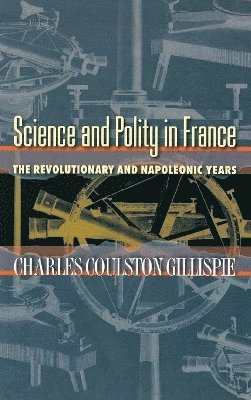
From the 1770s through the 1820s the French scientific community predominated in the world to a degree that no other scientific establishment did in any period prior to the Second World War. In his classic Science and Polity in France: The End of the Old Regime, Charles Gillispie analyzed the cultural, political, and technical factors that encouraged scientific productivity on the eve of the Revolution. In the present monumental and elegantly written sequel to that work, which Princeton is reissuing concurrently, he examines how the revolutionary and Napoleonic context contributed to modernization both of politics and science. In politics, argues Gillispie, the central feature of this modernization was conversion of subjects of a monarchy into citizens of a republic in direct contact with a state enormously augmented in power. To the scientific community, attainment of professional status was what citizenship was to all Frenchmen in the republic proper, namely the license to self-governance and dignity within the respective contexts. Revolutionary circumstances set up a resonance between politics and science since practitioners of both were future oriented in their outlook and scornful of the past. Among the creations of the First French Republic were institutions providing the earliest higher education in science. From them emerged rigorously trained people who constituted the founding generation in the disciplines of mathematical physics, positivistic biology, and clinical medicine. That scientists were able to achieve their ends was owing to the expertise they provided the revolutionary and imperial authorities in education, medicine, warfare, empire building, and industrial technology.
485 kr
Läs direkt efter köp
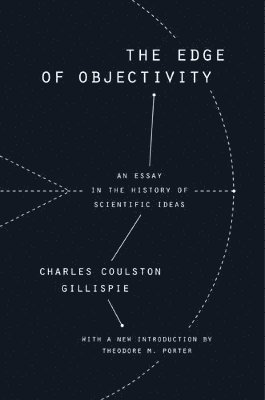
Originally published in 1960, The Edge of Objectivity helped to establish the history of science as a full-fledged academic discipline. In the mid-1950s, a young professor at Princeton named Charles Gillispie began teaching Humanities 304, one of the first undergraduate courses offered anywhere in the world on the history of science. From Galileo''s analysis of motion to theories of evolution and relativity, Gillispie introduces key concepts, individuals, and themes. The Edge of Objectivity arose out of this course. It must have been a lively class. The Edge of Objectivity is pointed, opinionated, and selective. Even at six hundred pages, the book is, as the title suggests, an essay. Gillispie is unafraid to rate Mendel higher than Darwin, Maxwell above Faraday. Full of wry turns of phrase, the book effectively captures people and places. And throughout the book, Gillispie pushes an argument. He views science as the progressive development of more objective, detached, mathematical ways of viewing the world, and he orchestrates his characters and ideas around this theme. This edition of Charles Coulston Gillispie’s landmark book introduces a new generation of readers to his provocative and enlightening account of the advancement of scientific thought over the course of four centuries. Since the original publication of The Edge of Objectivity, historians of science have focused increasingly on the social context of science rather than its internal dynamics, and they have frequently viewed science more as a threatening instance of power than as an accumulation of knowledge. Nevertheless, Gillispie’s book remains a sophisticated, fast-moving, idiosyncratic account of the development of scientific ideas over four hundred years, by one of the founding intellects in the history of science.Featuring a new foreword by Theodore Porter, who places the work in its intellectual context and the development of the field, this edition of The Edge of Objectivity is a monumental work by one of the founding intellects of the history of science.
Lazare and Sadi Carnot
A Scientific and Filial Relationship
1 635 kr
Skickas inom 10-15 vardagar
Lazare and Sadi Carnot
A Scientific and Filial Relationship
1 635 kr
Skickas inom 10-15 vardagar
1 977 kr
Läs direkt efter köp
Lazare Carnot was the unique example in the history of science of someone who inadvertently owed the scientific recognition he eventually achieved to earlier political prominence. He and his son Sadi produced work that derived from their training as engineering and went largely unnoticed by physicists for a generation or more, even though their respective work introduced concepts that proved fundamental when taken up later by other hands. There was, moreover, a filial as well as substantive relation between the work of father and son. Sadi applied to the functioning of heat engines the analysis that his father had developed in his study of the operation of ordinary machines. Specifically, Sadi''s idea of a reversible process originated in the use his father made of geometric motions in the analysis of machines in general.
This unique book shows how the two Carnots influenced each other in their work in the fields of mechanics and thermodynamics and how future generations of scientists have further benefited from their work.