Charles H. Feinstein - Böcker
Visar alla böcker från författaren Charles H. Feinstein. Handla med fri frakt och snabb leverans.
6 produkter
6 produkter
850 kr
Skickas inom 5-8 vardagar
The European Economy between the Wars, (OUP, 1997) has become the definitive economic history of Europe in the inter-war period. Placing the Great Depression of 1929-33 and the associated financial crisis at the center of the narrative, the authors comprehensively examined the lead-up to and consequences of the depression and recovery. Peter Temin and Gianni Toniolo (their former co-author, Charles H. Feinstein, has died) now expand their scope to include the entire world economy, and have created a new edition: The World Economy between the Wars. New material focuses on the structure of the world economy in the 1920s, including a special focus on the United States, Japan, and Latin America. In addition, chapters that discuss the post-depression recovery now cover The New Deal and recovery in general in the United States and Japan. This new edition is a necessary update, and invaluable resource for those who desire an overview of the inter-war area beyond the usual discussion of the 1929 stock market crash. The book's broad geographic coverage, as well as its clarity and chronological execution, will appeal to students of economic history, as well as those academics in other fields whose research involves the inter-war period.
2 797 kr
Skickas inom 5-8 vardagar
Capital formation plays a large part in any evaluation of economic growth and decline. In recent years the provision of capital in the British industrial revolution has received renewed attention. This interest arises out of attempts to trace the course and explain the progress of the pioneer industrializing country; to assess the reasons for Britain's subsequent loss of economic pre-eminence; and to explain the process of industrialization in a general way, in particular on behalf of countries which are in the midst of this process today.The debate has been largely theoretical because of the lack of reliable data for the period prior to 1850, and up-to-date estimates for the period thereafter. This book seeks to remedy this lack. Part I, based largely on archival and other primary sources, contains detailed studies of the amount of capital invested in the main sectors of the economy (coal mining, agriculture, textiles, roads and waterways) from 1750-1850. Part II provides for the first time a comprehensive set of estimates compiled on a consistent basis for the entire period from 1750-1920. It thus provides the foundation for a full study of capital accumulation in Britain from the industrial revolution to the First World War.
1 002 kr
Skickas inom 5-8 vardagar
The European Economy Between the Wars provides a full and up-to-date economic history of Europe in the inter-war period. The authors place the Great Depression of 1929-33 and the associated financial crisis at the centre of the narrative, and present these as both the culmination of the economic consequences of the First World War, the post-war peace treaties, and the policies and practices of the 1920s, and as a powerful influence on the subsequent economic history of the 1930s.In describing and explaining these developments, the authors show that errors in international economic policy, especially the commitment to the gold standard, were a principal cause of both the deep crisis and the partial recovery. The overall theme is illustrated at every point by a discussion of similarities and contrasts in the economic history and policies of individual countries, large and small.The basic approach is chronological, the style is clear and straightforward, and the book is accessible to students in a range of disciplines. The work takes full account of recent research, and there is an annotated guide to further reading with a substantial bibliography.
605 kr
Skickas inom 7-10 vardagar
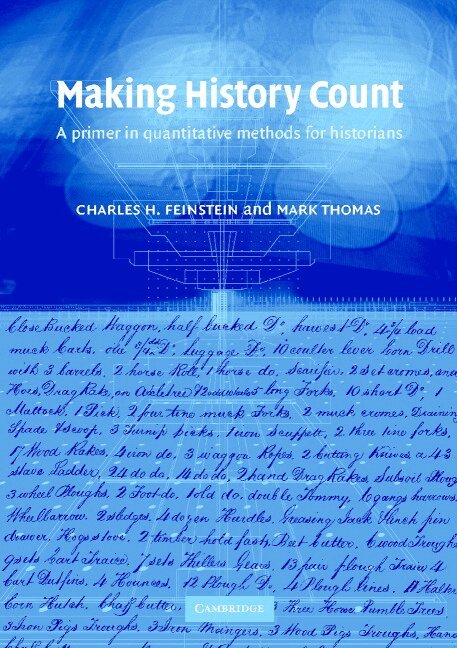
Making History Count introduces the main quantitative methods used in historical research. The emphasis is on intuitive understanding and application of the concepts, rather than formal statistics; no knowledge of mathematics beyond simple arithmetic is required. The techniques are illustrated by applications in social, political, demographic and economic history. Students will learn to read and evaluate the application of the quantitative methods used in many books and articles, and to assess the historical conclusions drawn from them. They will also see how quantitative techniques can open up new aspects of an enquiry, and supplement and strengthen other methods of research. This textbook will encourage students to recognize the benefits of using quantitative methods in their own research projects. The text is clearly illustrated with tables, graphs and diagrams, leading the student through key topics. Additional support includes five specific historical data-sets, available from the Cambridge website.
474 kr
Skickas inom 7-10 vardagar
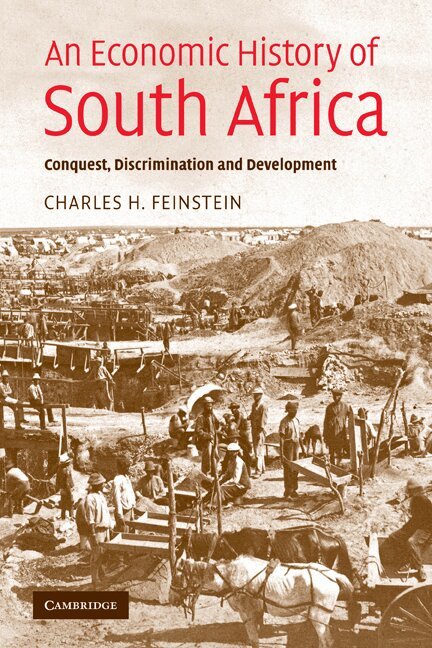
This book is the first economic history of South Africa in over sixty years. Professor Charles H. Feinstein offers an authoritative survey of five hundred years of South African economic history from the years preceding European settlements in 1652 through to the post-Apartheid era. He charts the early phase of slow growth, and then the transformation of the economy as a result of the discovery of diamonds and gold in the 1870s, followed by the rapid rise of industry in the wartime years. The final chapters cover the introduction of apartheid after 1948, and its consequences for economic performance. Special attention is given to the processes by which the black population were deprived of their land, and to the methods by which they were induced to supply labour for white farms, mines and factories. This book will be essential reading for students in economics, African history, imperial history and politics.
An Economic History of South Africa
Conquest, Discrimination, and Development
Inbunden, Engelska, 2005
1 065 kr
Skickas inom 7-10 vardagar
This book is the first economic history of South Africa in over sixty years. Professor Charles H. Feinstein offers an authoritative survey of five hundred years of South African economic history from the years preceding European settlements in 1652 through to the post-Apartheid era. He charts the early phase of slow growth, and then the transformation of the economy as a result of the discovery of diamonds and gold in the 1870s, followed by the rapid rise of industry in the wartime years. The final chapters cover the introduction of apartheid after 1948, and its consequences for economic performance. Special attention is given to the processes by which the black population were deprived of their land, and to the methods by which they were induced to supply labour for white farms, mines and factories. This book will be essential reading for students in economics, African history, imperial history and politics.