Charles Plumpton – författare
Visar alla böcker från författaren Charles Plumpton. Handla med fri frakt och snabb leverans.
12 produkter
12 produkter
Häftad, Engelska, 1985
167 kr
Skickas inom 5-8 vardagar
E-bok
PDF, Engelska, 1985154 kr
Läs direkt efter köp
E-bok
PDF, Engelska, 2013979 kr
Läs direkt efter köp
Advanced Theoretical Mechanics deals with advanced theoretical mechanics in three dimensions, making use of concepts and methods such as matrices, vectors, tensors, and transformation methods. The definition of a vector via the transformation law obeyed by its components is emphasized, and matrix methods are used to handle sets of components. Special attention is given to the definition of angular velocity and the proof that it can be represented by a vector. This book is comprised of 11 chapters and begins with an introduction to kinematics in three dimensions. Lagrange''s equations and analytical dynamics are then presented, along with the simpler problems of three-dimensional dynamics, often with the help of rotating axes. Stability and small oscillations are also considered. The subsequent chapters focus on the dynamics of a particle and the motion of a system of particles; gyroscopic motion, free rotation, and steady motion; oscillations of a dynamical system with a finite number of degrees of freedom; and the vibrations of strings. The final chapter is devoted to analytical dynamics, paying particular attention to Hamilton''s principle and equations of motion as well as the Hamilton-Jacobi equation. This monograph is intended for engineers and scientists as well as students of mathematics, physics, and engineering.
E-bok
PDF, Engelska, 2013756 kr
Läs direkt efter köp
A Course of Mathematics for Engineers and Scientists, Volume 3: Theoretical Mechanics introduces the concepts of virtual work, generalized coordinates and the derivation of generalized forces from the potential energy function. This book is composed of 10 chapters and begins with the principles of mechanics, plane statistics, virtual work, and continuously distributed forces. The succeeding chapters deal with the motion of a particle and the uniplanar motion of a rigid body, as well as the concept of particle dynamics. These topics are followed by discussions of the motions of interacting particles and the principles of stability. The final chapter describes the impulsive motion of a system of particles and collision between bodies. This book will be of value to mathematics and engineering students.
E-bok
PDF, Engelska, 2016756 kr
Läs direkt efter köp
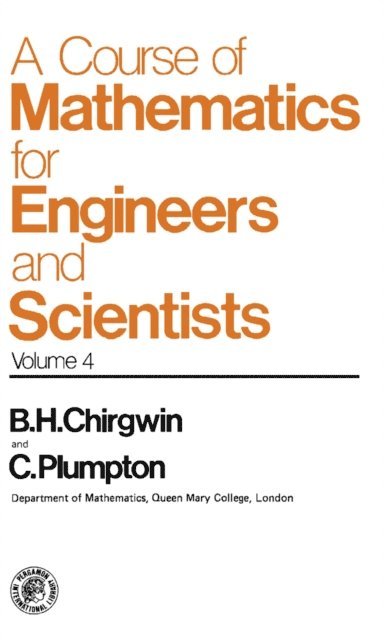
A Course of Mathematics for Engineers and Scientists, Volume 4 focuses on mathematical methods required in the more advanced parts of physics and engineering. Organized into five chapters, this book begins by elucidating vector analysis and the differential and integral operations and theorems concerning vectors. Chapter II shows solution of ordinary and some partial differential equations. Chapter III addresses the properties of Bessel, Legendre, Laguerre, and Hermite functions that commonly occur in the solution of boundary and initial value problems. The last two chapters detail the differential equations of field lines and level surfaces, as well as the matrices. This book will be useful to undergraduate students so that they can appreciate and use the mathematical methods required in the more advanced parts of physics and engineering.
E-bok
PDF, Engelska, 2017979 kr
Läs direkt efter köp
A Course of Mathematics for Engineers and Scientists, Volume 2 continues the course of pure and applied mathematics for undergraduate science and engineering students. It contains further examples and exercises from examination papers from Oxford University, Cambridge University, and the University of London. The topics covered in this book include differential equations, linear equations, matrices and determinants, vector algebra and coordinate geometry, and differentiation and integration of functions of two or more variables. This book is intended as a reference for students taking science and engineering courses at British and Commonwealth Universities.
E-bok
PDF, Engelska, 2013763 kr
Läs direkt efter köp
A Course of Mathematics for Engineers and Scientists offers a mathematics course for undergraduate students reading science and engineering at British and Commonwealth Universities and colleges. The aim of this volume is to generalize and develop the ideas and methods of earlier volumes so that the student can appreciate and use the mathematical methods required in the more advanced parts of physics and engineering. This book begins with elementary ideas of vector algebra which are generalized and developed in two ways. The first is an account of vector analysis and the differential and integral operations and theorems concerning vectors. These ideas find their first generalization in tensor analysis and the transformation of coordinates, including orthogonal curvilinear coordinates. The second development is to matrices, where the properties of arrays of elements, linear equations, and quadratic forms are shown to be the generalizations of elementary algebra and, using ''vector space'', of familiar geometrical ideas to n dimensions. The solution of differential equations by series provides a general method for the solution of ordinary and some partial differential equations. A discussion of the properties of the solutions in the light of the Sturm-Liouville theory introduces the conceptions of eigenvalues and orthogonal functions, forming a link with matrices. A chapter on the special functions gives some of the better known properties of Bessel, Legendre, Laguerre, and Hermite functions, which commonly occur in the solution of boundary and initial value problems.
E-bok
PDF, Engelska, 2013756 kr
Läs direkt efter köp
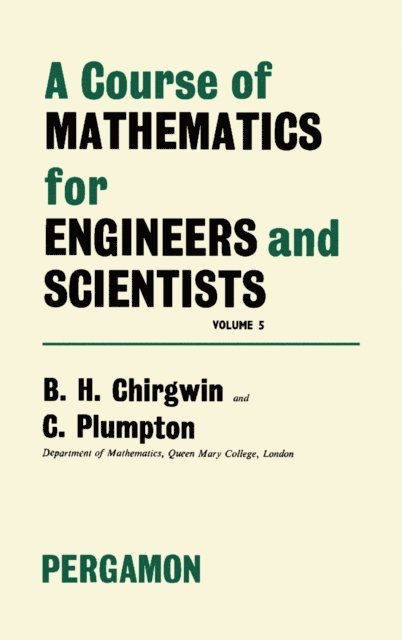
A Course of Mathematics for Engineers and Scientists, Volume 5 presents the solutions of differential equations by obtaining the results in different forms. This book discusses the significant branch of mathematics generalizing the elementary ideas of function, integration, and differentiation. Organized into four chapters, this volume begins with an overview of the use of Fourier series that leads to solutions consisting of infinite series. This text then discusses the fundamental advantage of Laplace and Fourier transformation. Other chapters consider the technique of obtaining the solutions of ordinary, and several partial, differential equations from definite integrals. This book discusses as well the mathematical basis underlying the transformation methods connecting Laplace and Fourier transformations, which is given by the advancement of complex variable theory. The final chapter deals with the series of devices for inverting the transformation functions. This book is a valuable resource for scientists, engineers, mathematicians, and undergraduate students.
E-bok
PDF, Engelska, 2014979 kr
Läs direkt efter köp
Mathematical Methods is an introductory course on mathematical methods for students aiming for a first degree in engineering or science. Topics covered include differentiation and integration and their applications; the geometry of two dimensions, and complex numbers. Statistics and probability are also discussed. Comprised of eight chapters, this volume begins with an introduction to fundamental concepts, including the roots of equations; elementary two-dimensional coordinate geometry; limits and continuity; inequalities and quadratic forms; mathematical induction; and convergence. The discussion then turns to the techniques of differentiation and integration and their applications; the geometry of two dimensions; and complex numbers and their roots, together with trigonometric expansions. The book concludes with a chapter on statistics and probability, paying particular attention to the properties of a frequency distribution; some special probability distributions; normal distribution and the error function; and some probability problems. This monograph is intended for students taking a course in engineering or science.
E-bok
PDF, Engelska, 2014756 kr
Läs direkt efter köp
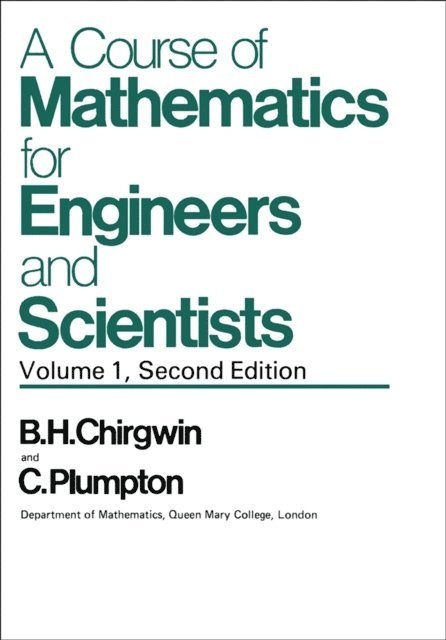
A Course of Mathematics for Engineers and Scientists, Volume 1 studies the various concepts in pure and applied mathematics, specifically the technique and applications of differentiation and integration of one variable, geometry of two dimensions, and complex numbers. The book is divided into seven chapters, wherein the first of which presents the introductory concepts, such as the functional notation and fundamental definitions; the roots of equations; and limits and continuity. The text then tackles the techniques and applications of differentiation and integration. Geometry of two dimensions and complex numbers are also encompassed in the book. The text will be very invaluable to students of pure and applied mathematics and engineering, as well as those mathematicians and engineers who need a refresher on the topic.
E-bok
PDF, Engelska, 2014756 kr
Läs direkt efter köp
A Course of Mathematics for Engineers and Scientists, Volume 3: Theoretical Mechanics details the fundamentals concepts of theoretical mechanics. The title first covers the foundations of mechanics, and then proceeds to tackling plane statics and virtual work. Next, the selection talks about continuously distributed forces. The text also deals with kinematics, along with particle dynamics. Chapter VII covers systems of particles, while Chapter VIII tackles the uniplanar motion of a rigid body. The ninth chapter discusses stability, and the last chapter details impulsive motion and variable mass. The book will be of great use to students of engineering and pure and applied mathematics.
E-bok
PDF, Engelska, 2013344 kr
Läs direkt efter köp
Magnetohydrodynamics with Hydrodynamics, Volume 1 details various concepts in magnetohydrodynamics as it relates to hydrodynamics. The title first covers the methods and techniques appropriate to an elementary discussion of magnetohydrodynamics, and then proceeds to tackling the fundamental results of fluid dynamics. Next, the selection discusses the electromagnetic effects, along with the motion of a fluid in a uniform magnetic field. In the last chapter, the text talks about steady states and equilibrium configuration. The book will be of great interest to students, researchers, and practitioners of physics and engineering.