Chris Bissell - Böcker
Visar alla böcker från författaren Chris Bissell. Handla med fri frakt och snabb leverans.
5 produkter
5 produkter
576 kr
Skickas inom 10-15 vardagar
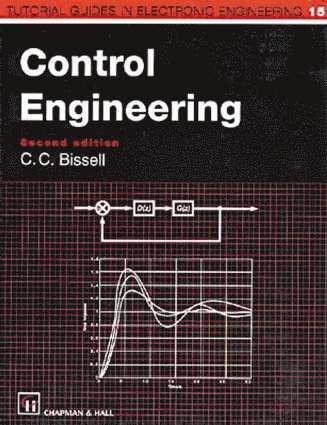
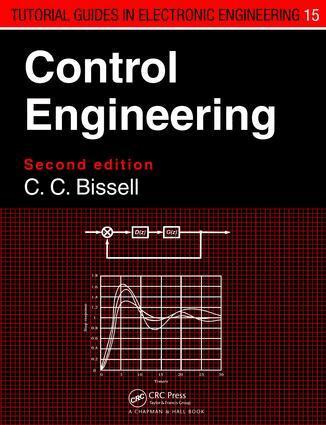
Since its inception, the Tutorial Guides in Electronic Engineering series has met with great success among both instructors and students. Designed for first- and second-year undergraduate courses, each text provides a concise list of objectives at the beginning of every chapter, key definitions and formulas highlighted in margin notes, and references to other texts in the series.With emphasis on the fundamental ideas and applications of modelling and design, Control Engineering imparts a thorough understanding of the principles of feedback control. Simple but detailed design examples used throughout the book illustrate how various classical feedback control techniques can be employed for single-input, single-output systems. Noting the interdisciplinary nature of control engineering, the author makes the text equally relevant to students whose interests lie outside of electronics by concentrating on general systems characteristics rather than on specific implementations.The author assumes students are familiar with complex numbers, phasors, and elementary calculus, and while a knowledge of simple linear differential equations would be useful, this treatment has few other mathematical requirements. With its clear explanations, copious illustrations, well-chosen examples, and end-of-chapter exercises, Control Engineering forms an outstanding first-course textbook.
862 kr
Skickas inom 7-10 vardagar
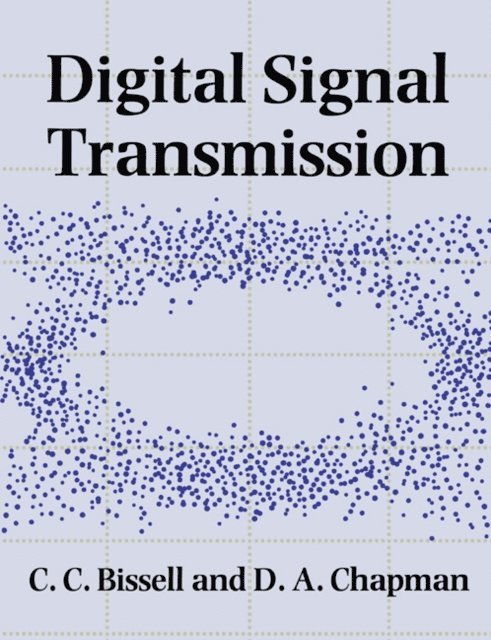
This textbook will provide both undergraduates and practising engineers with an up-to-date and thorough grounding in the concepts of modern digital transmission. The book is not encyclopaedic, rather it selects the key concepts and processes and explains them in a deliberate pedagogic style. These concepts and processes are then illustrated by a number of system descriptions. The book is divided into three parts. The longest, Part II, describes the basic processes of digital transmission, such as matched filter detection, pulse shaping, line coding, channel coding, error detection and correction, etc. Understanding the concepts behind these processes requires a grasp of basic mathematical models, and this is provided in Part I. Finally, to put the processes in context, Part III describes elements of the public switched telephone network. The text is written throughout in a modern, digital context, and is comprehensively illustrated with helpful figures. Although the mathematical models (time- and frequency-domain concepts) have wider relevance, they are developed specifically for modelling digital signals. The processes described are those found in current transmission systems, and the description of the PSTN includes an outline of newly formulated standards for the synchronous digital hierarchy (SDH), SONET and for broadband ISDN (ATM). The book will be of great value to 2nd and 3rd year undergraduates studying telecommunications, as well as to graduate trainees and practising engineers. It is appropriate for either private study or as a text associated with a taught telecommunications course. The many worked examples and exercises with solutions will be particularly helpful.
2 692 kr
Skickas inom 10-15 vardagar
Since its inception, the Tutorial Guides in Electronic Engineering series has met with great success among both instructors and students. Designed for first- and second-year undergraduate courses, each text provides a concise list of objectives at the beginning of every chapter, key definitions and formulas highlighted in margin notes, and references to other texts in the series.With emphasis on the fundamental ideas and applications of modelling and design, Control Engineering imparts a thorough understanding of the principles of feedback control. Simple but detailed design examples used throughout the book illustrate how various classical feedback control techniques can be employed for single-input, single-output systems. Noting the interdisciplinary nature of control engineering, the author makes the text equally relevant to students whose interests lie outside of electronics by concentrating on general systems characteristics rather than on specific implementations.The author assumes students are familiar with complex numbers, phasors, and elementary calculus, and while a knowledge of simple linear differential equations would be useful, this treatment has few other mathematical requirements. With its clear explanations, copious illustrations, well-chosen examples, and end-of-chapter exercises, Control Engineering forms an outstanding first-course textbook.
Del 1 - Automation, Collaboration, & E-Services
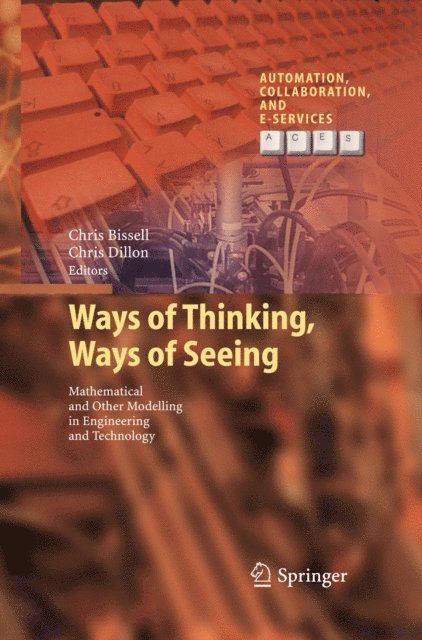
Ways of Thinking, Ways of Seeing
Mathematical and other Modelling in Engineering and Technology
Inbunden, Engelska, 2012
1 578 kr
Skickas inom 10-15 vardagar
This fascinating book examines some of the characteristics of technological/engineering models that are likely to be unfamiliar to those who are interested primarily in the history and philosophy of science and mathematics, and which differentiate technological models from scientific and mathematical ones. Themes that are highlighted include: • the role of language: the models developed for engineering design have resulted in new ways of talking about technological systems • communities of practice: related to the previous point, particular engineering communities have particular ways of sharing and developing knowledge • graphical (re)presentation: engineers have developed many ways of reducing quite complex mathematical models to more simple representations • reification: highly abstract mathematical models are turned into ‘objects’ that can be manipulated almost like components of a physical system • machines: not only the currently ubiquitous digital computer, but also older analogue devices – slide rules, physical models, wind tunnels and other small-scale simulators, as well as mechanical, electrical and electronic analogue computers • mathematics and modelling as a bridging tool between disciplines This book studies primarily modelling in technological practice. It is worth noting that models of the type considered in the book are not always highly valued in formal engineering education at university level, which often takes an “applied science” approach close to that of the natural sciences (something that can result in disaffection on the part of students). Yet in an informal context, such as laboratories, industrial placements, and so on, a very different situation obtains. A number of chapters considers such epistemological aspects, as well as the status of different types of models within the engineering education community. The book will be of interest topractising engineers and technologists; sociologists of science and technology; and historians and philosophers of science and mathematics. It will also be written in a way that will be accessible to non-specialists.
Del 1 - Automation, Collaboration, & E-Services
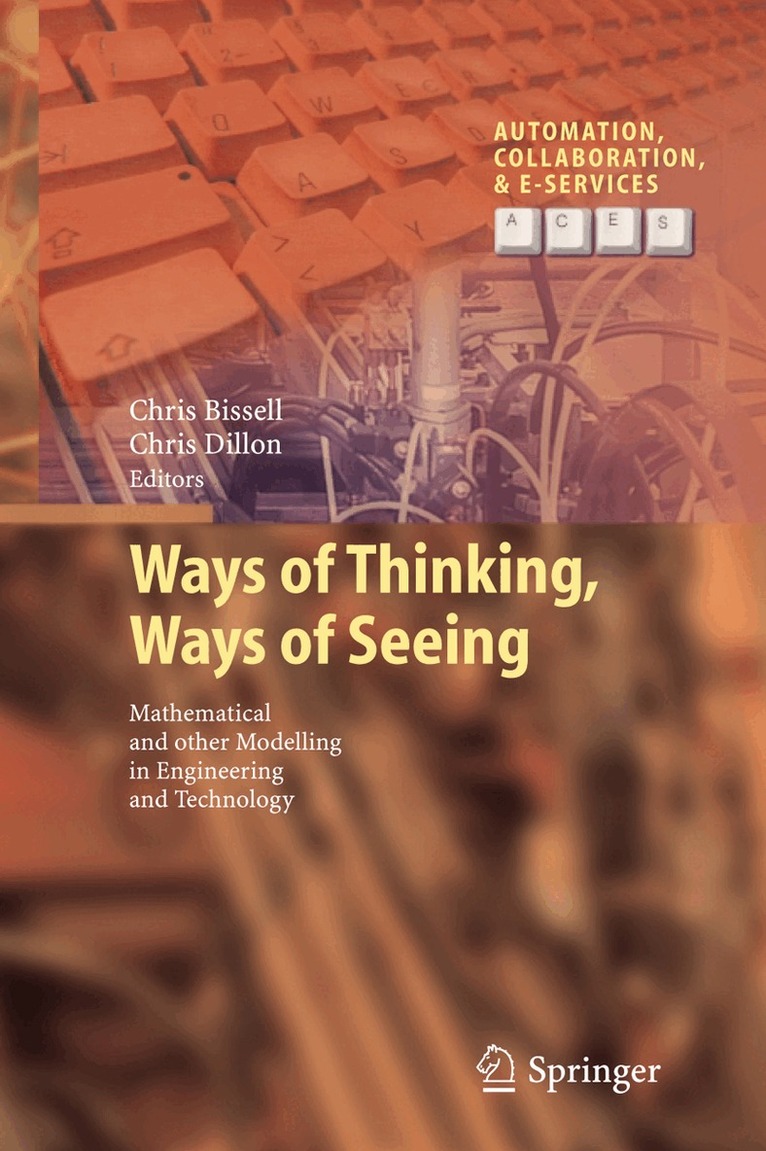
Ways of Thinking, Ways of Seeing
Mathematical and other Modelling in Engineering and Technology
Häftad, Engelska, 2014
1 578 kr
Skickas inom 10-15 vardagar
This fascinating book examines some of the characteristics of technological/engineering models that are likely to be unfamiliar to those who are interested primarily in the history and philosophy of science and mathematics, and which differentiate technological models from scientific and mathematical ones. Themes that are highlighted include: • the role of language: the models developed for engineering design have resulted in new ways of talking about technological systems • communities of practice: related to the previous point, particular engineering communities have particular ways of sharing and developing knowledge • graphical (re)presentation: engineers have developed many ways of reducing quite complex mathematical models to more simple representations • reification: highly abstract mathematical models are turned into ‘objects’ that can be manipulated almost like components of a physical system • machines: not only the currently ubiquitous digital computer, but also older analogue devices – slide rules, physical models, wind tunnels and other small-scale simulators, as well as mechanical, electrical and electronic analogue computers • mathematics and modelling as a bridging tool between disciplines This book studies primarily modelling in technological practice. It is worth noting that models of the type considered in the book are not always highly valued in formal engineering education at university level, which often takes an “applied science” approach close to that of the natural sciences (something that can result in disaffection on the part of students). Yet in an informal context, such as laboratories, industrial placements, and so on, a very different situation obtains. A number of chapters considers such epistemological aspects, as well as the status of different types of models within the engineering education community. The book will be of interest topractising engineers and technologists; sociologists of science and technology; and historians and philosophers of science and mathematics. It will also be written in a way that will be accessible to non-specialists.