Chris Demchak – författare
Visar alla böcker från författaren Chris Demchak. Handla med fri frakt och snabb leverans.
3 produkter
3 produkter
Häftad, Engelska, 2010
714 kr
Skickas inom 5-8 vardagar
In the wake of severe climatic events and terrorist acts, and the emergence of dangerous technologies, communities, nations, and global organizations have diligently sought to create strategies to prepare for such events. Designing Resilience presents case studies of extreme events and analyzes the ability of affected individuals, institutions, governments, and technological systems to cope with disaster. This volume defines resilience as it relates to disaster management at specific stages: mitigation, prevention, preparation, and response and recovery. The book illustrates models by which to evaluate resilience at levels ranging from individuals to NGOs to governmental jurisdictions and examines how resilience can be developed and sustained. A group or nation\u2019s ability to withstand events and emerge from them with their central institutions intact is at the core of resilience. Quality of response, capacity to improvise, coordination, flexibility, and endurance are also determinants. Individual case studies, including Hurricane Katrina in the United States, the London bombings, and French preparedness for the Avian flu, demonstrate effective and ineffective strategies.The contributors reveal how the complexity and global interconnectivity of modern systems—whether they are governments, mobile populations, power grids, financial systems, or the Internet—have transcended borders and created a new level of exposure that has made them especially vulnerable to extreme events. Yet these far-reaching global systems also possess the ability to alert and respond at greater speeds than ever before. The authors analyze specific characteristics of resilient systems—the qualities they possess and how they become resilient—to determine if there are ways to build a system of resilience from the ground up. As such, Designing Resilience will inform a broad range of students and scholars in areas of public administration, public policy, and the social sciences.
Häftad, Engelska, 2003
544 kr
Skickas inom 10-15 vardagar
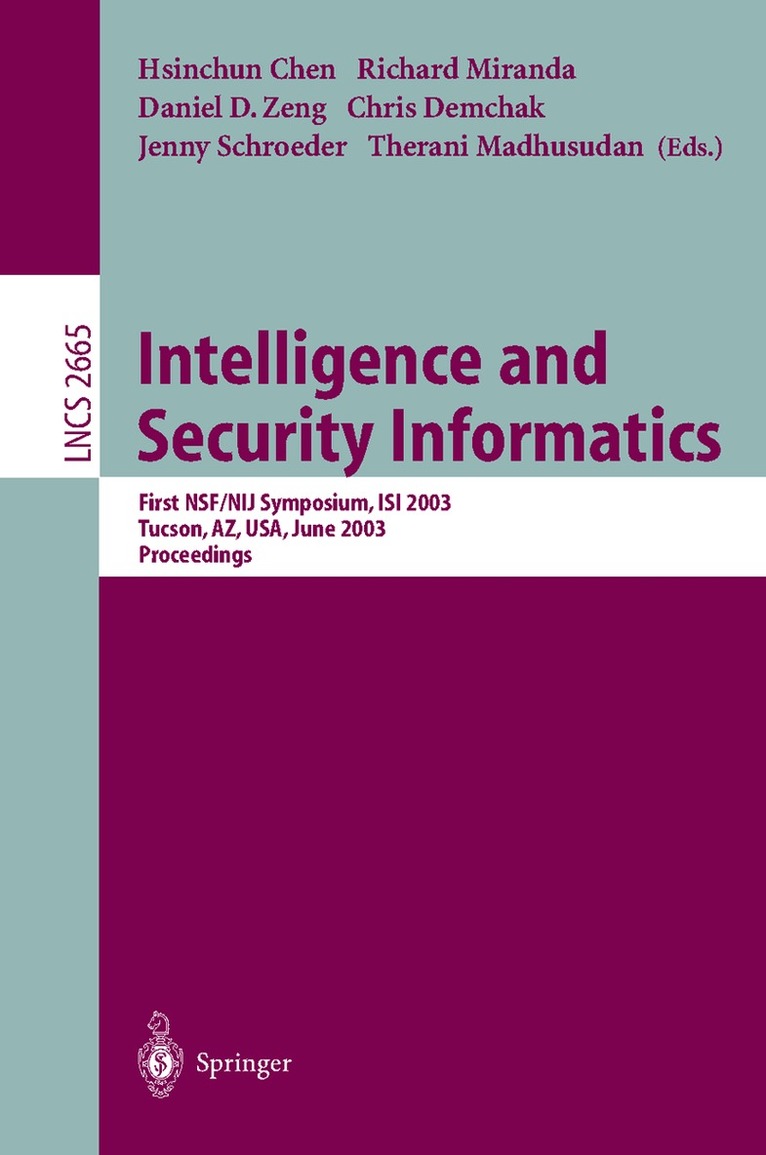
This book constitutes the refereed proceedings of the First NSF/NIJ Symposium on Intelligence and Security Informatics, ISI 2003, held in Tucson, AZ, USA in June 2003. The 24 revised full papers and 16 revised short papers presented were carefully reviewed and selected for inclusion in the book. The papers are organized in topical sections on data management and data mining, deception detection, analytical techniques, for crime detection, visualization, knowledge management and adoption, collaborative systems and methodologies, and monitoring and surveillance.
E-bok
PDF, Engelska, 2003687 kr
Läs direkt efter köp
Since the tragic events of September 11, 2001, academics have been called on for possible contributions to research relating to national (and possibly internat- nal) security. As one of the original founding mandates of the National Science Foundation, mid- to long-term national security research in the areas of inf- mation technologies, organizational studies, and security-related public policy is critically needed. In a way similar to how medical and biological research has faced signi?cant information overload and yet also tremendous opportunities for new inno- tion, law enforcement, criminal analysis, and intelligence communities are facing the same challenge. We believe, similar to “medical informatics” and “bioinf- matics,” that there is a pressing need to develop the science of “intelligence and security informatics” – the study of the use and development of advanced information technologies, systems, algorithms and databases for national se- rity related applications,through an integrated technological,organizational,and policy-based approach. We believe active “intelligence and security informatics” research will help improve knowledge discovery and dissemination and enhance information s- ring and collaboration across law enforcement communities and among aca- mics, local, state, and federal agencies, and industry. Many existing computer and information science techniques need to be reexamined and adapted for - tional security applications. New insights from this unique domain could result in signi?cant breakthroughs in new data mining, visualization, knowledge - nagement, and information security techniques and systems.