Chris Kaposy – författare
382 kr
Skickas inom 5-8 vardagar
355 kr
Läs direkt efter köp
Prenatal genetic testing has changed the circumstances under which parents choose what pregnancies to carry to term. Some have predicted that as a result of parents’ choices, people with Down syndrome will disappear from our communities in the near future. Chris Kaposy, a bioethicist who has a son with Down syndrome, reflects on parenting his son in the midst of this supposed disappearance.
Writing from a pro-choice, disability-positive perspective, Kaposy presents some of the decades-old bioethical controversies involving children with Down syndrome, illustrating a prehistory of disappearance that has shaped current attitudes toward intellectual disability. Layered throughout this history are elements of Kaposy’s personal experience with his son and family. Transcending monograph and memoir, The Beautiful Unwanted draws creatively upon the past and the present, upon myth, history, science, and personal stories, to present the world of families that include children with Down syndrome from a series of uncommon perspectives. This account encompasses the changeling myths of Newfoundland, the “discovery” of Down syndrome by John Langdon Down and Jérôme Lejeune, and the twentieth-century experience of institutionalization, as well as recent advances in reproductive technology.
We must recognize that we have some control over the future, Kaposy argues, and we must ask what kind of future we want for those who have intellectual disabilities. The Beautiful Unwanted poses this question in a way that is engaging, often bewildering, and always fascinating.
355 kr
Läs direkt efter köp
Prenatal genetic testing has changed the circumstances under which parents choose what pregnancies to carry to term. Some have predicted that as a result of parents’ choices, people with Down syndrome will disappear from our communities in the near future. Chris Kaposy, a bioethicist who has a son with Down syndrome, reflects on parenting his son in the midst of this supposed disappearance.
Writing from a pro-choice, disability-positive perspective, Kaposy presents some of the decades-old bioethical controversies involving children with Down syndrome, illustrating a prehistory of disappearance that has shaped current attitudes toward intellectual disability. Layered throughout this history are elements of Kaposy’s personal experience with his son and family. Transcending monograph and memoir, The Beautiful Unwanted draws creatively upon the past and the present, upon myth, history, science, and personal stories, to present the world of families that include children with Down syndrome from a series of uncommon perspectives. This account encompasses the changeling myths of Newfoundland, the “discovery” of Down syndrome by John Langdon Down and Jérôme Lejeune, and the twentieth-century experience of institutionalization, as well as recent advances in reproductive technology.
We must recognize that we have some control over the future, Kaposy argues, and we must ask what kind of future we want for those who have intellectual disabilities. The Beautiful Unwanted poses this question in a way that is engaging, often bewildering, and always fascinating.
474 kr
Läs direkt efter köp
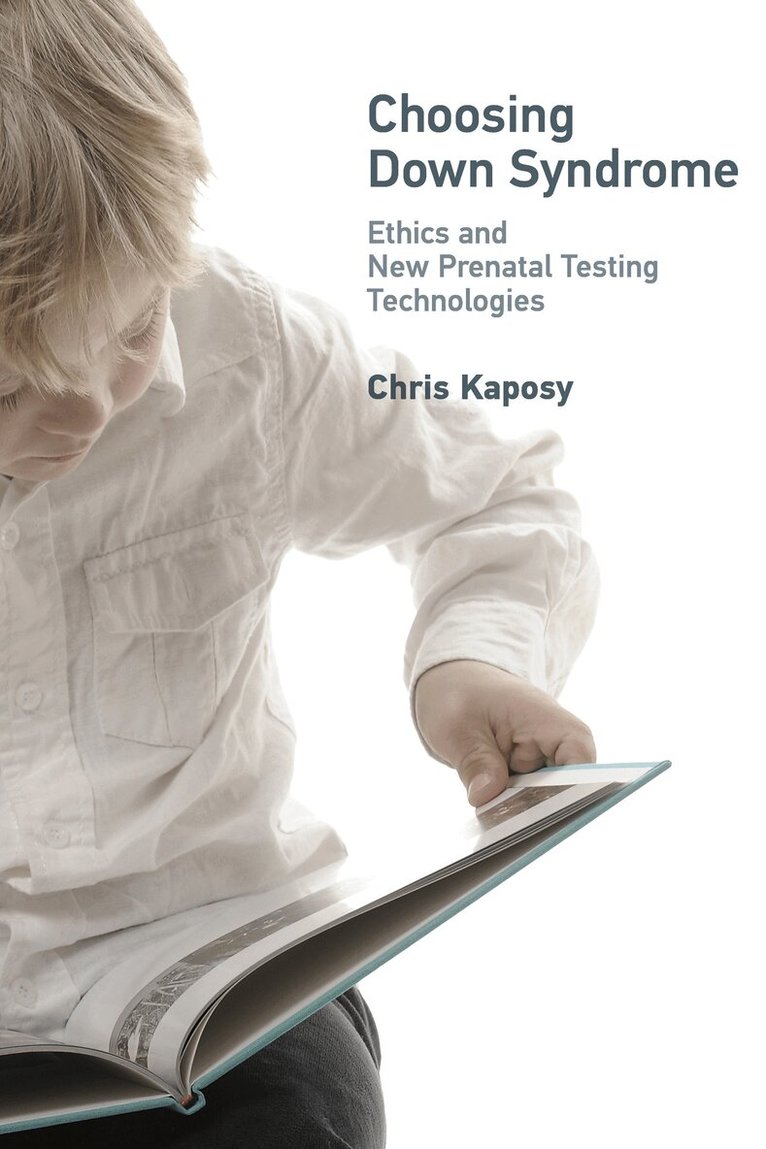
An argument that more people should have children with Down syndrome, written from a pro-choice, disability-positive perspective.
The rate at which parents choose to terminate a pregnancy when prenatal tests indicate that the fetus has Down syndrome is between 60 and 90 percent. In Choosing Down Syndrome, Chris Kaposy offers a carefully reasoned ethical argument in favor of choosing to have such a child. Arguing from a pro-choice, disability-positive perspective, Kaposy makes the case that there is a common social bias against cognitive disability that influences decisions about prenatal testing and terminating pregnancies, and that more people should resist this bias by having children with Down syndrome.
Drawing on accounts by parents of children with Down syndrome, and arguing for their objectivity, Kaposy finds that these parents see themselves and their families as having benefitted from having a child with Down syndrome. To counter those who might characterize these accounts as based on self-deception or expressing adaptive preference, Kaposy cites supporting evidence, including divorce rates and observational studies showing that families including children with Down syndrome typically function well. Himself the father of a child with Down syndrome, Kaposy argues that cognitive disability associated with Down syndrome does not lead to diminished well-being. He argues further that parental expectations are influenced by neoliberal ideologies that unduly focus on the supposed diminished economic potential of a person with Down syndrome.
Kaposy does not advocate restricting access to abortion or prenatal testing for Down syndrome, and he does not argue that it is ethically mandatory in all cases to give birth to a child with Down syndrome. People should be free to make important decisions based on their values. Kaposy''s argument shows that it may be consistent with their values to welcome a child with Down syndrome into the family.
572 kr
Skickas inom 5-8 vardagar