Christian J. Emden – författare
Visar alla böcker från författaren Christian J. Emden. Handla med fri frakt och snabb leverans.
14 produkter
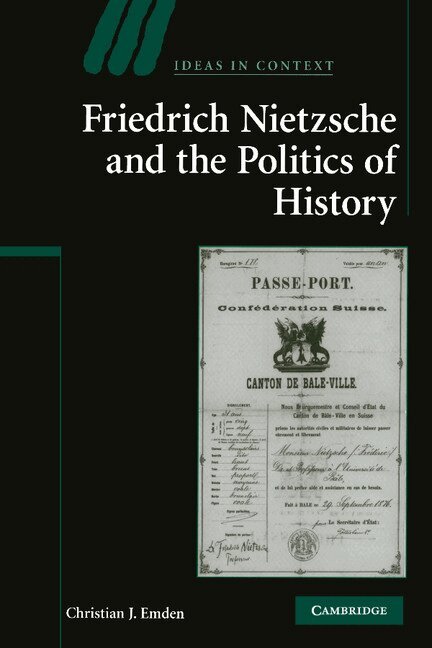
Friedrich Nietzsche and the Politics of History
Häftad, 2011
684 kr
Lägg i varukorg
This book explores Friedrich Nietzsche's understanding of modern political culture and his position in the history of modern political thought. Surveying Nietzsche's entire intellectual career from his years as a student in Bonn and Leipzig during the 1860s to his genealogical project of the 1880s, …
Nietzsche on Language, Consciousness, and the Body
Inbunden, 2005
512 kr
Lägg i varukorg
Nietzsche and the philosopy of language have been a well trafficked crossroads for a generation, but almost always as a checkpoint for post-modernism and its critics. This work takes a historical approach to Nietzsche's work on language, connecting it to his predecessors and contemporaries rather …
Nietzsche on Language, Consciousness, and the Body
E-bok, 2010
568 kr
Lägg i varukorg
Nietzsche and the philosopy of language have been a well trafficked crossroads for a generation, but almost always as a checkpoint for post-modernism and its critics. This work takes a historical approach to Nietzsche’s work on language, connecting it to his predecessors and contemporaries rather …
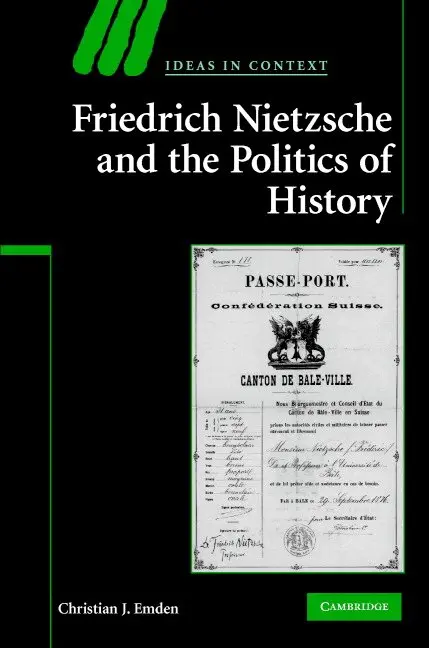
Friedrich Nietzsche and the Politics of History
Inbunden, 2008
1051 kr
Lägg i varukorg
This book explores Friedrich Nietzsche's understanding of modern political culture and his position in the history of modern political thought. Surveying Nietzsche's entire intellectual career from his years as a student in Bonn and Leipzig during the 1860s to his genealogical project of the 1880s, …
Changing Perceptions of the Public Sphere
Av Christian J. Emden, David Midgley
Inbunden, 2012
1936 kr
Lägg i varukorg
Initially propounded by the philosopher Jürgen Habermas in 1962 in order to describe the realm of social discourse between the state on one hand, and the private sphere of the market and the family on the other, the concept of a bourgeois public sphere quickly became a central point of reference in …
Changing Perceptions of the Public Sphere
Av David Midgley, Christian J. Emden
E-bok, 2012
335 kr
Lägg i varukorg
Initially propounded by the philosopher Jürgen Habermas in 1962 in order to describe the realm of social discourse between the state on one hand, and the private sphere of the market and the family on the other, the concept of a bourgeois public sphere quickly became a central point of reference in …
Beyond Habermas
Democracy, Knowledge, and the Public Sphere
Av Christian J. Emden, David Midgley
Inbunden, 2012
1921 kr
Lägg i varukorg
During the 1960s the German philosopher Jürgen Habermas introduced the notion of a “bourgeois public sphere” in order to describe the symbolic arena of political life and conversation that originated with the cultural institutions of the early eighteenth-century; since then the “public sphere” …
Beyond Habermas
Democracy, Knowledge, and the Public Sphere
Av David Midgley, Christian J. Emden
E-bok, 2012
335 kr
Lägg i varukorg
During the 1960s the German philosopher Jürgen Habermas introduced the notion of a “bourgeois public sphere” in order to describe the symbolic arena of political life and conversation that originated with the cultural institutions of the early eighteenth-century; since then the “public sphere” …
Democracy and the Limits of Community
Inbunden, 2026
1563 kr
Lägg i varukorg
At a historical moment when democracy experiences a legitimation crisis, demands for 'community' and for a 'democracy of the common' have become central themes in political theory and philosophy on both sides of the Atlantic. Such appeals entail a critique, even a rejection, of liberal …
Nietzsche's Naturalism
Philosophy and the Life Sciences in the Nineteenth Century
Inbunden, 2014
1593 kr
Lägg i varukorg
This book explores Nietzsche's philosophical naturalism in its historical context, showing that his position is best understood against the background of encounters between neo-Kantianism and the life sciences in the nineteenth century. Analyzing most of Nietzsche's writings from the late 1860s …
Nietzsche's Naturalism
Philosophy and the Life Sciences in the Nineteenth Century
Häftad, 2019
569 kr
Lägg i varukorg
This book explores Nietzsche's philosophical naturalism in its historical context, showing that his position is best understood against the background of encounters between neo-Kantianism and the life sciences in the nineteenth century. Analyzing most of Nietzsche's writings from the late 1860s …
Beyond Habermas
Democracy, Knowledge, and the Public Sphere
Av Christian J. Emden, David Midgley
Häftad, 2014
527 kr
Lägg i varukorg
During the 1960s the German philosopher Jurgen Habermas introduced the notion of a "bourgeois public sphere" in order to describe the symbolic arena of political life and conversation that originated with the cultural institutions of the early eighteenth-century; since then the "public sphere" …