Christian N. Madu - Böcker
Visar alla böcker från författaren Christian N. Madu. Handla med fri frakt och snabb leverans.
13 produkter
13 produkter
2 489 kr
Skickas inom 10-15 vardagar
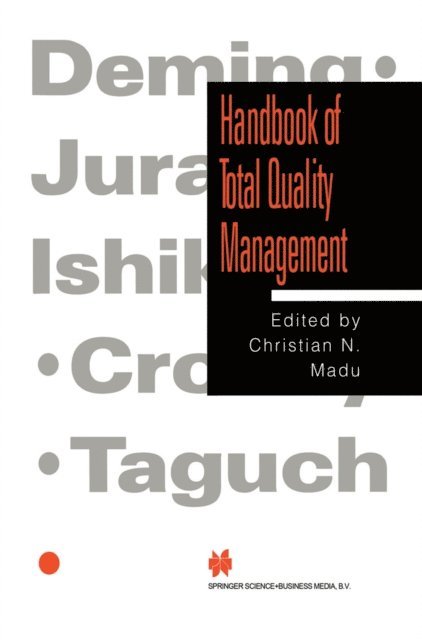
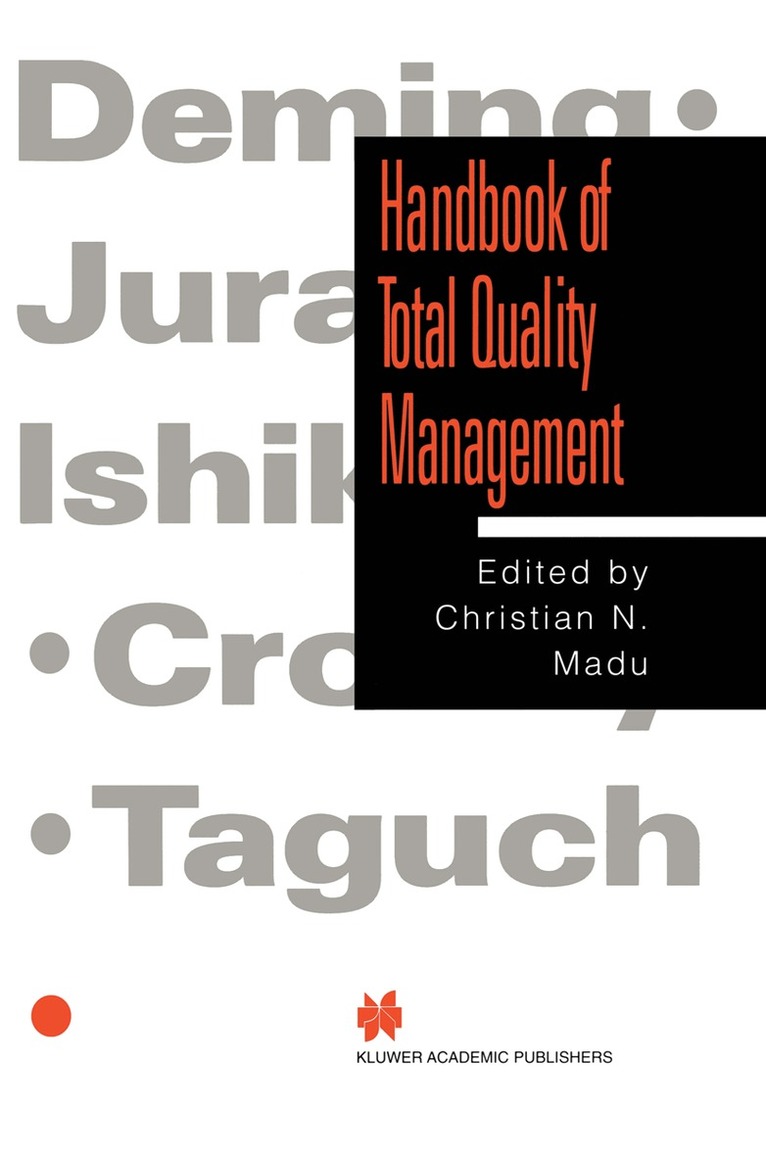
Quality issues are occupying an increasingly prominent position in today's global business market, with firms seeking to compete on an international level on both price and quality. Consumers are demanding higher quality standards from manufacturers and service providers, while virtually all industrialized nations have instituted quality programs to help indigenous corporations. A proliferation in nation-wide and regional quality awards such as the Baldridge award and certification to ISO 9000 series are making corporations world-wide quality-conscious and eager to implement programs of continuous improvement. To achieve competitiveness, quality practice is a necessity and this book offers an exposition of how quality can be attained. The Handbook of Total Quality Management: Explores in separate chapters new topics such as re-engineering, concurrent engineering, ISO standards, QFD, the Internet, the environment, advanced manufacturing technology and benchmarking Discusses the views of leading quality practitioners such as Derning, Juran, Ishikawa, Crosby and Taguchi throughout the book Considers important strategies for quality improvement, including initiation and performance evaluation through auditing, re-engineering, and process and design innovations. With contributions from 47 authors in 13 different countries, the Handbook of Total Quality Management is invaluable as a reference guide for anyone involved with quality management and deployment, including consultants, practitioners and engineers in the professional sector, and students and lecturers of information systems, management and industrial engineering.
1 039 kr
Skickas inom 10-15 vardagar
Management of new technologies is a critical factor in achieving global competitiveness. A recent survey of managers in the United States revealed that the implementation of new and advanced technologies is the most popular strategy in achieving global competitiveness. This book explores the role of technology in that context. The book identifies the role of new technologies in improving quality and shows that adopting a strategic total quality management will, in fact, lead to improved productivity and survivability of the firm. A thorough comparison of the Japanese and American production management practices is presented. This in-depth analysis helps to identify the problems of managing new technologies and shows that human resources management is a critical factor that should not be overlooked. Other strategies for improving global competitiveness are presented. Each of the five sections of the book deals with a major thrust that confronts management of new technologies. The book also discusses information system management and product design. The book uses real-life cases, models, and conceptual frameworks to support the views presented.Productivity, quality, and competitiveness are all related to technology. The success of Japanese corporations in achieving quality management has impelled the U.S. executives to listen and re-evaluate their management practices. Increasingly, many managers believe that new, advanced technologies can contribute to improving the productivity, quality, and competitiveness of a firm. However, simply adopting a new technology will not put an end to productivity and/or quality problems. This fact is most apparent in the case of computer-integrated manufacturing. The islands of automation that have resulted convinced many that effective management of new technologies is necessary in order to exploit any potential benefits. This book focuses on efficient management techniques and looks at the critical areas that can enhance the performance of a firm as a result of the adoption of new technologies.The book is divided into five sections: The total quality management section contains four chapters that present a comparison between the Japanese and American production practices. This section also presents a new way to measure the performance of a firm---not just by the direct quality of the product or service produced, but also by the sensitivity and responsibility of the firm to environmental and greening issues. The selection and implementation of new technologies section discusses the problems associated with the cost-accounting techniques in justifying new technologies and uses a multicriteria decision framework to show how this decision could be made. The strategic management section presents issues on production innovation and performance; The knowledge-based techniques section investigates the role of artificial intelligence and expert systems in the management of new technologies. Finally, the product design and inventory management section discusses the role of product design and reduced lot sizes in achieving a competitive advantage.
2 028 kr
Skickas inom 5-8 vardagar
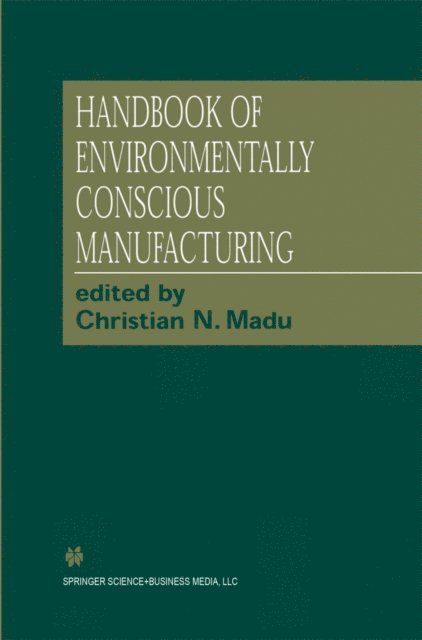
Manufacturers are increasingly, under pressure from their major stakeholders to integrate environmental issues in the design and management of their products. These stakeholders include customer, regulators, employees, communities, and interest groups who have a common stake in protecting the earth from pollution and in limiting the exploitation of earth's limited natural resources. Manufacturers recognize that being environmentally responsible also offers competitive advantage to the firm. Hence the Handbook of Environmentally Conscious Manufacturing is written as a state-of-the-art reference to environmentally conscious manufacturing (ECM). The chapter authors were carefully selected. All the chapter authors have done extensive research and / or practice work in the field of ECM. The Handbook covers all the major topics in Environmentally Conscious Manufacturing. There are specific chapters to deal with sustainable manufacturing, recycling, eco-labelling, life cycle assessment, and ISO 14000 series of standards, as well as decision-making aspects of Environmentally Conscious Manufacturing. Decision-oriented topics on supply chain, decision models, quality initiative, environmental costing and decision support systems are also covered. The influence of ECM on marketing imperative is also covered. The Handbook is the most comprehensive treatment of Environmentally Conscious Manufacturing available to-date. It is the definitive, state-of-the-art reference to ECM and its applications to today's manufacturing firms.
2 111 kr
Skickas inom 10-15 vardagar
Quality issues are occupying an increasingly prominent position in today's global business market, with firms seeking to compete on an international level on both price and quality. Consumers are demanding higher quality standards from manufacturers and service providers, while virtually all industrialized nations have instituted quality programs to help indigenous corporations. A proliferation in nation-wide and regional quality awards such as the Baldridge award and certification to ISO 9000 series are making corporations world-wide quality-conscious and eager to implement programs of continuous improvement. To achieve competitiveness, quality practice is a necessity and this book offers an exposition of how quality can be attained. The Handbook of Total Quality Management: Explores in separate chapters new topics such as re-engineering, concurrent engineering, ISO standards, QFD, the Internet, the environment, advanced manufacturing technology and benchmarking Discusses the views of leading quality practitioners such as Derning, Juran, Ishikawa, Crosby and Taguchi throughout the book Considers important strategies for quality improvement, including initiation and performance evaluation through auditing, re-engineering, and process and design innovations. With contributions from 47 authors in 13 different countries, the Handbook of Total Quality Management is invaluable as a reference guide for anyone involved with quality management and deployment, including consultants, practitioners and engineers in the professional sector, and students and lecturers of information systems, management and industrial engineering.
546 kr
Skickas inom 7-10 vardagar
Quality function deployment (QFD) is an effective tool to help organizations to become more competitive by designing their products and services to satisfy customers’ requirements. This book is precise and direct and focuses on the key issues in building the House of Quality otherwise known as Quality Function Deployment (QFD). By reading this book, the manager understands how to solicit customer requirement information, how design requirements are matched to customer requirements, how priorities of customer needs are established, and how activities are benchmarked. Furthermore, this new edition expands the topic to include process change initiatives on the premise that QFD cannot be achieved if the organization itself is not transformed to achieve customer satisfaction. The manager is guided on how to solve critical problems to achieve customer satisfaction. The book guides the reader to understand how companywide quality activities are related to QFD. This association is often lacking in other presentations that treat QFD as if it is independent of other quality efforts, such as process change initiative. The book will therefore include information on related quality initiatives such as:• Identification of customer needs• Benchmarking & re-engineering• Strategic planning• Quality assurance• Stakeholder teams• Cost control & productivity improvement• Six sigma• Process change initiative
1 007 kr
Skickas inom 7-10 vardagar
Quality function deployment (QFD) is an effective tool to help organizations to become more competitive by designing their products and services to satisfy customers’ requirements. This book is precise and direct and focuses on the key issues in building the House of Quality otherwise known as Quality Function Deployment (QFD). By reading this book, the manager understands how to solicit customer requirement information, how design requirements are matched to customer requirements, how priorities of customer needs are established, and how activities are benchmarked. Furthermore, this new edition expands the topic to include process change initiatives on the premise that QFD cannot be achieved if the organization itself is not transformed to achieve customer satisfaction. The manager is guided on how to solve critical problems to achieve customer satisfaction. The book guides the reader to understand how companywide quality activities are related to QFD. This association is often lacking in other presentations that treat QFD as if it is independent of other quality efforts, such as process change initiative. The book will therefore include information on related quality initiatives such as:• Identification of customer needs• Benchmarking & re-engineering• Strategic planning• Quality assurance• Stakeholder teams• Cost control & productivity improvement• Six sigma• Process change initiative
1 896 kr
Skickas inom 3-6 vardagar
Competing in today's marketplace requires a holistic view of both products and processes. It requires that companies pay attention to their stakeholders in addition to their customers. Environmental planning lays the foundation to adapt to the needs of the changing world and avoid the hazards, risks and high costs associated with poor environmental practices.Written by an expert in chemical safety, security management, sustainability management, disaster risk reduction, process change and quality control in environmental planning, this book identifies good environmental practices, and lays down effective strategies and practical models. The book focuses mostly on designing for the environment, using sustainable practices to achieve competitiveness. Following the successful publication of the 1st edition, this edition brings existing chapters up to date as well as introduces new chapters on current topics of concern such as global environmental challenges, a circular economy, environmental impact assessment, climate change, and disaster risk reduction and management. The case studies presented point to companies that have increased profitability because of their environmental programs.This book is intended as an introduction to corporate environmental management and is suitable for basic courses in sustainability management, and environmental management and planning. Practitioners would also find it helpful as it explains some of the basic concepts and environmental strategies that are in practice today.
2 169 kr
Tillfälligt slut
1 250 kr
Tillfälligt slut
This book focuses on environmental planning and management. Environmental problems are not purely scientific; some of the major problems deal with poor management and the inability to involve people in environmental decision making process. The approach taken in this book is to review environmental problems as they are affected by poor planning and management. Understanding of management issues involved will help to get top management to buy into environmental management. The tendency is for top management to view environmental management efforts as expensive and wasteful to an organization. However, when top management is exposed to the high cost of doing nothing and the lack of competitiveness as a result of poor environmental quality, it is more likely to buy into the idea of environmental quality and work towards achieving sustainable goals.
2 321 kr
Skickas inom 10-15 vardagar
Manufacturers, under pressure from their major stakeholders, integrate environmental issues in the design and management of their products. The Handbook of Environmentally Conscious Manufacturing is written as a state-of-the-art reference to guide environmentally conscious manufacturing (ECM).
521 kr
Skickas inom 5-8 vardagar
Handbook Of Disaster Risk Reduction & Management: Climate Change And Natural Disasters
Inbunden, Engelska, 2017
3 933 kr
Skickas inom 5-8 vardagar
Climate change is increasingly of great concern to the world community. The earth has witnessed the buildup of greenhouse gases (GHG) in the atmosphere, changes in biodiversity, and more occurrences of natural disasters. Recently, scientists have begun to shift their emphasis away from curbing carbon dioxide emission to adapting to carbon dioxide emission. The increase in natural disasters around the world is unprecedented in earth's history and these disasters are often associated to climate changes. Many nations along the coastal lines are threatened by massive floods and tsunamis. Earthquakes are increasing in intensity and erosion and droughts are problems in many parts of the developing countries. This book is therefore to investigate ways to prepare and effectively manage these disasters and possibly reduce their impacts. The focus is on mitigation strategies and policies that will help to reduce the impacts of natural disasters. The book takes an in-depth look at climate change and its association to socio-economic development and cultures especially in vulnerable communities; and investigates how communities can develop resilience to disasters. A balanced and a multiple perspective approach to manage the risks associated with natural disasters is offered by engaging authors from the entire globe to proffer solutions.
4 150 kr
Skickas inom 5-8 vardagar
Sustainability is about the effective management of nonrenewable and nonreplenishable natural resources. These resources are limited and critical to maintaining ecological balance. A collective effort is required to balance our socio-economic needs with environmental needs. This could be achieved by re-evaluating policies and actions as to how they affect the environment. Sustainability requires changes in traditional practices of doing things and refocusing ourselves to the needs of the earth. This handbook explores the role of sustainability in achieving social development, environmental protection, and economic development. These three areas constitute what is referred to as the triple bottom line (TBL). Sustainability management may help organizations and their global supply networks to re-evaluate their policies, processes, programs, and projects in terms of triple bottom line. Sustainability helps to facilitate planning, implementing, reviewing, and improving an organization's actions and operations to meet ecological goals.