Christian Rauh – författare
Visar alla böcker från författaren . Handla med fri frakt och snabb leverans.
7 produkter
7 produkter
E-bok
PDF, Engelska, 20141 335 kr
Läs direkt efter köp
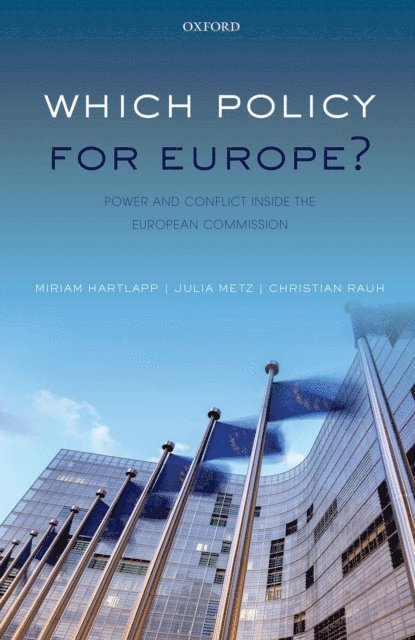
The European Commission is at the center of the European Union''s political system. Within its five-year terms each Commission proposes up to 2000 binding legal acts and therefore crucially shapes EU policy, which in turn impacts on the daily lives of more than 500 million European citizens. However, despite the Commissions key role in setting the agenda for European decision making, little is known about its internal dynamics when preparing legislation. This book provides a problem-driven, theoretically-founded, and empirically rich treatment of the so far still understudied process of position-formation inside the European Commission. It reveals that various internal political positions prevail and that the role of power and conflict inside the European Commission is essential to understanding its policy proposals. Opening the ''black box'' of the Commission, the book identifies three ideal types of internal position-formation. The Commission is motivated by technocratic problem-solving, by competence-seeking utility maximization or ideologically-motivated policyseeking. Specifying conditions that favor one logic over the others, the typology furthers understanding of how the EU system functions and provides novel explanations of EU policies with substantial societal implications.
Inbunden, Engelska, 2014
1 530 kr
Skickas inom 7-10 vardagar
The European Commission is at the center of the European Union's political system. Within its five-year terms each Commission proposes up to 2000 binding legal acts and therefore crucially shapes EU policy, which in turn impacts on the daily lives of more than 500 million European citizens. However, despite the Commissions key role in setting the agenda for European decision making, little is known about its internal dynamics when preparing legislation.This book provides a problem-driven, theoretically-founded, and empirically rich treatment of the so far still understudied process of position-formation inside the European Commission. It reveals that various internal political positions prevail and that the role of power and conflict inside the European Commission is essential to understanding its policy proposals.Opening the 'black box' of the Commission, the book identifies three ideal types of internal position-formation. The Commission is motivated by technocratic problem-solving, by competence-seeking utility maximization or ideologically-motivated policyseeking. Specifying conditions that favor one logic over the others, the typology furthers understanding of how the EU system functions and provides novel explanations of EU policies with substantial societal implications.
Inbunden, Engelska, 2016
1 062 kr
Skickas inom 5-8 vardagar
Häftad, Engelska, 2016
679 kr
Skickas inom 5-8 vardagar
E-bok
PDF, Engelska, 2006243 kr
Läs direkt efter köp
Seminar paper from the year 2005 in the subject Politics - Topic: European Union, grade: 1,0, , course: Difficult enlargement - New member states in the EU, language: English, abstract: In the view of ongoing political debates about the future and scope of the European Union in general and about EU enlargement specifically, this paper addresses the readiness of Romania in terms of political requirements specified in the Copenhagen Criteria. A theoretically oriented section highlights approaches that explain the influence of the EU on reforms in (potential) candidate states. It concludes that it is the prospect of membership that supports reforms. The following section attempts a quantitative comparison regarding the political criterion between Romania and the baselines of (a) the EU 25, (b) the EU 12 and (c) the eight Central and Eastern European States that accessed the EU in 2004. The analysis thereby relies on the most recent data set of the World Bank Governance Indicators. The results suggest that Romania is factually far away from all three baselines in terms of the political criterion. Accordingly, the paper concludes that a postponement of accession in the framework of the existing treaties would be highly reasonable - both from the Romanian and the European perspective and apart from biases stemming from short term political interests that inform most often the contemporary debate.
E-bok
PDF, Engelska, 2006177 kr
Läs direkt efter köp
Seminar paper from the year 2004 in the subject Politics - Methods, Research, grade: 1,0, University of Constance, course: European Co-operation and Integration, language: English, abstract: The European Union seems to be a very attractive field for scholars of political science. This is probably due to its sui generis character but the even more likely motivation may stem from the intellectual challenges provided by the European decision-making process. This process consists of multiple actors - such as the member state governments or the European Commissioners - and of multiple levels - such as the subnational, the national or the supranational level. I do not want to claim that explaining this process is just a means for intellectual satisfaction, rather questions that affect more or less all citizens within the European Union can be answered this way. For example, if it is known which actor has which influence in the legislative process, any public or private interest group can figure out where to spend its resources effectively. A fruitful school of thought in this research area is the rational choice institutionalism. Scholars that can be assigned to this school are eager to find parsimonious explanations in order to cover a large class of events within the European legislation. Actors that are assumed to act (at least on average) rationally and to have preferences being exogenous to the decisionmaking processes under analysis are the base for such explanations. Formal or informal rules (that are institutions ) enable or constrain these actors in pursuing their preferences (Aspinwall & Schneider 2000). Hence, modelling such institutions, figuring out their implications and comparing these results to empirical data is the most useful research strategy. Indeed modelling always means a simplification of reality without which one can not produce generaliseable statements. Researchers differ in their views on reality and may put emphasis on different aspects when establishing a model. Thus different results and therefore debates can emerge that, if at all, only can be solved by empirical examination using a reliable and valid research design. A famous example for such a debate is the one between George Tsebelis and Peter Moser on the implications of the cooperation procedure (Tsebelis 1994, Moser 1994). Here different interpretations of the legal basis lead to different statements on the power the European Parliament is expected to have under this procedure.
Häftad, Tyska, 2007
367 kr
Skickas inom 3-6 vardagar