Christian S. Calude – författare
Visar alla böcker från författaren Christian S. Calude. Handla med fri frakt och snabb leverans.
5 produkter
5 produkter
Häftad, Engelska, 2001
544 kr
Skickas inom 10-15 vardagar
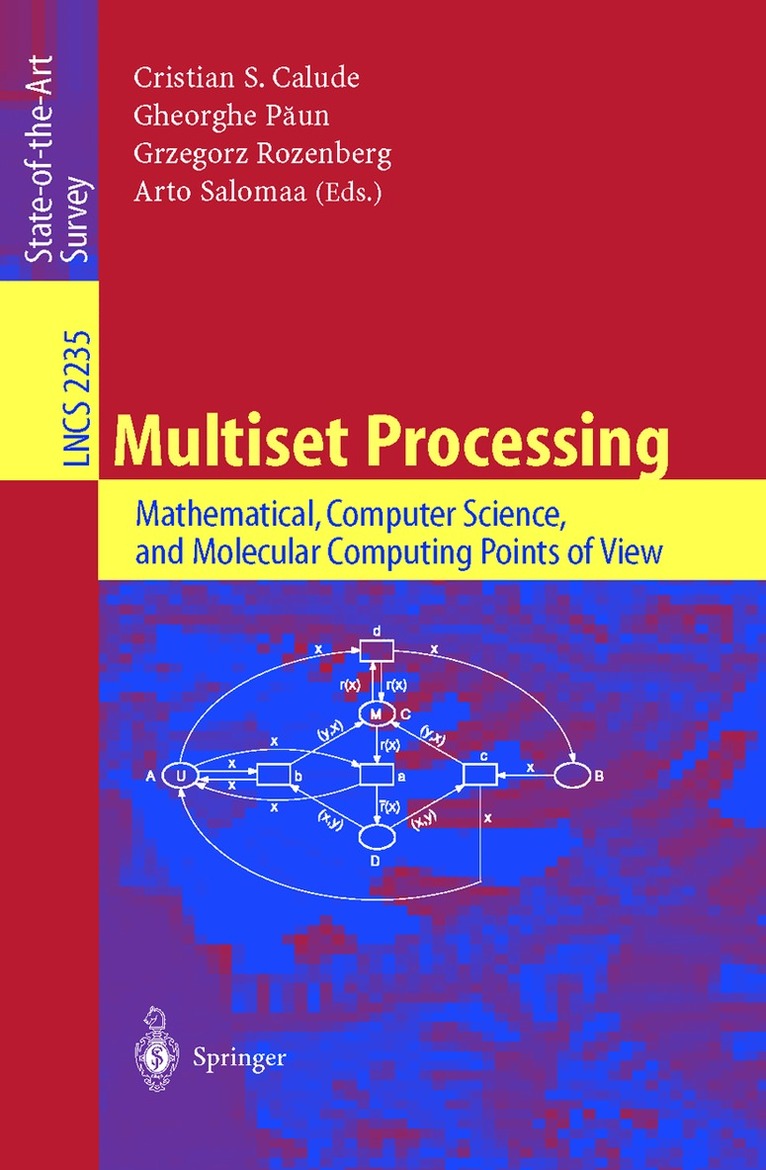
Themultiset (a set with multiplicities associated with its elements, in the form of natural numbers) is a notion which has appeared again and again in many areas of mathematics and computer science, sometimes called abag (some h- torical information appears in the enclosed paper by A. Syropoulos). As a data structure, this notion stands "in-between"strings/lists, where a linear ordering of symbols/items is present, andsets, where no ordering and no multiplicity is considered;inamultiset,onlythemultiplicityofelementsmatters,nottheir ordering. Actually, in between lists and multisets we also havepomsets, partially ordered multisets. Con?ning ourselves to computer science, we may mention many areas where multisets are used: formal power series, Petri nets, data bases, logics, formal language theory (in relation with Parikh mapping, commutative grammars, etc), concurrency, and so on. In the last few years, the notion has occurred in a rather natural way in the molecular computing area. An aqueous solution of chemical compounds, swimming together in a given space, without any given spatial relation between individual elements, is just a multiset.Actually, this chemical metaphor was used several years before the occurrence of what is now called molecular computing, as the basic ingredient of the Gamma language and the Chemical Abstract Machine (a comprehensive survey of these ideas is provided by J. -P. Ban atre, P. Fradet, D. Le Metayer).
Häftad, Engelska, 2009
544 kr
Skickas inom 10-15 vardagar
This book constitutes the refereed proceedings of the 8th International Conference on Unconventional Computation, UC 2009, held in Ponta Delgada, Portugal, in September 2009. The 18 revised full papers presented together with 8 invited talks, 3 tutorials and 5 posters were carefully reviewed and selected from 40 submissions. The papers are devoted to all aspects of unconventional computation ranging from theoretical and experimental aspects to various applications. Typical topics are: natural computing including quantum; cellular, molecular, neural and evolutionary computing; chaos and dynamical system-based computing; and various proposals for computational mechanisms that go beyond the Turing model.
Häftad, Engelska, 2010
544 kr
Skickas inom 10-15 vardagar
The 9th International Conference on Unconventional Computation, UC 2010, was organized under the auspices of EATCS and Academia Europaea, by the University of Tokyo (Tokyo, Japan), and the Center for Discrete Mathematics and Theoretical Computer Science (Auckland, New Zealand). It was held in Tokyoduring June 21–25,2010(seehttp://arn.local.frs.riken.jp/UC10/). The venue was the Sanjo (Hilltop) Conference Hall at Hongo Campus of the University of Tokyo. Hongo Campus was formerly the residence of the Maeda family, one of the richest feudal lords in the Edo period of Japan. The Japanese garden in the residence is partially preserved, including the pond and the hill on which the conference hall is located. Within walking distance from Hongo Campus are Ueno park with many museums, the Akihabara area, which is now the center of Japanesepop culture, and the Korakuenamusement park/baseball stadium. The International Conference on Unconventional Computation (UC) series (seehttp://www.cs.auckland.ac.nz/CDMTCS/conferences/uc/)isdevotedto all aspects of unconventional computation — theory as well as experiments and applications. Typical, but not exclusive, topics are: natural computing including quantum, cellular, molecular, membrane, neural, and evolutionary computing, as well as chaos and dynamical system-based computing, and various proposals for computational mechanisms that go beyond the Turing model.
Inbunden, Engelska, 2010
561 kr
Skickas inom 10-15 vardagar
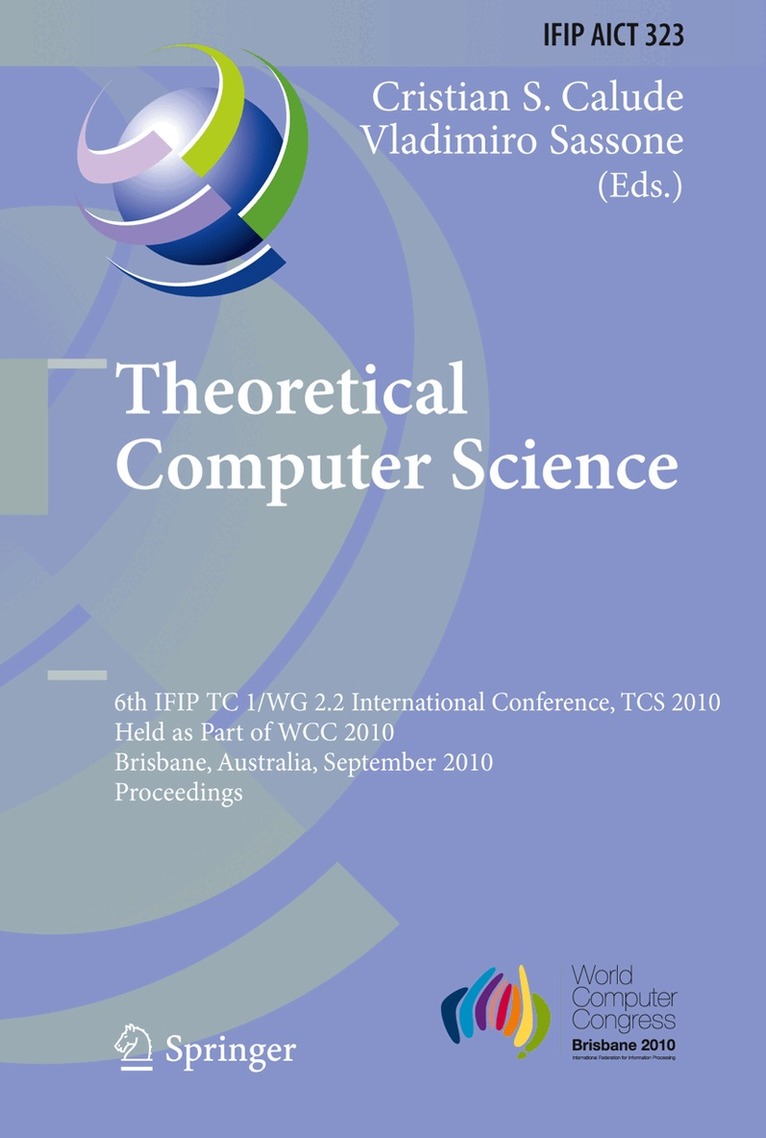
Thisvolumecontainstheinvitedandregularpaperspresentedat TCS 2010,the 6thIFIP International Conference on Theoretical Computer Science, organised by IFIP Tech- cal Committee 1 (Foundations of Computer Science) and IFIP WG 2.2 (Formal - scriptions of Programming Concepts) in association with SIGACT and EATCS. TCS 2010 was part of the World Computer Congress held in Brisbane, Australia, during September 20-23, 2010 ( ). TCS 2010 is composed of two main areas: (A) Algorithms, Complexity and Models of Computation, and (B) Logic, Semantics, Speci?cation and Veri?cation. The selection process led to the acceptance of 23 papers out of 39 submissions, eachofwhichwasreviewedbythreeProgrammeCommitteemembers.TheProgramme Committee discussion was held electronically using Easychair. The invited speakers at TCS 2010 are: Rob van Glabbeek (NICTA, Australia) Bart Jacobs (Nijmegen, The Netherlands) Catuscia Palamidessi (INRIA and LIX, Paris, France) Sabina Rossi (Venice, Italy) James Harland (Australia) and Barry Jay (Australia) acted as TCS 2010 Chairs.We take this occasion to thank the members of the Programme Committees and the external reviewers for the professional and timely work; the conference Chairs for their support; the invited speakers for their scholarly contribution; and of course the authors for submitting their work to TCS 2010.
Del 323 - IFIP Advances in Information and Communication Technology
Theoretical Computer Science
6th IFIP WG 2.2 International Conference, TCS 2010, Held as a Part of WCC 2010, Brisbane, Australia, September 20-23, 2010, Proceedings
Häftad, Engelska, 2014
561 kr
Skickas inom 10-15 vardagar
Thisvolumecontainstheinvitedandregularpaperspresentedat TCS 2010,the 6thIFIP International Conference on Theoretical Computer Science, organised by IFIP Tech- cal Committee 1 (Foundations of Computer Science) and IFIP WG 2.2 (Formal - scriptions of Programming Concepts) in association with SIGACT and EATCS. TCS 2010 was part of the World Computer Congress held in Brisbane, Australia, during September 20-23, 2010 ( ). TCS 2010 is composed of two main areas: (A) Algorithms, Complexity and Models of Computation, and (B) Logic, Semantics, Speci?cation and Veri?cation. The selection process led to the acceptance of 23 papers out of 39 submissions, eachofwhichwasreviewedbythreeProgrammeCommitteemembers.TheProgramme Committee discussion was held electronically using Easychair. The invited speakers at TCS 2010 are: Rob van Glabbeek (NICTA, Australia) Bart Jacobs (Nijmegen, The Netherlands) Catuscia Palamidessi (INRIA and LIX, Paris, France) Sabina Rossi (Venice, Italy) James Harland (Australia) and Barry Jay (Australia) acted as TCS 2010 Chairs.We take this occasion to thank the members of the Programme Committees and the external reviewers for the professional and timely work; the conference Chairs for their support; the invited speakers for their scholarly contribution; and of course the authors for submitting their work to TCS 2010.