Christiane Fröhlich – författare
Visar alla böcker från författaren Christiane Fröhlich. Handla med fri frakt och snabb leverans.
5 produkter
5 produkter
Inbunden, Engelska, 2017
1 306 kr
Skickas inom 10-15 vardagar
This edited collection develops a gendered lens for genocide prevention by uncovering socially constructed gender roles which are crucial for the onset, form and prevention of genocide and mass atrocities. This volume draws on contemporary feminist theory, concepts of masculinity, critical discussions of international law, and in-depth case studies to provide a better understanding of the function of gender at different stages of genocide and mass atrocity processes as well as a basis for more comprehensive strategies for genocide prevention.
Häftad, Engelska, 2018
1 415 kr
Skickas inom 10-15 vardagar
This edited collection develops a gendered lens for genocide prevention by uncovering socially constructed gender roles which are crucial for the onset, form and prevention of genocide and mass atrocities. This volume draws on contemporary feminist theory, concepts of masculinity, critical discussions of international law, and in-depth case studies to provide a better understanding of the function of gender at different stages of genocide and mass atrocity processes as well as a basis for more comprehensive strategies for genocide prevention.
Inbunden, Engelska, 2017
1 306 kr
Skickas inom 10-15 vardagar
This book examines water security as a prime example of how the economic, socio-cultural and political-normative systems that regulate access to water reflect the evolving and gendered power relations between different societal groups. Access to water is characterized by inequalities: it depends not only on natural water availability, but also on the respective socio-political context. It is regulated by gender-differentiated roles and responsibilities towards the resource, which are strongly influenced by, among others, tradition, religion, customary law, geographical availability, as well as the historical and socio-political context. While gender has been recognized as a key intervening variable in achieving equitable water access, most studies fail to acknowledge the deep interrelations between social structures and patterns of water use. Proof of these shortcomings is the enduring lack of data on water accessibility, availability and utilization that sufficiently acknowledges the relational nature of gender and other categories of power and difference, like class and socioeconomic status, as well as their comprehensive analysis. This book addresses this major research gap.
Häftad, Engelska, 2018
1 306 kr
Skickas inom 10-15 vardagar
This book examines water security as a prime example of how the economic, socio-cultural and political-normative systems that regulate access to water reflect the evolving and gendered power relations between different societal groups. Access to water is characterized by inequalities: it depends not only on natural water availability, but also on the respective socio-political context. It is regulated by gender-differentiated roles and responsibilities towards the resource, which are strongly influenced by, among others, tradition, religion, customary law, geographical availability, as well as the historical and socio-political context. While gender has been recognized as a key intervening variable in achieving equitable water access, most studies fail to acknowledge the deep interrelations between social structures and patterns of water use. Proof of these shortcomings is the enduring lack of data on water accessibility, availability and utilization that sufficiently acknowledges the relational nature of gender and other categories of power and difference, like class and socioeconomic status, as well as their comprehensive analysis. This book addresses this major research gap.
513 kr
Skickas inom 10-15 vardagar
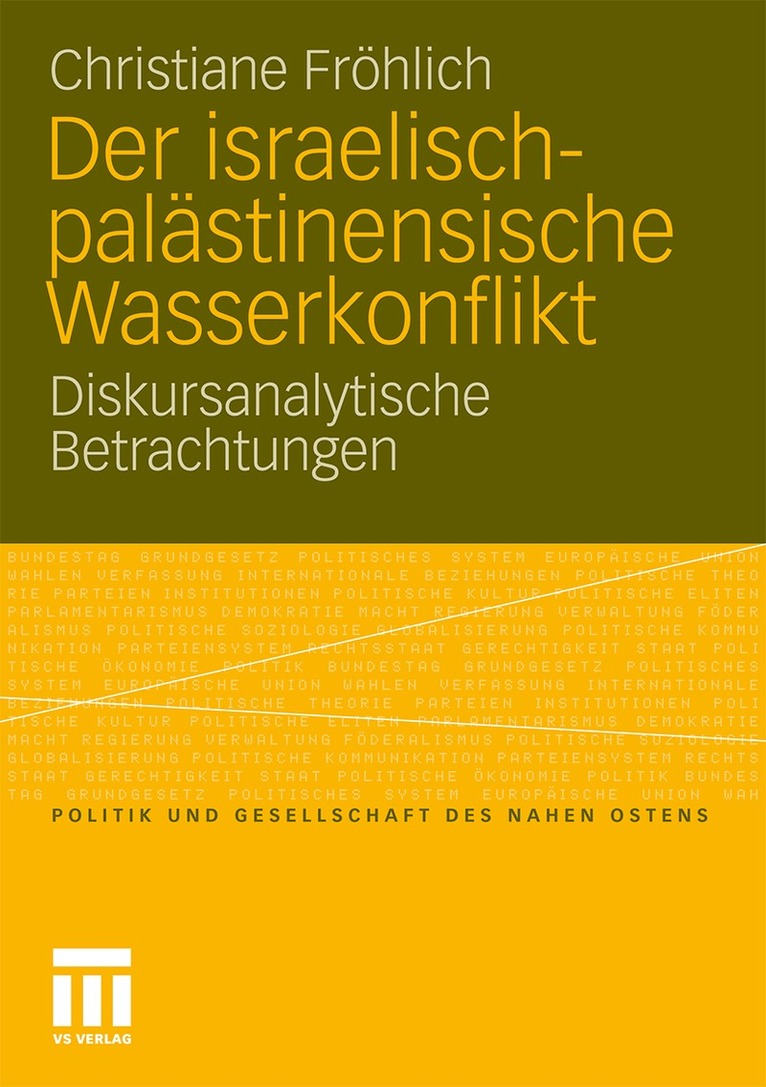
In der Forschung zum israelisch-palästinensischen Konflikt verschwindet das fluide Wasserthema hinter den großen geopolitischen Themen wie Sicherheit, Grenzen und Jerusalem. In einer detaillierten Betrachtung weist dieser Band dem Gegenstand „Wasser“ seinen rechtmäßig zentralen Platz bei der Analyse des Konfliktes zu. Statt wie üblich Konflikt oder Kooperation um Wasser zu diskutieren, bringt die Autorin Sozial- und Naturwissenschaften miteinander in Dialog und überprüft diskursanalytisch die Bedeutung von Wasser für den Konfliktverlauf. Darauf aufbauend arbeitet sie Ansatzpunkte für den Dialog zwischen Israel und Palästina über das knappe und lebenswichtige Gut heraus.