Christine Franzen – författare
Visar alla böcker från författaren Christine Franzen. Handla med fri frakt och snabb leverans.
9 produkter
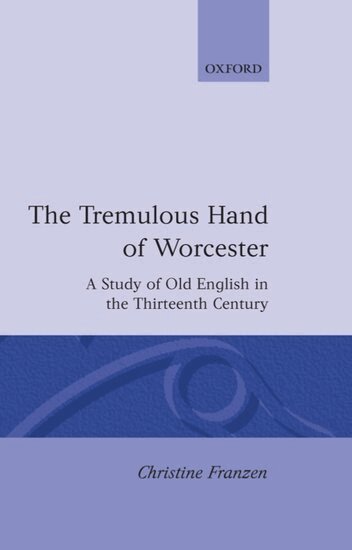
The Tremulous Hand of Worcester
A Study of Old English in the Thirteenth Century
Inbunden, 1991
4022 kr
Lägg i varukorg
The shaky handwriting of the thirteenth-century scribe known as `the tremulous hand of Worcester' appears in at least twenty manuscripts dating from the late ninth to the twelfth century, glossing perhaps 50,000 Old English words, sometimes into Middle English, but much more often into Latin. This …
Ashgate Critical Essays on Early English Lexicographers
Volume 1: Old English
Inbunden, 2012
7800 kr
Lägg i varukorg
Anglo-Saxon lexicography studies Latin texts and words. The earliest English lexicographers are largely unidentifiable students, teachers, scholars and missionaries. Materials brought from abroad by early teachers were augmented by their teachings and passed on by their students. Lexicographical …
Ashgate Critical Essays on Early English Lexicographers
Volume 1: Old English
Häftad, 2024
627 kr
Lägg i varukorg
Anglo-Saxon lexicography studies Latin texts and words. The earliest English lexicographers are largely unidentifiable students, teachers, scholars and missionaries. Materials brought from abroad by early teachers were augmented by their teachings and passed on by their students. Lexicographical …
Ashgate Critical Essays on Early English Lexicographers
Volume 2: Middle English
Häftad, 2024
627 kr
Lägg i varukorg
The teaching of Latin remained important after the Conquest but Anglo-Norman now became a language of instruction and, from the thirteenth century onwards, a language to be learned. During this period English lexicographers were more numerous, more identifiable and their works more varied, for …
Ashgate Critical Essays on Early English Lexicographers
Volume 2: Middle English
E-bok, 2017
660 kr
Lägg i varukorg
The teaching of Latin remained important after the Conquest but Anglo-Norman now became a language of instruction and, from the thirteenth century onwards, a language to be learned. During this period English lexicographers were more numerous, more identifiable and their works more varied, for …
Ashgate Critical Essays on Early English Lexicographers
Volume 2: Middle English
E-bok, 2017
646 kr
Lägg i varukorg
The teaching of Latin remained important after the Conquest but Anglo-Norman now became a language of instruction and, from the thirteenth century onwards, a language to be learned. During this period English lexicographers were more numerous, more identifiable and their works more varied, for …
Ashgate Critical Essays on Early English Lexicographers
Volume 1: Old English
E-bok, 2017
660 kr
Lägg i varukorg
Anglo-Saxon lexicography studies Latin texts and words. The earliest English lexicographers are largely unidentifiable students, teachers, scholars and missionaries. Materials brought from abroad by early teachers were augmented by their teachings and passed on by their students. Lexicographical …
Ashgate Critical Essays on Early English Lexicographers
Volume 1: Old English
E-bok, 2017
660 kr
Lägg i varukorg
Anglo-Saxon lexicography studies Latin texts and words. The earliest English lexicographers are largely unidentifiable students, teachers, scholars and missionaries. Materials brought from abroad by early teachers were augmented by their teachings and passed on by their students. Lexicographical …
Ashgate Critical Essays on Early English Lexicographers
Volume 2: Middle English
Inbunden, 2012
7800 kr
Lägg i varukorg
The teaching of Latin remained important after the Conquest but Anglo-Norman now became a language of instruction and, from the thirteenth century onwards, a language to be learned. During this period English lexicographers were more numerous, more identifiable and their works more varied, for …