Christine L. Borgman – författare
341 kr
Läs direkt efter köp
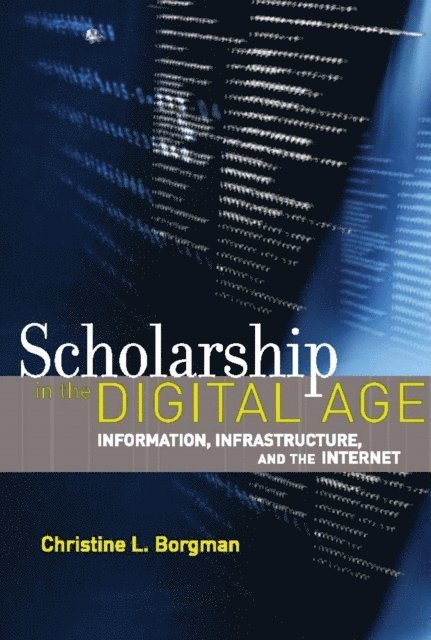
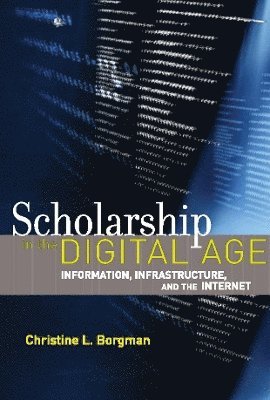
An exploration of the technical, social, legal, and economic aspects of the scholarly infrastructure needed to support research activities in all fields in the twenty-first century.
Scholars in all fields now have access to an unprecedented wealth of online information, tools, and services. The Internet lies at the core of an information infrastructure for distributed, data-intensive, and collaborative research. Although much attention has been paid to the new technologies making this possible, from digitized books to sensor networks, it is the underlying social and policy changes that will have the most lasting effect on the scholarly enterprise. In Scholarship in the Digital Age, Christine Borgman explores the technical, social, legal, and economic aspects of the kind of infrastructure that we should be building for scholarly research in the twenty-first century.
Borgman describes the roles that information technology plays at every stage in the life cycle of a research project and contrasts these new capabilities with the relatively stable system of scholarly communication, which remains based on publishing in journals, books, and conference proceedings. No framework for the impending “data deluge” exists comparable to that for publishing. Analyzing scholarly practices in the sciences, social sciences, and humanities, Borgman compares each discipline''s approach to infrastructure issues. In the process, she challenges the many stakeholders in the scholarly infrastructure—scholars, publishers, libraries, funding agencies, and others—to look beyond their own domains to address the interaction of technical, legal, economic, social, political, and disciplinary concerns. Scholarship in the Digital Age will provoke a stimulating conversation among all who depend on a rich and robust scholarly environment.
346 kr
Läs direkt efter köp
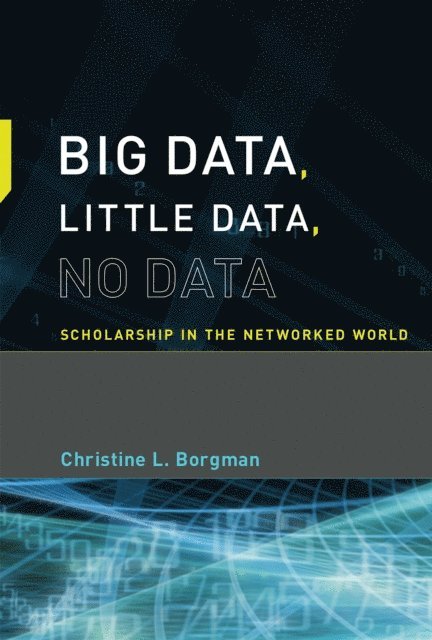
An examination of the uses of data within a changing knowledge infrastructure, offering analysis and case studies from the sciences, social sciences, and humanities.
“Big Data” is on the covers of Science, Nature, the Economist, and Wired magazines, on the front pages of the Wall Street Journal and the New York Times. But despite the media hyperbole, as Christine Borgman points out in this examination of data and scholarly research, having the right data is usually better than having more data; little data can be just as valuable as big data. In many cases, there are no data—because relevant data don''t exist, cannot be found, or are not available. Moreover, data sharing is difficult, incentives to do so are minimal, and data practices vary widely across disciplines.
Borgman, an often-cited authority on scholarly communication, argues that data have no value or meaning in isolation; they exist within a knowledge infrastructure—an ecology of people, practices, technologies, institutions, material objects, and relationships. After laying out the premises of her investigation—six “provocations” meant to inspire discussion about the uses of data in scholarship—Borgman offers case studies of data practices in the sciences, the social sciences, and the humanities, and then considers the implications of her findings for scholarly practice and research policy. To manage and exploit data over the long term, Borgman argues, requires massive investment in knowledge infrastructures; at stake is the future of scholarship.
640 kr
Läs direkt efter köp
640 kr
Läs direkt efter köp
88 kr
Tillfälligt slut
240 kr
Tillfälligt slut
80 kr
Tillfälligt slut
259 kr
Tillfälligt slut