Christine Monikowski – författare
Visar alla böcker från författaren Christine Monikowski. Handla med fri frakt och snabb leverans.
4 produkter
4 produkter
E-bok
Engelska, 2005865 kr
Läs direkt efter köp
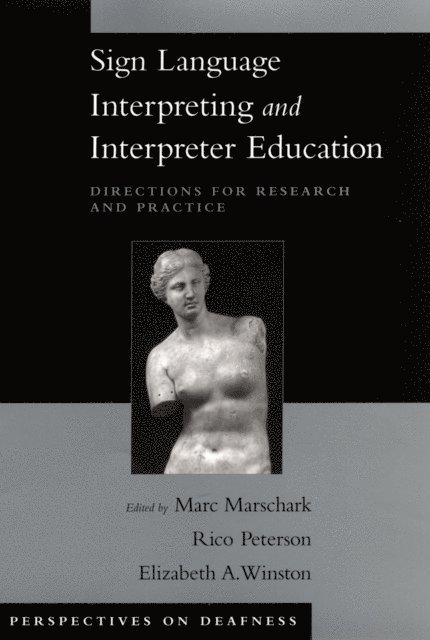
More the 1.46 million people in the United States have hearing losses in sufficient severity to be considered deaf; another 21 million people have other hearing impairments. For many deaf and hard-of-hearing individuals, sign language and voice interpreting is essential to their participation in educational programs and their access to public and private services. However, there is less than half the number of interpreters needed to meet the demand, interpreting quality is often variable, and there is a considerable lack of knowledge of factors that contribute to successful interpreting. Perhaps it is not surprising, then, that a study by the National Association of the Deaf (NAD) found that 70% of the deaf individuals are dissatisfied with interpreting quality. Because recent legislation in the United States and elsewhere has mandated access to educational, employment, and other contexts for deaf individuals and others with hearing disabilities, there is an increasing need for quality sign language interpreting. It is in education, however, that the need is most pressing, particularly because more than 75% of deaf students now attend regular schools (rather than schools for the deaf), where teachers and classmates are unable to sign for themselves. In the more than 100 interpreter training programs in the U.S. alone, there are a variety of educational models, but little empirical information on how to evaluate them or determine their appropriateness in different interpreting and interpreter education-covering what we know, what we do not know, and what we should know. Several volumes have covered interpreting and interpreter education, there are even some published dissertations that have included a single research study, and a few books have attempted to offer methods for professional interpreters or interpreter educators with nods to existing research. This is the first volume that synthesizes existing work and provides a coherent picture of the field as a whole, including evaluation of the extent to which current practices are supported by validating research. It will be the first comprehensive source, suitable as both a reference book and a textbook for interpreter training programs and a variety of courses on bilingual education, psycholinguistics and translation, and cross-linguistic studies.
E-bok
PDF, Engelska, 2005865 kr
Läs direkt efter köp
More the 1.46 million people in the United States have hearing losses in sufficient severity to be considered deaf; another 21 million people have other hearing impairments. For many deaf and hard-of-hearing individuals, sign language and voice interpreting is essential to their participation in educational programs and their access to public and private services. However, there is less than half the number of interpreters needed to meet the demand, interpreting quality is often variable, and there is a considerable lack of knowledge of factors that contribute to successful interpreting. Perhaps it is not surprising, then, that a study by the National Association of the Deaf (NAD) found that 70% of the deaf individuals are dissatisfied with interpreting quality. Because recent legislation in the United States and elsewhere has mandated access to educational, employment, and other contexts for deaf individuals and others with hearing disabilities, there is an increasing need for quality sign language interpreting. It is in education, however, that the need is most pressing, particularly because more than 75% of deaf students now attend regular schools (rather than schools for the deaf), where teachers and classmates are unable to sign for themselves. In the more than 100 interpreter training programs in the U.S. alone, there are a variety of educational models, but little empirical information on how to evaluate them or determine their appropriateness in different interpreting and interpreter education-covering what we know, what we do not know, and what we should know. Several volumes have covered interpreting and interpreter education, there are even some published dissertations that have included a single research study, and a few books have attempted to offer methods for professional interpreters or interpreter educators with nods to existing research. This is the first volume that synthesizes existing work and provides a coherent picture of the field as a whole, including evaluation of the extent to which current practices are supported by validating research. It will be the first comprehensive source, suitable as both a reference book and a textbook for interpreter training programs and a variety of courses on bilingual education, psycholinguistics and translation, and cross-linguistic studies.
Del 7 - Interpreter Education
Evolving Paradigms in Interpreter Education
Inbunden, Engelska, 2013
571 kr
Skickas inom 5-8 vardagar
Evolving Paradigms in Interpreter Education brings together a cadre of world-renowned educators and researchers who conduct a rich exploration of paradigms, both old and new, in interpreter education. They review existing research, explicate past and current practices, and call for a fresh examination of the roots of interpreter education. Expert commentary accompanies each chapter to provide a starting point for reflection on and discussion of the growing needs in this discipline.
Del 9 - Interpreter Education
Conversations with Interpreter Educators – Exploring Best Practices
Inbunden, Engelska, 2017
520 kr
Skickas inom 5-8 vardagar
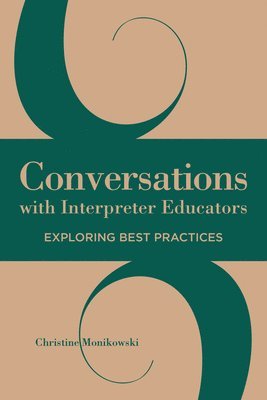
Sign language interpreter education is a relatively young field that is moving toward more theory-based and research-oriented approaches. The concept of sharing research, which is strongly encouraged in this academic community, inspired Christine Monikowski to develop a volume that collects and distills the best teaching practices of leading academics in the interpreting field. In Conversations with Interpreter Educators, Monikowski assembles a group of 17 professors in the field of sign language interpretation. Through individual interviews conducted via Skype, Monikowski engages them in informal conversations about their teaching experiences and the professional publications that have influenced their teaching philosophies. She guides each conversation by asking these experts to share a scholarly publication that they assign to their students. They discuss the merits of the text and its role in the classroom, which serves to highlight the varying goals each professor sets for students. The complexity of the interpreting task, self-reflection, critical thinking, linguistics, backchannel feedback, and cultural understanding are a sampling of topics explored in these exchanges.Engaging and accessible, Monikowski's conversations offer evidence-based practices that will inform and inspire her fellow educators.