Christine Sypnowich – författare
1 424 kr
Läs direkt efter köp
1 651 kr
Skickas inom 5-8 vardagar
1 741 kr
Skickas inom 5-8 vardagar
700 kr
Skickas inom 10-15 vardagar
643 kr
Skickas inom 10-15 vardagar
757 kr
Läs direkt efter köp
In making the argument for the remedy of inequality, contemporary political philosophers often emphasize the arbitrariness of disadvantage, stressing how one’s lot in life is to a significant extent determined by the circumstances of one’s birth, that is, in which family, and in what part of the world. In the latter instance, people differ in how well they live in a large part because of their context in the global order. But equally important for a person’s chances in life is the family that raises her (if the person is lucky enough to have a family in the first place). In Family Values: the Ethics of Parent-Child Relationships, Harry Brighouse and Adam Swift provide a systematic analysis of the morality and politics of the family, exploring why families are valuable, whether people have a right to parent, what rights and duties parents have, and, in particular, what rights children have that may constrain the rights of their parents. The essays in this volume assess Brighouse and Swift’s contribution, taking up a number of controversial issues about autonomy, human flourishing, parental rights, and indeed the nature of childhood itself. Contributors offer a range of arguments, some challenging, others complementing, of Brighouse and Swift’s account of the ethics of parent-child relationships.
The chapters in this book were originally published in a special issue in the Critical Review of International Social and Political Philosophy.
757 kr
Läs direkt efter köp
In making the argument for the remedy of inequality, contemporary political philosophers often emphasize the arbitrariness of disadvantage, stressing how one’s lot in life is to a significant extent determined by the circumstances of one’s birth, that is, in which family, and in what part of the world. In the latter instance, people differ in how well they live in a large part because of their context in the global order. But equally important for a person’s chances in life is the family that raises her (if the person is lucky enough to have a family in the first place). In Family Values: the Ethics of Parent-Child Relationships, Harry Brighouse and Adam Swift provide a systematic analysis of the morality and politics of the family, exploring why families are valuable, whether people have a right to parent, what rights and duties parents have, and, in particular, what rights children have that may constrain the rights of their parents. The essays in this volume assess Brighouse and Swift’s contribution, taking up a number of controversial issues about autonomy, human flourishing, parental rights, and indeed the nature of childhood itself. Contributors offer a range of arguments, some challenging, others complementing, of Brighouse and Swift’s account of the ethics of parent-child relationships.
The chapters in this book were originally published in a special issue in the Critical Review of International Social and Political Philosophy.
2 921 kr
Skickas inom 3-6 vardagar
The internationally renowned contributors examine the senses in which we are `social selves' whose very identities are intimately bound up with the communities and cultures in which we live. Drawing on Wittgenstein, Marx, Foucault, Bakhtin, Gilligan and MacIntyre, among others, the chapters show the diversity of influences that have shaped this exciting and controversial issue.
2 269 kr
Skickas inom 10-15 vardagar
2 198 kr
Skickas inom 10-15 vardagar
824 kr
Läs direkt efter köp
How should we approach the daunting task of renewing the ideal of equality?
In this book, Christine Sypnowich proposes a theory of equality centred on human flourishing or wellbeing. She argues that egalitarianism should be understood as seeking to make people more equal in the constituents of a good life. Inequality is a social ill because of the damage it does to human flourishing: unequal distribution of wealth can have the effect that some people are poorly housed, badly nourished, ill-educated, unhappy or uncultured, among other things. When we seek to make people more equal our concern is not just resources or property, but how people fare under one distribution or another. Ultimately, the best answer to the question, ‘equality of what?,’ is some conception of flourishing, since whatever policies or principles we adopt, it is flourishing that we hope will be more equal as a result of our endeavours.
Sypnowich calls for both retrieval and innovation. What is to be retrieved is the ideal of equality itself, which is often assumed as a background condition of theories of justice, yet at the same time, dismissed as too homogenising, abstract and rigid a criterion for political argument. We must retrieve the ideal of equality as a central political principle. In doing so, she casts doubt on the value of focussing on cultural difference, and rejects the idea of neutrality that dominates contemporary political philosophy in favour of a view of the state as enabling the betterment of its citizens.
824 kr
Läs direkt efter köp
How should we approach the daunting task of renewing the ideal of equality?
In this book, Christine Sypnowich proposes a theory of equality centred on human flourishing or wellbeing. She argues that egalitarianism should be understood as seeking to make people more equal in the constituents of a good life. Inequality is a social ill because of the damage it does to human flourishing: unequal distribution of wealth can have the effect that some people are poorly housed, badly nourished, ill-educated, unhappy or uncultured, among other things. When we seek to make people more equal our concern is not just resources or property, but how people fare under one distribution or another. Ultimately, the best answer to the question, ‘equality of what?,’ is some conception of flourishing, since whatever policies or principles we adopt, it is flourishing that we hope will be more equal as a result of our endeavours.
Sypnowich calls for both retrieval and innovation. What is to be retrieved is the ideal of equality itself, which is often assumed as a background condition of theories of justice, yet at the same time, dismissed as too homogenising, abstract and rigid a criterion for political argument. We must retrieve the ideal of equality as a central political principle. In doing so, she casts doubt on the value of focussing on cultural difference, and rejects the idea of neutrality that dominates contemporary political philosophy in favour of a view of the state as enabling the betterment of its citizens.
725 kr
Skickas inom 5-8 vardagar
254 kr
Skickas inom 5-8 vardagar
816 kr
Läs direkt efter köp
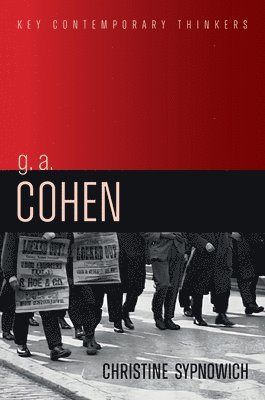
G. A. Cohen was one of the towering political philosophers of the late twentieth and early twenty-first centuries. His intellectual career was unusually wide-ranging, and he was celebrated internationally not only for his penetrating ideas about liberty, justice and equality, but also for his method, a highly original and influential combination of analytical philosophy and Marxism.
Christine Sypnowich guides readers through the rich body of Cohen’s work. By identifying five paradoxes in his thought, she explores the origins of his interest in analytical philosophy, his engagement with the ideas of right-wing libertarianism, his critique of John Rawls’s work, his late-career turn to conservatism, and the tension between his preoccupation with individual responsibility and the idea of a socialist ethos. Sypnowich acknowledges the strengths of Cohen’s positions as well as their tensions and flaws, and presents him as a thinker of startling insight.
This compelling introduction is a go-to resource for students and scholars of modern political philosophy.
267 kr
Läs direkt efter köp
G. A. Cohen was one of the towering political philosophers of the late twentieth and early twenty-first centuries. His intellectual career was unusually wide-ranging, and he was celebrated internationally not only for his penetrating ideas about liberty, justice and equality, but also for his method, a highly original and influential combination of analytical philosophy and Marxism.
Christine Sypnowich guides readers through the rich body of Cohen’s work. By identifying five paradoxes in his thought, she explores the origins of his interest in analytical philosophy, his engagement with the ideas of right-wing libertarianism, his critique of John Rawls’s work, his late-career turn to conservatism, and the tension between his preoccupation with individual responsibility and the idea of a socialist ethos. Sypnowich acknowledges the strengths of Cohen’s positions as well as their tensions and flaws, and presents him as a thinker of startling insight.
This compelling introduction is a go-to resource for students and scholars of modern political philosophy.
245 kr
Läs direkt efter köp
Equal opportunity is a widely shared ideal. As Joe Biden put it in his first executive order as president, “equal opportunity is the bedrock of American democracy.”But is equal opportunity enough? Does it truly capture the meaning of equality? In a neoliberal age that prizes personal responsibility and individual merit, the ideal has been increasingly called into question. Taking equality seriously, critics argue, means aiming to ensure that we all live equally flourishing lives—not merely that we have equal shots at upward mobility. That means rethinking a range of social institutions, from education and land ownership to finance and neighborhood development. Featuring work by philosophers and economists, historians and sociologists, this issue explores the importance of outcomes, not just opportunities.
200 kr
Tillfälligt slut