Christoph Hartnig - Böcker
Visar alla böcker från författaren Christoph Hartnig. Handla med fri frakt och snabb leverans.
3 produkter
3 produkter
3 788 kr
Skickas inom 5-8 vardagar
This two volume set reviews the fundamentals, performance, and in situ characterization of PEMFCs and DMFCs. Volume 1 covers the fundamental science and engineering of these low temperature fuel cells, focusing on understanding and improving performance and operation. Part one reviews systems fundamentals, ranging from fuels and fuel processing, to the development of membrane and catalyst materials and technology, and gas diffusion media and flowfields, as well as life cycle aspects and modelling approaches. Part two details performance issues relevant to fuel cell operation and durability, such as catalyst ageing, materials degradation and durability testing, and goes on to review advanced transport simulation approaches, degradation modelling and experimental monitoring techniques.Volume 2 details in situ characterization, including experimental and innovative techniques, used to understand fuel cell operational issues and materials performance. Part I reviews enhanced techniques for characterization of catalyst activities and processes, such as X-ray absorption and scattering, advanced microscopy and electrochemical mass spectrometry. Part II reviews characterization techniques for water and fuel management, including neutron radiography and tomography, magnetic resonance imaging and Raman spectroscopy. Finally, Part III focuses on locally resolved characterization methods, from transient techniques and electrochemical microscopy, to laser-optical methods and synchrotron radiography.
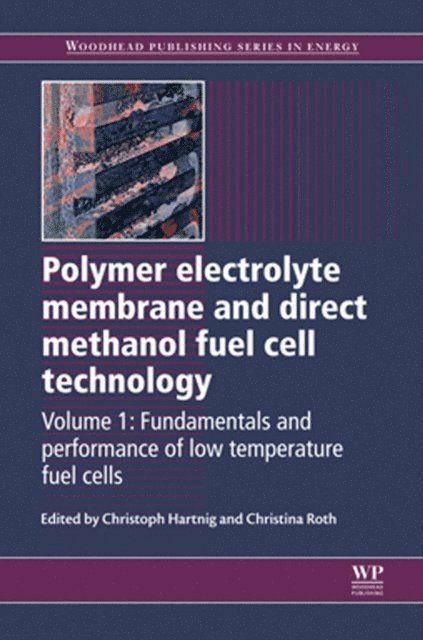
Polymer Electrolyte Membrane and Direct Methanol Fuel Cell Technology
Volume 1: Fundamentals and Performance of Low Temperature Fuel Cells
Inbunden, Engelska, 2012
2 288 kr
Skickas inom 7-10 vardagar
Polymer electrolyte membrane fuel cells (PEMFCs) and direct methanol fuel cells (DMFCs) technology are promising forms of low-temperature electrochemical power conversion technologies that operate on hydrogen and methanol respectively. Featuring high electrical efficiency and low operational emissions, they have attracted intense worldwide commercialization research and development efforts. These R&D efforts include a major drive towards improving materials performance, fuel cell operation and durability. In situ characterization is essential to improving performance and extending operational lifetime through providing information necessary to understand how fuel cell materials perform under operational loads.This two volume set reviews the fundamentals, performance, and in situ characterization of PEMFCs and DMFCs. Volume 1 covers the fundamental science and engineering of these low temperature fuel cells, focusing on understanding and improving performance and operation. Part one reviews systems fundamentals, ranging from fuels and fuel processing, to the development of membrane and catalyst materials and technology, and gas diffusion media and flowfields, as well as life cycle aspects and modelling approaches. Part two details performance issues relevant to fuel cell operation and durability, such as catalyst ageing, materials degradation and durability testing, and goes on to review advanced transport simulation approaches, degradation modelling and experimental monitoring techniques.With its international team of expert contributors, Polymer electrolyte membrane and direct methanol fuel cell technology Volumes 1 & 2 is an invaluable reference for low temperature fuel cell designers and manufacturers, as well as materials science and electrochemistry researchers and academics.Covers the fundamental science and engineering of polymer electrolyte membrane fuel cells (PEMFCs) and direct methanol fuel cells (DMFCs), focusing on understanding and improving performance and operationReviews systems fundamentals, ranging from fuels and fuel processing, to the development of membrane and catalyst materials and technology, and gas diffusion media and flowfields, as well as life cycle aspects and modelling approachesDetails performance issues relevant to fuel cell operation and durability, such as catalyst ageing, materials degradation and durability testing, and reviews advanced transport simulation approaches, degradation modelling and experimental monitoring techniques
Polymer Electrolyte Membrane and Direct Methanol Fuel Cell Technology
Volume 2: In Situ Characterization Techniques for Low Temperature Fuel Cells
Inbunden, Engelska, 2012
2 203 kr
Skickas inom 7-10 vardagar
Polymer electrolyte membrane fuel cells (PEMFCs) and direct methanol fuel cells (DMFCs) technology are promising forms of low-temperature electrochemical power conversion technologies that operate on hydrogen and methanol respectively. Featuring high electrical efficiency and low operational emissions, they have attracted intense worldwide commercialization research and development efforts. These R&D efforts include a major drive towards improving materials performance, fuel cell operation and durability. In situ characterization is essential to improving performance and extending operational lifetime through providing information necessary to understand how fuel cell materials perform under operational loads.Polymer Electrolyte Membrane and Direct Methanol Fuel Cell Technology, Volume 2 details in situ characterization, including experimental and innovative techniques, used to understand fuel cell operational issues and materials performance. Part I reviews enhanced techniques for characterization of catalyst activities and processes, such as X-ray absorption and scattering, advanced microscopy and electrochemical mass spectrometry. Part II reviews characterization techniques for water and fuel management, including neutron radiography and tomography, magnetic resonance imaging and Raman spectroscopy. Finally, Part III focuses on locally resolved characterization methods, from transient techniques and electrochemical microscopy, to laser-optical methods and synchrotron radiography.With its international team of expert contributors, Polymer electrolyte membrane and direct methanol fuel cell technology will be an invaluable reference for low temperature fuel cell designers and manufacturers, as well as materials science and electrochemistry researchers and academics. Polymer electrolyte membrane and direct methanol fuel cell technology is an invaluable reference for low temperature fuel cell designers and manufacturers, as well as materials science and electrochemistry researchers and academics.Details in situ characterisation of polymer electrolyte membrane fuel cells (PEMFCs) and direct methanol fuel cells (DMFCs), including the experimental and innovative techniques used to understand fuel cell operational issues and materials performanceExamines enhanced techniques for characterisation of catalyst activities and processes, such as X-ray absorption and scattering, advanced microscopy and electrochemical mass spectrometryReviews characterisation techniques for water and fuel management, including neutron radiography and tomography, and comprehensively covers locally resolved characterisation methods, from transient techniques to laser-optical methods