Christoph Rohde – författare
Visar alla böcker från författaren Christoph Rohde. Handla med fri frakt och snabb leverans.
6 produkter
Hans J. Morgenthau und der weltpolitische Realismus
Häftad, 2004
721 kr
Lägg i varukorg
Hans J. Morgenthau wird in den USA zu den großen Intellektuellen des Landes gezählt. Um so erstaunlicher ist die Tatsache, dass sein umfassendes Werk in Deutschland in nur fragmentarischer Weise rezipiert wurde. Der 1904 in Coburg geborene Jude konzipierte die erste als solche anerkannte …
Religion and the Liberal State in Niebuhr's Christian Realism
Häftad, 2021
934 kr
Lägg i varukorg
This book intends to analyze Reinhold Niebuhr's understanding of the state in his Christian Realism. Although his overall notion was thoroughly analyzed in different disciplines and respects, this specific focus can be diagnosed as a lacuna. The task of this book is to develop a hypothesis in terms …
Religion and the Liberal State in Niebuhr's Christian Realism
E-bok, 2021
1214 kr
Lägg i varukorg
This book intends to analyze Reinhold Niebuhr''s understanding of the state in his Christian Realism. Although his overall notion was thoroughly analyzed in different disciplines and respects, this specific focus can be diagnosed as a lacuna. The task of this book is to develop a hypothesis in …
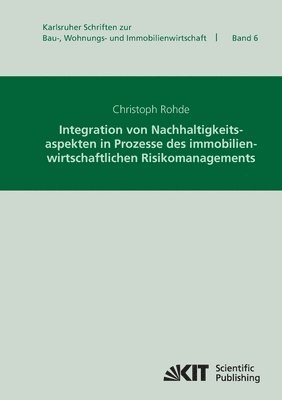
Integration von Nachhaltigkeitsaspekten in Prozesse des immobilienwirtschaftlichen Risikomanagements
Häftad, 2014
576 kr
Lägg i varukorg