Christophe Guyeux – författare
Visar alla böcker från författaren Christophe Guyeux. Handla med fri frakt och snabb leverans.
7 produkter
Discrete Dynamical Systems and Chaotic Machines
Theory and Applications
Av Jacques Bahi, Christophe Guyeux
Häftad, 2019
1040 kr
Lägg i varukorg
For computer scientists, especially those in the security field, the use of chaos has been limited to the computation of a small collection of famous but unsuitable maps that offer no explanation of why chaos is relevant in the considered contexts. Discrete Dynamical Systems and Chaotic Machines: …
Discrete Dynamical Systems and Chaotic Machines
Theory and Applications
Av Christophe Guyeux, Jacques Bahi
E-bok, 2013
1203 kr
Lägg i varukorg
Until the authors'' recent research, the practical implementation of the mathematical theory of chaos on finite machines raised several issues. This self-contained book shows how to make finite machines, such as computers, neural networks, and wireless sensor networks, work chaotically as defined …
Discrete Dynamical Systems and Chaotic Machines
Theory and Applications
Av Jacques Bahi, Christophe Guyeux
Inbunden, 2013
1826 kr
Lägg i varukorg
For computer scientists, especially those in the security field, the use of chaos has been limited to the computation of a small collection of famous but unsuitable maps that offer no explanation of why chaos is relevant in the considered contexts. Discrete Dynamical Systems and Chaotic Machines: …
Discrete Dynamical Systems and Chaotic Machines
Theory and Applications
Av Christophe Guyeux, Jacques Bahi
E-bok, 2013
1230 kr
Lägg i varukorg
Until the authors'' recent research, the practical implementation of the mathematical theory of chaos on finite machines raised several issues. This self-contained book shows how to make finite machines, such as computers, neural networks, and wireless sensor networks, work chaotically as defined …
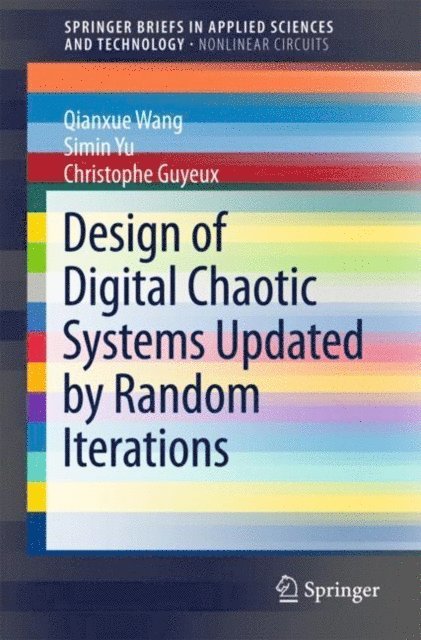
Design of Digital Chaotic Systems Updated by Random Iterations
Av Qianxue Wang, Simin Yu m. fl.
Häftad, 2018
542 kr
Lägg i varukorg
This brief studies the general problem of constructing digital chaotic systems in devices with finite precision from low-dimensional to high-dimensional settings, and establishes a general framework for composing them. The contributors demonstrate that the associated state networks of digital …
Design of Digital Chaotic Systems Updated by Random Iterations
Av Christophe Guyeux, Simin Yu m. fl.
E-bok, 2018
710 kr
Lägg i varukorg
This brief studies the general problem of constructing digital chaotic systems in devices with finite precision from low-dimensional to high-dimensional settings, and establishes a general framework for composing them. The contributors demonstrate that the associated state networks of digital …