Christopher F. Baum - Böcker
Visar alla böcker från författaren Christopher F. Baum. Handla med fri frakt och snabb leverans.
3 produkter
3 produkter
1 189 kr
Tillfälligt slut
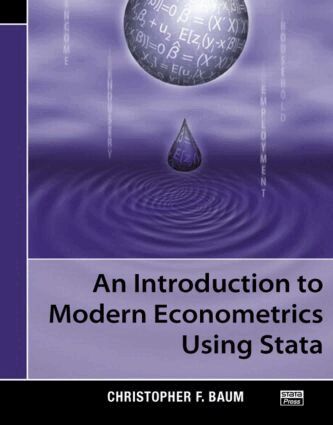
Integrating a contemporary approach to econometrics with the powerful computational tools offered by Stata, An Introduction to Modern Econometrics Using Stata focuses on the role of method-of-moments estimators, hypothesis testing, and specification analysis and provides practical examples that show how the theories are applied to real data sets using Stata.As an expert in Stata, the author successfully guides readers from the basic elements of Stata to the core econometric topics. He first describes the fundamental components needed to effectively use Stata. The book then covers the multiple linear regression model, linear and nonlinear Wald tests, constrained least-squares estimation, Lagrange multiplier tests, and hypothesis testing of nonnested models. Subsequent chapters center on the consequences of failures of the linear regression model's assumptions. The book also examines indicator variables, interaction effects, weak instruments, underidentification, and generalized method-of-moments estimation. The final chapters introduce panel-data analysis and discrete- and limited-dependent variables and the two appendices discuss how to import data into Stata and Stata programming.Presenting many of the econometric theories used in modern empirical research, this introduction illustrates how to apply these concepts using Stata. The book serves both as a supplementary text for undergraduate and graduate students and as a clear guide for economists and financial analysts.
1 032 kr
Skickas inom 7-10 vardagar
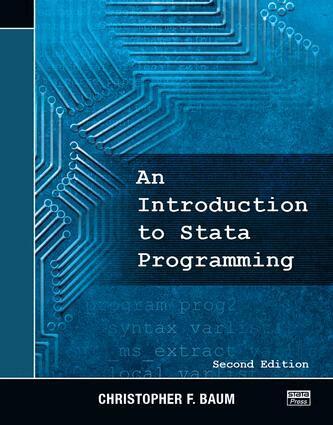
In this second edition of An Introduction to Stata Programming, the author introduces concepts by providing the background and importance for the topic, presents common uses and examples, then concludes with larger, more applied examples referred to as "cookbook recipes." This is a great reference for anyone who wants to learn Stata programming. For those learning, the author assumes familiarity with Stata and gradually introduces more advanced programming tools. For the more advanced Stata programmer, the book introduces Stata’s Mata programming language and optimization routines.
904 kr
Skickas
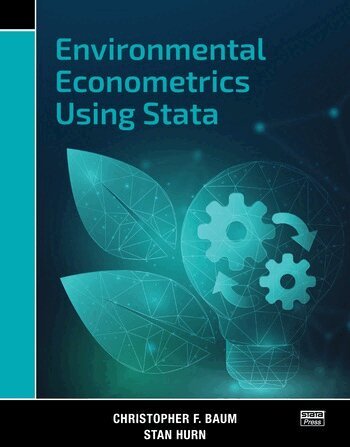
Aspects of environmental change are some of the greatest challenges faced by policymakers today. The key issues addressed by environmental science are often empirical, and in many instances very detailed, sizable datasets are available. Researchers in this field should have a solid understanding of the econometric tools best suited for analysis of these data. While complex and expensive physical models of the environment exist, it is becoming increasingly clear that reduced-form econometric models have an important role to play in modeling environmental phenomena. In short, successful environmental modeling does not necessarily require a structural model, but the econometric methods underlying a reduced-form approach must be competently executed. Environmental Econometrics Using Stata provides an important starting point for this journey by presenting a broad range of applied econometric techniques for environmental econometrics and illustrating how they can be applied in Stata. The emphasis is not only on how to formulate and fit models in Stata but also on the need to use a wide range of diagnostic tests in order to validate the results of estimation and subsequent policy conclusions. This focus on careful, reproducible research should be appreciated by academic and non-academic researchers who are seeking to produce credible, defensible conclusions about key issues in environmental science.