Christopher Heady - Böcker
Visar alla böcker från författaren Christopher Heady. Handla med fri frakt och snabb leverans.
3 produkter
3 produkter
4 513 kr
Skickas inom 7-10 vardagar
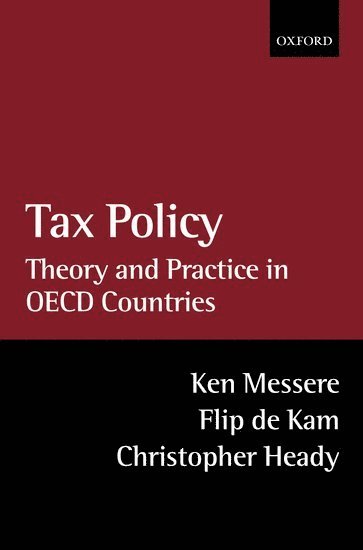
How do governments justify their choice of tax policy? What are the arguments for and against the choices they make? Are there common trends in the tax policy choices of OECD countries? This book provides a unique guide to tax policies pursued by the governments of OECD countries by assessing recent policies, offering a thorough critique of their justification and looking at actual examples of policy choice. The authors give an overview of post-war tax developments, addressing in detail topics such as the dynamics of tax revenues and public sector developments. They go on to examine the arguments for and against governments' main tax policy choices, looking at personal income tax, social security contributions, business taxes, consumption taxation and taxes on wealth, capital gains, and property. They rigorously examine arguments used by governments to justify certain policy choices, providing an objective evaluation of both the valid and invalid arguments for the choices made with regard to domestic taxation.In addition to a thorough critique of recent tax policies, the book looks at the actual tax choices of 25 of the thirty OECD countries and aims to identify the similarities and the differences between them. The authors draw on these real examples and on their considerable experience in assessing possibilities for future tax systems. The book will be of special interest to academics and students in the field of public finance, national and international tax policymakers, politicians, and journalists.
1 629 kr
Skickas inom 7-10 vardagar
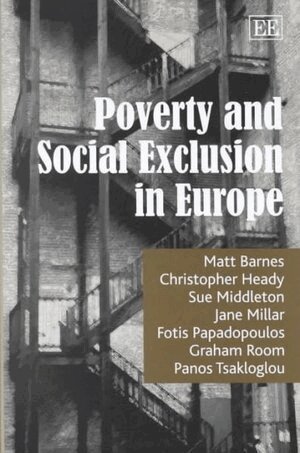
There are estimated to be almost 60 million people living in poverty throughout the European Union. This bleak statistic underlines the value of this important book which explores the nature and extent of poverty and social exclusion in six European countries, namely: Austria, Germany, Greece, Norway, Portugal and the UK. The book focuses on four 'life course' groups who might be considered particularly at risk: young adults, lone parents, the sick and disabled, and the retired.The authors show how poverty is the outcome of the interaction between several factors including education, gender and family structure. They emphasise the importance of distinguishing between poverty and non-monetary measures of deprivation and isolation. Although the poor are more at risk of suffering from deprivation, the authors demonstrate that this relationship is more tenuous than many people suppose. Employing rigorous theoretical and methodological analyses they go on to relate their findings to the policy environment in each of the countries, which were specifically chosen to reflect differing welfare systems. In this way the authors compare the impact of government policy on both the level of poverty and social exclusion, and on who is most at risk of experiencing them.Both statistically and in policy terms this book will be essential reading for students and academics of economics and the social sciences, and policy makers at both the national and European level.
531 kr
Skickas inom 7-10 vardagar
There are estimated to be almost 60 million people living in poverty throughout the European Union. This bleak statistic underlines the value of this important book which explores the nature and extent of poverty and social exclusion in six European countries, namely: Austria, Germany, Greece, Norway, Portugal and the UK. The book focuses on four 'life course' groups who might be considered particularly at risk: young adults, lone parents, the sick and disabled, and the retired.The authors show how poverty is the outcome of the interaction between several factors including education, gender and family structure. They emphasise the importance of distinguishing between poverty and non-monetary measures of deprivation and isolation. Although the poor are more at risk of suffering from deprivation, the authors demonstrate that this relationship is more tenuous than many people suppose. Employing rigorous theoretical and methodological analyses they go on to relate their findings to the policy environment in each of the countries, which were specifically chosen to reflect differing welfare systems. In this way the authors compare the impact of government policy on both the level of poverty and social exclusion, and on who is most at risk of experiencing them.Both statistically and in policy terms this book will be essential reading for students and academics of economics and the social sciences, and policy makers at both the national and European level.