Christopher May - Böcker
Visar alla böcker från författaren Christopher May. Handla med fri frakt och snabb leverans.
17 produkter
17 produkter
569 kr
Skickas inom 10-15 vardagar
It has become a commonplace that there has been an information revolution, transforming both society and the economy. In 1995 the Trade Related Intellectual Property (TRIPs) agreement aimed to harmonise protection for property in knowledge throughout the global system.This book considers the contemporary disputes about the ownership of knowledge resources - as in the cases of genetically modified foods, the music industry or the internet - and the problematic nature of the TRIPs agreement. In this highly topical book, Christopher May reveals that, because of such problems, at present the balance in intellectual property rights between public good and private reward is more often than not weighted towards the latter.
2 181 kr
Skickas inom 10-15 vardagar
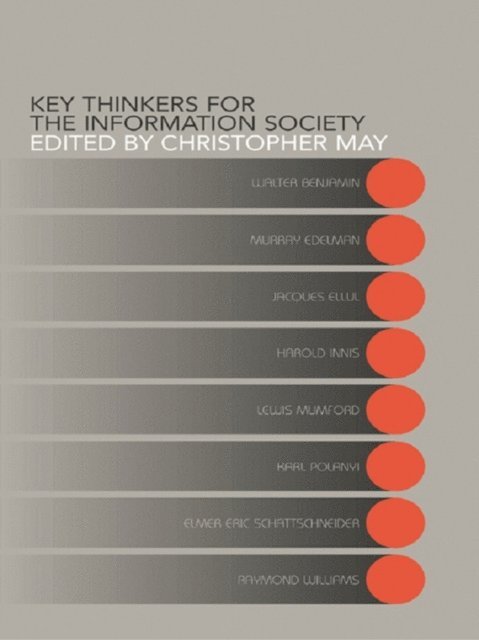
Key Thinkers for the Information Society provides an introduction to some important social theorists whose work has considerable relevance to today's 'brave new world' of information and communication technologies. With the aim of widening current perspectives on the information society, each contributor introduces a particular theorist and discusses the way in which their insights can be reintroduced into debates regarding the social, political and cultural impact of ICTs. Theorists presented in Volume 1 include some well-known and some less well-known figures: Walter Benjamin; Murray Edeleman; Jacques Ellul; Harold Innes; Lewis Mumford; Karl Polanyi; Eric Elmer Scattachneider and Raymond Williams. Each has something fresh and pertinent to say and taken as a whole this volume provides an exciting new resource for contemporary studies.
713 kr
Skickas inom 10-15 vardagar
Key Thinkers for the Information Society provides an introduction to some important social theorists whose work has considerable relevance to today's 'brave new world' of information and communication technologies. With the aim of widening current perspectives on the information society, each contributor introduces a particular theorist and discusses the way in which their insights can be reintroduced into debates regarding the social, political and cultural impact of ICTs. Theorists presented in Volume 1 include some well-known and some less well-known figures: Walter Benjamin; Murray Edeleman; Jacques Ellul; Harold Innes; Lewis Mumford; Karl Polanyi; Eric Elmer Scattachneider and Raymond Williams. Each has something fresh and pertinent to say and taken as a whole this volume provides an exciting new resource for contemporary studies.
World Intellectual Property Organization (WIPO)
Resurgence and the Development Agenda
Inbunden, Engelska, 2006
1 944 kr
Skickas inom 10-15 vardagar
Covering the World Intellectual Property Organization, this volume introduces a much ignored element of the contemporary structure of global governance to scholars of international political economy. Christopher May discusses: how the World Intellectual Property Organization works, its antecedents and history the debates about the role and justification of intellectual property the role of WIPO within contemporary global politics the key elements of its relations with the World Trade Organization the Agreement on Trade Related Aspects of Intellectual Property Rights. The analysis then examines the recent political economy of the organization and argues that far from being the neutral or technical agency that it often presents itself as, the WIPO is highly politicized and acts to socialize policy makers and civil servants into a specific view of intellectual property. However, the recent proposal to establish a Development Agenda at the WIPO is an important development, and the book concludes by examining the problems which have promoted this agenda, suggesting that these reforms of the WIPO should be welcomed. The World Intellectual Property Organization is a clear and accessible volume that will confirm the WIPO as one of the global institutions which any student of global governance must understand.
World Intellectual Property Organization (WIPO)
Resurgence and the Development Agenda
Häftad, Engelska, 2006
506 kr
Skickas inom 10-15 vardagar
Covering the World Intellectual Property Organization, this volume introduces a much ignored element of the contemporary structure of global governance to scholars of international political economy. Christopher May discusses: how the World Intellectual Property Organization works, its antecedents and history the debates about the role and justification of intellectual property the role of WIPO within contemporary global politics the key elements of its relations with the World Trade Organization the Agreement on Trade Related Aspects of Intellectual Property Rights. The analysis then examines the recent political economy of the organization and argues that far from being the neutral or technical agency that it often presents itself as, the WIPO is highly politicized and acts to socialize policy makers and civil servants into a specific view of intellectual property. However, the recent proposal to establish a Development Agenda at the WIPO is an important development, and the book concludes by examining the problems which have promoted this agenda, suggesting that these reforms of the WIPO should be welcomed. The World Intellectual Property Organization is a clear and accessible volume that will confirm the WIPO as one of the global institutions which any student of global governance must understand.
Global Political Economy of Intellectual Property Rights, 2nd ed
The New Enclosures
Inbunden, Engelska, 2009
1 944 kr
Skickas inom 10-15 vardagar
The first edition established itself as one of the leading books to situate the issue of intellectual property within the discipline of International Political Economy (IPE). Since its publication, intellectual property has continued to rise up the global agenda, reflecting expanding interest in the area among policy-makers and advocacy groups, linked to the increasingly fraught politics of the global governance of IPRs.Significantly revised and updated to take account of developments within the World Trade Organization and the World Intellectual Property Organization, this edition incorporates the author’s recent research on IPRs. It retains the theoretical and analytical elements of the first edition, whilst offering students and researchers a detailed analysis of how intellectual property is politically constructed, and how it is linked to the economics of knowledge and information in the contemporary global political economy. Rapidly-developing issues addressed in the work include: arguments around the implementation of the Agreement on Trade Related Aspects of IPRs (TRIPs) the WIPO Development agenda and the ‘resistance’ to socialization programmes the AIDS crisis and the pharmaceutical industry Digital Rights Management This book will be of interest to students and researchers of international political economy, international relations and intellectual property law.
Global Political Economy of Intellectual Property Rights, 2nd ed
The New Enclosures
Häftad, Engelska, 2009
644 kr
Skickas inom 10-15 vardagar
The first edition established itself as one of the leading books to situate the issue of intellectual property within the discipline of International Political Economy (IPE). Since its publication, intellectual property has continued to rise up the global agenda, reflecting expanding interest in the area among policy-makers and advocacy groups, linked to the increasingly fraught politics of the global governance of IPRs.Significantly revised and updated to take account of developments within the World Trade Organization and the World Intellectual Property Organization, this edition incorporates the author’s recent research on IPRs. It retains the theoretical and analytical elements of the first edition, whilst offering students and researchers a detailed analysis of how intellectual property is politically constructed, and how it is linked to the economics of knowledge and information in the contemporary global political economy. Rapidly-developing issues addressed in the work include: arguments around the implementation of the Agreement on Trade Related Aspects of IPRs (TRIPs) the WIPO Development agenda and the ‘resistance’ to socialization programmes the AIDS crisis and the pharmaceutical industry Digital Rights Management This book will be of interest to students and researchers of international political economy, international relations and intellectual property law.
2 176 kr
Skickas inom 10-15 vardagar
This book offers a concise and accessible overview and analysis of the place of large multinational and regional corporations in the political economy of global governance.May argues that not only do corporations have an impact on the institutions of global governance, but they must be understood as a multifaceted institution of global governance in their own right, controlling and shaping significant aspects of the global political economy. Topics include:What are global corporations?Corporations and global governanceThe legal personality of the corporationCorporations and powerCorporations and taxThe future role of corporations in a post crisis global systemHighlighting the central role of corporations in the generation and reproduction of norms in global governance, this work shows that corporations’ practices and relations are themselves both subjects, and sources of, global governance. It offers an enhanced understanding of the complex of issues that pattern the corporate global governance in the contemporary political economy and will be of interest to students in areas including IPE, global governance and international organizations.
679 kr
Skickas inom 10-15 vardagar
This book offers a concise and accessible overview and analysis of the place of large multinational and regional corporations in the political economy of global governance.May argues that not only do corporations have an impact on the institutions of global governance, but they must be understood as a multifaceted institution of global governance in their own right, controlling and shaping significant aspects of the global political economy. Topics include:What are global corporations?Corporations and global governanceThe legal personality of the corporationCorporations and powerCorporations and taxThe future role of corporations in a post crisis global systemHighlighting the central role of corporations in the generation and reproduction of norms in global governance, this work shows that corporations’ practices and relations are themselves both subjects, and sources of, global governance. It offers an enhanced understanding of the complex of issues that pattern the corporate global governance in the contemporary political economy and will be of interest to students in areas including IPE, global governance and international organizations.
1 862 kr
Skickas inom 7-10 vardagar
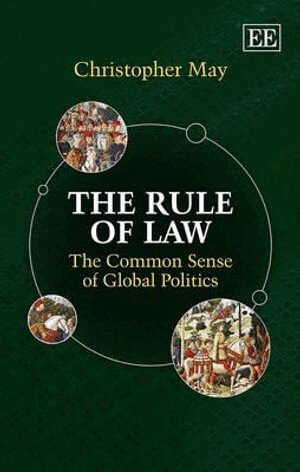
This timely book explores the complexities of the rule of law - a well-used but perhaps less well understood term - to explain why it is so often appealed to in discussions of global politics. Ranging from capacity building and the role of the World Bank to the discourse(s) of lawyers and jurisprudential critiques, it seeks to introduce non-lawyers to the important and complex political economy of the rule of law.In accessible terms, Christopher May argues that we can no longer merely use the idea of the rule of law without question but rather must appreciate its multifaceted and contested character if we are to begin to understand how and why it is now seen as a 'good thing' across the political spectrum. He expertly examines the problems encountered by rule of law programes in post-conflict and developing countries, as well as presenting the range of contested meanings of the term. The author also considers the possibility of establishing a pluralistic account of the rule of law and investigates the plausibility of an international rule of law.By building on and extending debates in socio-legal studies about the social role of law, and dealing with issues largely absent from international political economy this book will be of great interest to socio - legal scholars and political economists. It also presents an overarching analysis of the manner in which politics and law interact that will be of great value to political scientists and development economists.
437 kr
Skickas inom 7-10 vardagar
This timely book explores the complexities of the rule of law - a well-used but perhaps less well understood term - to explain why it is so often appealed to in discussions of global politics. Ranging from capacity building and the role of the World Bank to the discourse(s) of lawyers and jurisprudential critiques, it seeks to introduce non-lawyers to the important and complex political economy of the rule of law.In accessible terms, Christopher May argues that we can no longer merely use the idea of the rule of law without question but rather must appreciate its multifaceted and contested character if we are to begin to understand how and why it is now seen as a 'good thing' across the political spectrum. He expertly examines the problems encountered by rule of law programes in post-conflict and developing countries, as well as presenting the range of contested meanings of the term. The author also considers the possibility of establishing a pluralistic account of the rule of law and investigates the plausibility of an international rule of law.By building on and extending debates in socio-legal studies about the social role of law, and dealing with issues largely absent from international political economy this book will be of great interest to socio - legal scholars and political economists. It also presents an overarching analysis of the manner in which politics and law interact that will be of great value to political scientists and development economists.
3 708 kr
Skickas inom 7-10 vardagar
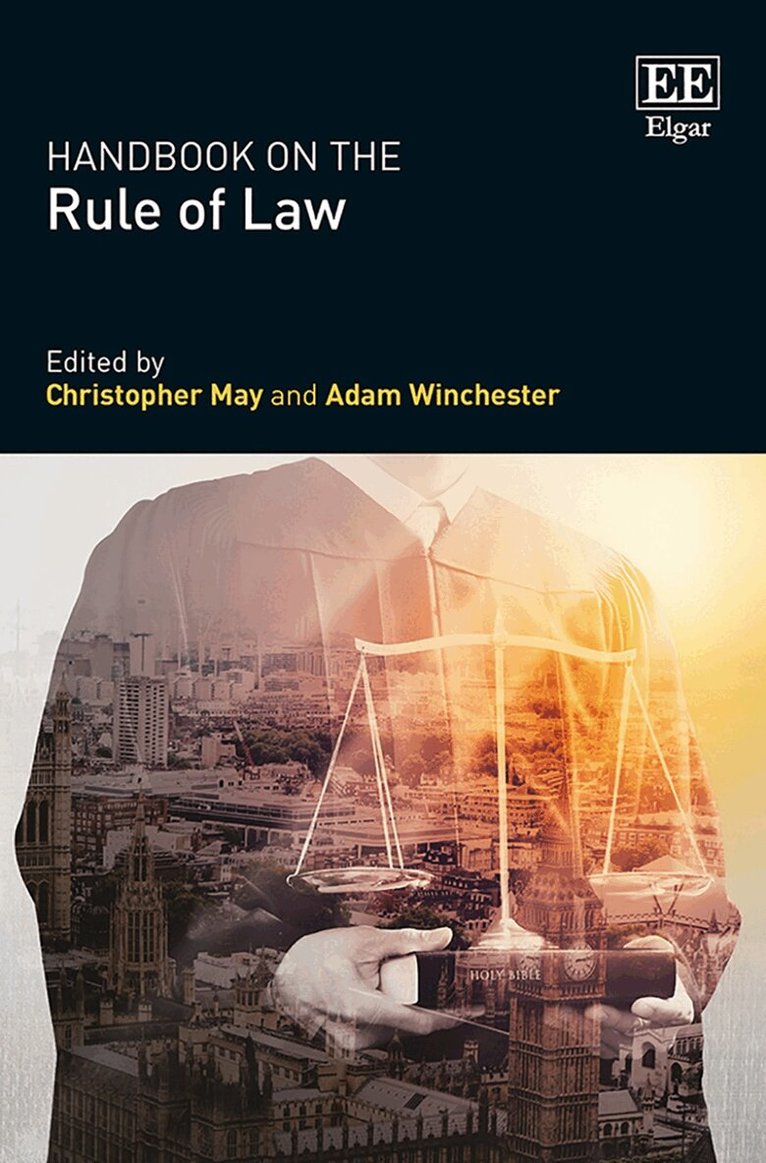
In the last half century, the rule of law has increasingly been appealed to as a common global value. The Handbook on the Rule of Law analyses the appeal of this idea, its context, and background through a range of questions about the character, history and global reach of the rule of law, offering readers a definitive understanding of this central global norm.Original contributions from leading academics explore the rule of law conceptually and historically through its associated institutions, as well as examine detailed cases evaluating how the everyday application of the rule of law impacts society as a whole. Exploring a wide range of research on the social, political and economic dimensions of the rule of law, this Handbook clearly illustrates the link between the rule of law and the global political system.This informative Handbook will be key reading for post-graduate students of international relations, global politics, and law, as well as for legal scholars wanting to build upon their knowledge with a wider account of the rule of law. Researchers in areas impacted by the rule of law will also find this volume to be stimulating reading.Contributors include: J. Allison, T. Almeida Cravo, D. Banik, A. Bedner, P. Costa, C. Cutler, D.l. Desai, C. Feinäugle, J. Flood, T. Ginsburg, J. Gutmann, S. Hinderling, D. Howath, T. Kellogg, T. Krever, M. Krygier, A. Loretoni, F. Macaulay, A. Magen, C. May, J. Møller, P. Nicholson, L. Pech, M.M. Prado, M. Rishmawi, C. Schwöbel-Patel, L.B. Tiede, V. Vadi, S. Voigt, C. Walker, A. Wiener, A. Winchester, P. Zumbansen
1 435 kr
Skickas inom 7-10 vardagar
Elgar Research Agendas outline the future of research in a given area. Leading scholars are given the space to explore their subject in provocative ways, and map out the potential directions of travel. They are relevant but also visionary.This exciting Research Agenda offers a multi-disciplinary and historically informed programme for the further investigation of the global political economy of the corporate sector. It tackles the question, can and should the corporation be reformed?Christopher May develops a range of intersecting areas for research while also offering an account of the possibilities for the reform of the global corporation. Based on an understanding of the history of corporations, the author provides key insights into their management and political agency as well as the operation of the global corporate supply chain. Drawing links between a range of disciplines and perspectives on business enterprises, May calls for a more nuanced understanding of the global corporate sector in order to better comprehend the contours of the contemporary global capitalist system.This Research Agenda will be a valuable resource for students and academics of politics, economics, sociology and law, who are curious to explore the corporation in relation to their area of study.
404 kr
Skickas inom 7-10 vardagar
Elgar Research Agendas outline the future of research in a given area. Leading scholars are given the space to explore their subject in provocative ways, and map out the potential directions of travel. They are relevant but also visionary.This exciting Research Agenda offers a multi-disciplinary and historically informed programme for the further investigation of the global political economy of the corporate sector. It tackles the question, can and should the corporation be reformed?Christopher May develops a range of intersecting areas for research while also offering an account of the possibilities for the reform of the global corporation. Based on an understanding of the history of corporations, the author provides key insights into their management and political agency as well as the operation of the global corporate supply chain. Drawing links between a range of disciplines and perspectives on business enterprises, May calls for a more nuanced understanding of the global corporate sector in order to better comprehend the contours of the contemporary global capitalist system.This Research Agenda will be a valuable resource for students and academics of politics, economics, sociology and law, who are curious to explore the corporation in relation to their area of study.
484 kr
Skickas inom 7-10 vardagar
Digital Rights Management examines the social context of new digital rights management (DRM) technologies in a lively and accessible style. It sets out the scope of DRMs in non-technical terms and then explores the shifts that DRM has produced within the regime of protection of intellectual property rights (IPRs). Focusing on the social norms around the protection of IPRs, it examines the music industry and software development sector to ask whether the protections established by DRM are legitimate and socially beneficial. Using these key examples to establish a more general argument, the books central conclusion is that rather than merely re-establishing threatened rights, the development of DRM has extended the rights of intellectual property owners, and that such an extension violates previous carefully balanced political compromises as regards the maintenance of the public domain.Places DRM in its political contextSets out the social impact of a new and important technologyAccessible and clearly written for a non-technical audience
13 155 kr
Skickas inom 7-10 vardagar
Christopher May - a leading authority in the field - has selected material that provides important insights on the global governance of intellectual property. His collection ranges across a number of disciplines and political perspectives to establish that the political economic analysis of intellectual property is both multifaceted and contested. Professor May has also provided an introduction that will serve as an authoritative and comprehensive guide to the main issues under discussion. This three-volume set will be an invaluable reference source both for those seeking an in-depth understanding of the main issues in this important field and for established scholars wishing to develop their analysis in new directions.
811 kr
Skickas inom 3-6 vardagar