Christopher Morash - Böcker
Visar alla böcker från författaren Christopher Morash. Handla med fri frakt och snabb leverans.
10 produkter
10 produkter
182 kr
Skickas
The short story flourishes in Ireland. All Irish conditions seem to favour it. With its roots in the fertile soil of the Gaelic folk tradition, it appeared to grow and thrive on the discontinuities of Irish history – the war of independence, civil war, political division. The first Golden Age was in the middle years of the 20th century; an extraordinary flowering of stories from Elizabeth Bowen, Seán Ó Faoláin, Flann O’Brien, Frank O’Connor, Samuel Beckett, Maeve Brennan, Edna O’Brien (the list could go on) came at a time when Ireland was repressed and inward-looking, dominated by the church and enervated by migration. But when the boom times came in the 1990s, it all happened again. The liberal, globalized, ethnically diverse society of 21st century Ireland is still witnessing a vibrant blossoming of short fiction from Anne Enright, Roddy Doyle, Colm Tóibín, Claire Keegan, Sally Rooney, Kevin Barry, Lucy Caldwell, Yan Ge …. Such a bumper crop of talent!
2 947 kr
Skickas inom 7-10 vardagar
In the late 1840s, more than one million Irish men and women died of starvation and disease, and a further two million emigrated in one of the worst European sustenance crises of modern times. Yet a general feeling persists that the Irish Famine eluded satisfactory representation. Writing the Famine examines literary texts by writers such as William Carleton. Anthony Trollope, James Clarence Mangan, John Mitchel, and Samuel Ferguson, and reveals how they interact with histories, sermons, economic treatises to construct a narrative of the most important and elusive events in Irish history.In this strikingly original and compelling contribution to Irish culture studies, Christopher Moras explores the concept of the Famine as a moment of absence. He argues the event constitutes an unspeakable moment in attempts to write the past - a point at which the great Victorian metanarratives of historical change collapse. Aligning itself with new historical literary criticism, Writing the Famine examines the attempts of a wide range of nineteenth-century writing to ensure the memorialization of an event which seems to resist representation.
580 kr
Skickas inom 7-10 vardagar
While most accounts of Irish theatre begin with the Abbey theatre, Chris Morash's comprehensive study goes back three centuries earlier to Ireland's first theatre. Written in an accessible style, yet drawing extensively on unpublished sources, it traces an often forgotten history leading up to the Irish Literary Revival, and then follows that history to the present. The main chapters are each followed by shorter chapters, focusing on a single night at the theatre. Morash creates a remarkably clear picture of the cultural contexts which produced the playwrights who have been responsible for making Irish theatre's world-wide historical and contemporary reputation. Morash also deals with aspects of Irish theatre often ignored, including audiences, performance styles, architecture, management and other aspects of Irish theatrical culture. This book is an essential, entertaining and highly original guide to the history and performance of Irish theatre.
826 kr
Skickas inom 7-10 vardagar
From the first book printed in Ireland in the sixteenth century, to the globalised digital media culture of today, Christopher Morash traces the history of forms of communication in Ireland over the past four centuries: the vigorous newspaper and pamphlet culture of the eighteenth century, the spread of popular literacy in the nineteenth century, and the impact of the telegraph, telephone, phonograph, cinema and radio, which arrived in Ireland just as the Irish Free State came into being. Morash picks out specific events for detailed analysis, such as the first radio broadcast, during the 1916 Rising, or the Live Aid concert in 1985. This book breaks ground within Irish studies. Its accessible narrative explains how Ireland developed into the modern, globally interconnected, economy of today. This is an essential and hugely informative read for anyone interested in Irish cultural history.
1 878 kr
Kommande
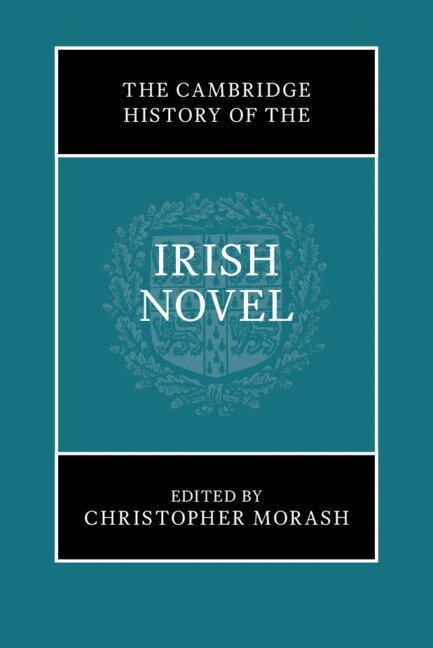
The Cambridge History of the Irish Novel appears at a moment when the novel in Ireland is particularly vibrant, with new work by Irish novelists achieving global prominence. The Cambridge History of the Irish Novel offers the first full multi-author survey of the Irish novel to extend from the earliest Irish novels in the seventeenth century to the present. Each of its forty-seven chapters is written by a leading scholar in the field. Cutting across this chronological organisation, The Cambridge History of the Irish Novel also features more than 300 internal cross-references, allowing the reader to track, for instance, the recurrence of the gothic, or the transnational, across genres, across readerships, and across centuries. As such, The Cambridge History of the Irish Novel provides, quite simply, the most extensive view of one of the world's great cultures of the novel.
563 kr
Skickas inom 7-10 vardagar
From the first book printed in Ireland in the sixteenth century, to the globalised digital media culture of today, Christopher Morash traces the history of forms of communication in Ireland over the past four centuries: the vigorous newspaper and pamphlet culture of the eighteenth century, the spread of popular literacy in the nineteenth century, and the impact of the telegraph, telephone, phonograph, cinema and radio, which arrived in Ireland just as the Irish Free State came into being. Morash picks out specific events for detailed analysis, such as the first radio broadcast, during the 1916 Rising, or the Live Aid concert in 1985. This book breaks ground within Irish studies. Its accessible narrative explains how Ireland developed into the modern, globally interconnected, economy of today. This is an essential and hugely informative read for anyone interested in Irish cultural history.
298 kr
Skickas inom 7-10 vardagar
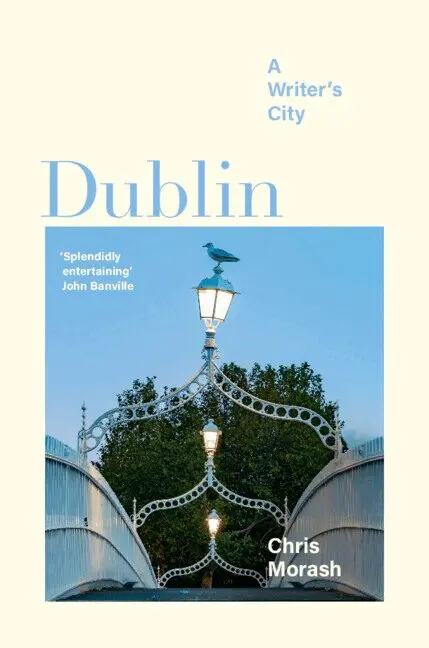
The words of its writers are part of the texture of Dublin, an invisible counterpart to the bricks and pavement we see around us. Beyond the ever-present footsteps of James Joyce's characters, Leopold Bloom or Stephen Dedalus, around the city centre, an ordinary-looking residential street overlooking Dublin Bay, for instance, presents the house where Nobel Laureate Seamus Heaney lived for many years; a few blocks away is the house where another Nobel Laureate, W. B. Yeats, was born. Just down the coast is the pier linked to yet another, Samuel Beckett, from which we can see the Martello Tower that is the setting for the opening chapter of Ulysses. But these are only a few. Step-by-step, Dublin: A Writer's City unfolds a book-lover's map of this unique city, inviting us to experience what it means to live in a great city of literature. The book is heavily illustrated, and features custom maps.
240 kr
Skickas inom 7-10 vardagar
The words of its writers are part of the texture of Dublin, an invisible counterpart to the bricks and pavement we see around us. Beyond the ever-present footsteps of James Joyce's characters, Leopold Bloom or Stephen Dedalus, around the city centre, an ordinary-looking residential street overlooking Dublin Bay, for instance, presents the house where Nobel Laureate Seamus Heaney lived for many years; a few blocks away is the house where another Nobel Laureate, W. B. Yeats, was born. Just down the coast is the pier linked to yet another, Samuel Beckett, from which we can see the Martello Tower that is the setting for the opening chapter of Ulysses. But these are only a few. Step-by-step, Dublin: A Writer's City unfolds a book-lover's map of this unique city, inviting us to experience what it means to live in a great city of literature. The book is heavily illustrated, and features custom maps.
1 189 kr
Skickas inom 7-10 vardagar
W. B. Yeats is recognised globally as one of the most significant poets of the past century. And yet, in his Nobel address, he singled out his work in the theatre as his main accomplishment. Yeats on Theatre restores Yeats not only a playwright, but as a writer and thinker who, over forty years, produced a body of theory covering all aspects of theatre, including the possibilities of performance space, the role of the audience and the nature of tragedy. When read as whole, in conjunction with his plays, letters, and extensive manuscript materials, Yeats's theatre writings emerge as a radical, cohesive, theatrical aesthetic, at odds with - and in advance of - the theatre of his time. Ultimately, the Yeats who takes shape in Yeats on Theatre is an artist who thinks through theatre, providing us with an urgently needed reassertion of the value of theatre as embodied thought.
405 kr
Skickas inom 10-15 vardagar
WINNER, Lawrence J. McCaffrey Prize for Books on Irish-America, given by The American Conference for Irish StudiesFollows a group of people exiled from Ireland after a failed rebellion and the role they had in the building of new nations and statesThis book is about the Young Irelanders, a group of Irish nationalists in the mid-nineteenth century, who were responsible for a failed rebellion in Ireland during the Great Famine, who once exiled from Ireland, came to play formative roles in the fledgling democracies of Australia, Canada, and the United States. Christopher Morash illustrates how the Young Ireland generation developed particular philosophies of nationalism, democracy, citizenship, and minority rights in Ireland, which became an integral part of how they engaged with their adopted nations, where they came to occupy significant political and cultural roles.Christopher Morash explores the stories and political trajectories of an acting-Governor of the Territory of Montana and Union Army General, a Confederate newspaper owner, a Premier of Victoria, and many other important figures. Despite their divergent trajectories, these individuals applied many of the same ideas that they had developed during their original Irish political project to their respective nations and movements. Young Ireland is a vital new perspective in the field of Irish diaspora studies, highlighting the impact the Young Ireland generation had on emerging democracies and international debates, both in spite of and because of their defeat and dispersion.