Chua Leon O Chua – författare
Visar alla böcker från författaren . Handla med fri frakt och snabb leverans.
15 produkter
15 produkter
E-bok
PDF, Engelska, 2013708 kr
Läs direkt efter köp
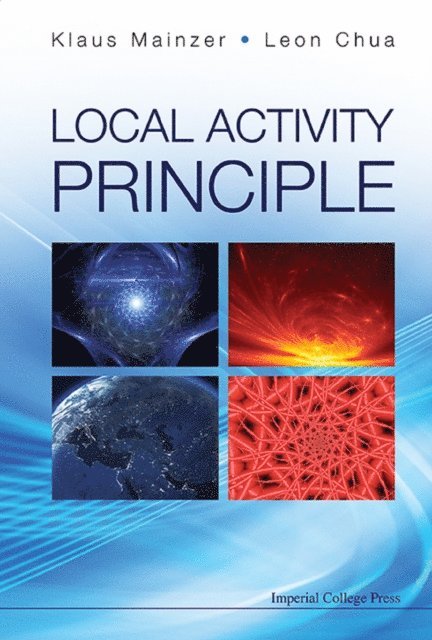
The principle of local activity explains the emergence of complex patterns in a homogeneous medium. At first defined in the theory of nonlinear electronic circuits in a mathematically rigorous way, it can be generalized and proven at least for the class of nonlinear reaction-diffusion systems in physics, chemistry, biology, and brain research. Recently, it was realized by memristors for nanoelectronic device applications. In general, the emergence of complex patterns and structures is explained by symmetry breaking in homogeneous media, which is caused by local activity. This book argues that the principle of local activity is really fundamental in science, and can even be identified in quantum cosmology as symmetry breaking of local gauge symmetries generating the complexity of matter and forces in our universe. Applications are considered in economic, financial, and social systems with the emergence of equilibrium states, symmetry breaking at critical points of phase transitions and risky acting at the edge of chaos.
E-bok
PDF, Engelska, 20201 632 kr
Läs direkt efter köp
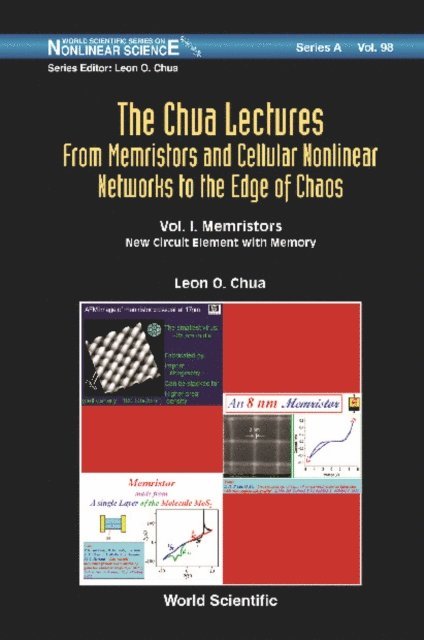
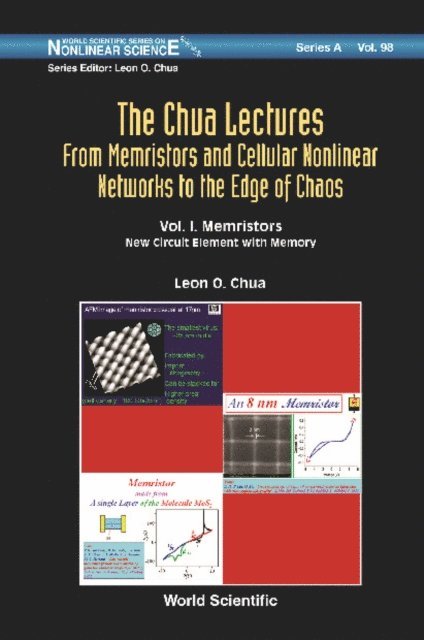
This 4-volume compendium contains the verbatim hard copies of all color slides from the Chua Lecture Series presented at HP in Palo Alto, during the period from September 22 to November 24, 2015. Each lecture consists of 90 minutes, divided into a formal lecture, a discussion session, and an Encore of special trivia that the audience found mesmerizing.These lectures share some unique features of the classic Feynman Lectures on Physics, as much of the materials are presented in the unique style of the author, and the content is original as discovered or invented by the author himself. Unlike most technical books that suffer a notoriously short life span as their features could be superseded by superior models, this series of Chua lectures are intended to never be obsolete - many concepts and principles introduced are in fact new laws of nature, written in the language of sophomore-level mathematics, providing the foundation and the elan vital for initiating and nurturing future concepts and inventions.Volume I - covers everything that a researcher may want to know about memristors but is too afraid to ask.
E-bok
PDF, Engelska, 20201 632 kr
Läs direkt efter köp
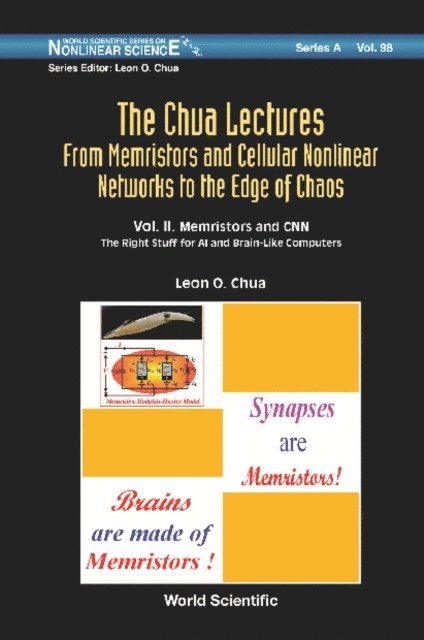
This 4-volume compendium contains the verbatim hard copies of all color slides from the Chua Lecture Series presented at HP in Palo Alto, during the period from September 22 to November 24, 2015. Each lecture consists of 90 minutes, divided into a formal lecture, a discussion session, and an Encore of special trivia that the audience found mesmerizing.These lectures share some unique features of the classic Feynman Lectures on Physics, as much of the materials are presented in the unique style of the author, and the content is original as discovered or invented by the author himself. Unlike most technical books that suffer a notoriously short life span as their features could be superseded by superior models, this series of Chua lectures are intended to never be obsolete - many concepts and principles introduced are in fact new laws of nature, written in the language of sophomore-level mathematics, providing the foundation and the elan vital for initiating and nurturing future concepts and inventions.Volume II - shows that memristors can be either volatile or non-volatile, and effectively proving that synapses are non-volatile memristors, while action potentials are generated by locally-active memristors.
E-bok
PDF, Engelska, 20201 632 kr
Läs direkt efter köp
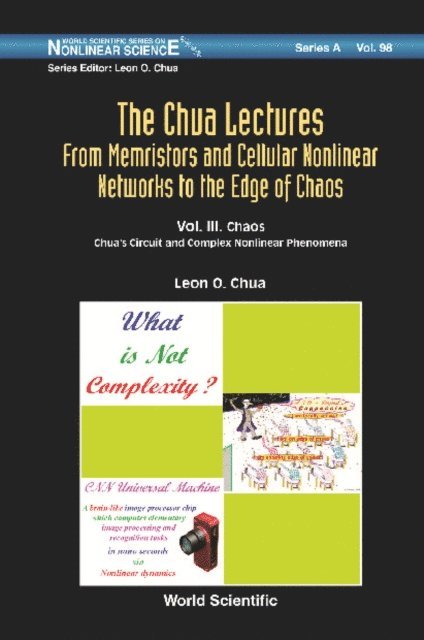
This 4-volume compendium contains the verbatim hard copies of all color slides from the Chua Lecture Series presented at HP in Palo Alto, during the period from September 22 to November 24, 2015. Each lecture consists of 90 minutes, divided into a formal lecture, a discussion session, and an Encore of special trivia that the audience found mesmerizing.These lectures share some unique features of the classic Feynman Lectures on Physics, as much of the materials are presented in the unique style of the author, and the content is original as discovered or invented by the author himself. Unlike most technical books that suffer a notoriously short life span as their features could be superseded by superior models, this series of Chua lectures are intended to never be obsolete - many concepts and principles introduced are in fact new laws of nature, written in the language of sophomore-level mathematics, providing the foundation and the elan vital for initiating and nurturing future concepts and inventions.Volume III - presents an overview of the fascinating phenomenon called chaos, while immersing the audience with the sights and sound of chaos from the Chua Circuit, invented in 1984 by Leon Chua, and has now become the standard textbook example of chaos exhibited by a real nonlinear electronic circuit, and not by computer simulations.
E-bok
PDF, Engelska, 20201 929 kr
Läs direkt efter köp
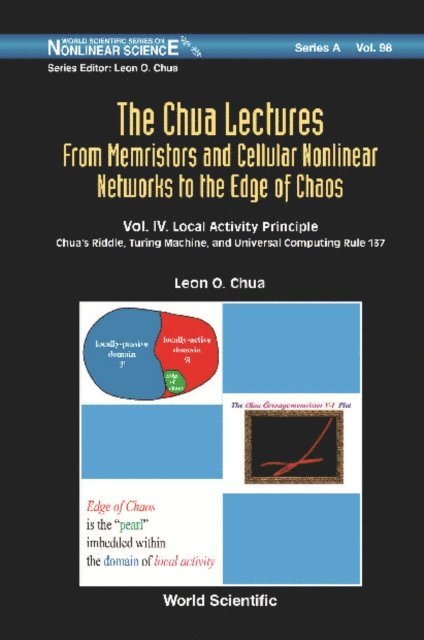
This 4-volume compendium contains the verbatim hard copies of all color slides from the Chua Lecture Series presented at HP in Palo Alto, during the period from September 22 to November 24, 2015. Each lecture consists of 90 minutes, divided into a formal lecture, a discussion session, and an Encore of special trivia that the audience found mesmerizing.These lectures share some unique features of the classic Feynman Lectures on Physics, as much of the materials are presented in the unique style of the author, and the content is original as discovered or invented by the author himself. Unlike most technical books that suffer a notoriously short life span as their features could be superseded by superior models, this series of Chua lectures are intended to never be obsolete - many concepts and principles introduced are in fact new laws of nature, written in the language of sophomore-level mathematics, providing the foundation and the elan vital for initiating and nurturing future concepts and inventions.Volume IV - surprises the audience with a new law of nature - dubbed the local activity principle, as discovered and proved mathematically in 1996 by Leon Chua. In particular, a Corollary of Chua's local activity theorem, dubbed the edge of chaos, is shown via insightful examples to be the originator of most complex phenomena, including intelligence, creativity, and deep learning. The edge of chaos is Mother Nature's tool for overcoming the tyranny of the second law of thermodynamics by providing an escape hatch for entropy to decrease over time. Indeed, the local activity principle which is profusely illustrated in the final volume, is widely recognized as a new law of thermodynamics, and is identified as the sine qua non of all complex phenomena, including life itself.
E-bok
PDF, Engelska, 20205 711 kr
Läs direkt efter köp
This 4-volume compendium contains the verbatim hard copies of all color slides from the Chua Lecture Series presented at HP in Palo Alto, during the period from September 22 to November 24, 2015. Each lecture consists of 90 minutes, divided into a formal lecture, a discussion session, and an Encore of special trivia that the audience found mesmerizing.These lectures share some unique features of the classic Feynman Lectures on Physics, as much of the materials are presented in the unique style of the author, and the content is original as discovered or invented by the author himself. Unlike most technical books that suffer a notoriously short life span as their features could be superseded by superior models, this series of Chua lectures are intended to never be obsolete — many concepts and principles introduced are in fact new laws of nature, written in the language of sophomore-level mathematics, providing the foundation and the elan vital for initiating and nurturing future concepts and inventions.Volume I — covers everything that a researcher may want to know about memristors but is too afraid to ask.Volume II — shows that memristors can be either volatile or non-volatile, and effectively proving that synapses are non-volatile memristors, while action potentials are generated by locally-active memristors.Volume III — presents an overview of the fascinating phenomenon called chaos, while immersing the audience with the sights and sound of chaos from the Chua Circuit, invented in 1984 by Leon Chua, and has now become the standard textbook example of chaos exhibited by a real nonlinear electronic circuit, and not by computer simulations.Volume IV — surprises the audience with a new law of nature — dubbed the local activity principle, as discovered and proved mathematically in 1996 by Leon Chua. In particular, a Corollary of Chua''s local activity theorem, dubbed the edge of chaos, is shown via insightful examples to be the originator of most complex phenomena, including intelligence, creativity, and deep learning. The edge of chaos is Mother Nature''s tool for overcoming the tyranny of the second law of thermodynamics by providing an escape hatch for entropy to decrease over time. Indeed, the local activity principle which is profusely illustrated in the final volume, is widely recognized as a new law of thermodynamics, and is identified as the sine qua non of all complex phenomena, including life itself.Exclusive Access to the accompanying Video and Audio materials comes with the purchase of this book.
E-bok
PDF, Engelska, 2012831 kr
Läs direkt efter köp
This penultimate volume contains numerous original, elegant, and surprising results in 1-dimensional cellular automata. Perhaps the most exciting, if not shocking, new result is the discovery that only 82 local rules, out of 256, suffice to predict the time evolution of any of the remaining 174 local rules from an arbitrary initial bit-string configuration. This is contrary to the well-known folklore that 256 local rules are necessary, leading to the new concept of quasi-global equivalence.Another surprising result is the introduction of a simple, yet explicit, infinite bit string called the super string S, which contains all random bit strings of finite length as sub-strings. As an illustration of the mathematical subtlety of this amazing discrete testing signal, the super string S is used to prove mathematically, in a trivial and transparent way, that rule 170 is as chaotic as a coin toss.Yet another unexpected new result, among many others, is the derivation of an explicit basin tree generation formula which provides an analytical relationship between the basin trees of globally-equivalent local rules. This formula allows the symbolic, rather than numerical, generation of the time evolution of any local rule corresponding to any initial bit-string configuration, from one of the 88 globally-equivalent local rules.But perhaps the most provocative idea is the proposal for adopting rule 137, over its three globally-equivalent siblings, including the heretofore more well-known rule 110, as the prototypical universal Turing machine.
E-bok
PDF, Engelska, 2013697 kr
Läs direkt efter köp
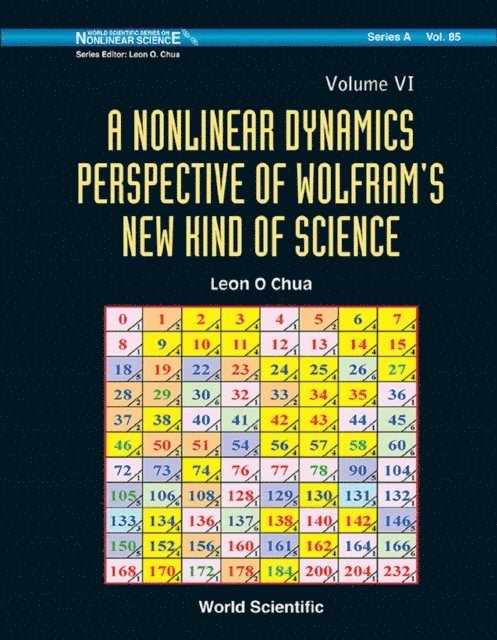
This invaluable volume ends the quest to uncover the secret recipes for predicting the long-term evolution of a ring of identical elementary cells where the binary state of each cell during each generation of an attractor (i.e. after the transients had disappeared) is determined uniquely by the state of its left and right neighbors in the previous generation, as decreed by one of 256 truth tables. As befitting the contents aimed at school children, it was found pedagogically appealing to code each truth table by coloring each of the 8 vertices of a cubical graph in red (for binary state 1), or blue (for binary state 0), forming a toy universe of 256 Boolean cubes, each bearing a different vertex color combination.The corresponding collection of 256 distinct Boolean cubes are then segegrated logically into 6 distinct groups where members from each group share certain common dynamics which allow the long-term evolution of the color configuration of each bit string, of arbitrary length, to be predicted painlessly, via a toy-like gaming procedure, without involving any calculation. In particular, the evolution of any bit string bearing any initial color configuration which resides in any one of the possibly many distinct attractors, can be systematically predicted, by school children who are yet to learn arithmetic, via a simple recipe, for any Boolean cube belonging to group 1, 2, 3, or 4. The simple recipe for predicting the time-asymptotic behaviors of Boolean cubes belonging to groups 1, 2, and 3 has been covered in Vols. I, II, ..., V.This final volume continues the recipe for each of the 108, out of 256, local rules, dubbed the Bernoulli rules, belonging to group 4. Here, for almost half of the toy universe, surprisingly simple recipes involving only the following three pieces of information are derived in Vol. VI; namely, a positive integer τ, a positive, or negative, integer σ, and a sign parameter β > 0, or β < 0. In particular, given any color configuration belonging to an attractor of any one of the 108 Boolean cubes from group 4, any child can predict the color configuration after τ generations, without any computation, by merely shifting each cell σ bits to the left (resp. right) if σ > 0 (resp. σ < 0), and then change the color of each cell if β < 0.As in the five prior volumes, Vol. VI also contains simple recipes which are, in fact, general and original results from the abstract theory of 1-dimensional cellular automata. Indeed, both children and experts from cellular automata will find this volume to be as deep, refreshing, and entertaining, as the previous volumes.

E-bok
PDF, Engelska, 2011915 kr
Läs direkt efter köp
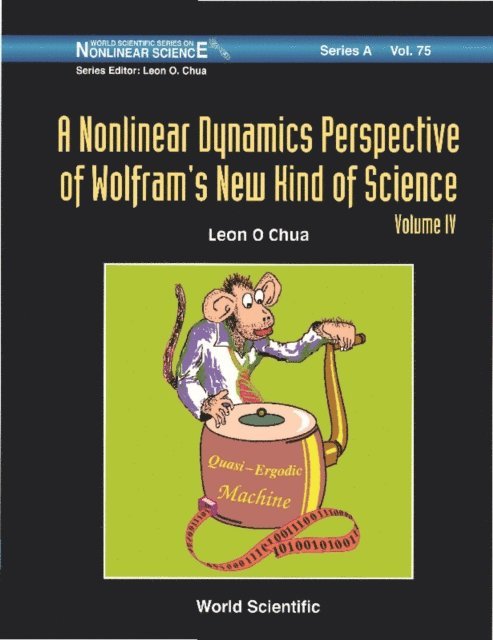
Volume IV continues the author''s odyssey on l-D cellular automata as chronicled in Volumes I, II and III, by uncovering a novel quasi-ergodicity phenomenon involving orbits meandering among omega-limit orbits of complex (group 5) and hyper (group 6) Bernoulli rules. This discovery is embellished with analytical formulas characterizing the fractal properties of characteristic functions, as well as explicit formulas for generating colorful and pedagogically revealing isomorphic basin tree diagrams. Many new results were derived and proved by uncovering subtle symmetries endowed by various subsets of the 256 Boolean cubes. For the first time, rigorous analyses were used to identify 67, out off 256, local rules whose asymptotic behaviors consist of robust period-l orbits. The highlight of this continuing odyssey is the discovery of an isolated period-3240 Isle of Eden hidden among the dense omega-limit orbits of Wolfram''s remarkable “random number generating” rule 30. This is the largest gem known to-date and readers are challenged to uncover even larger ones.
E-bok
PDF, Engelska, 2009778 kr
Läs direkt efter köp
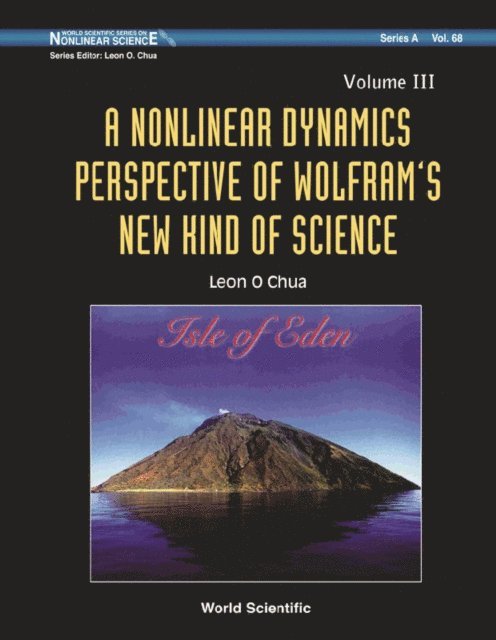
Volume III continues the author''s quest for developing a pedagogical, self-contained, yet rigorous analytical theory of 1-D cellular automata via a nonlinear dynamics perspective. Using carefully conceived and illuminating color graphics, the global dynamical behaviors of the 50 (out of 256) local rules that have not yet been covered in Volumes I and II are exposed via their stunningly revealing basin tree diagrams. The Bernoulli στ-shift dynamics discovered in Volume II is generalized to hold for all 50 (or 18 globally equivalent) local rules via complex and hyper Bernoulli wave dynamics. Explicit global state transition formulas derived for rules 60, 90, 105, and 150 reveal a new scale-free phenomenon. The most surprising new result unveiled in this volume is the “Isle of Eden” found hidden in most (almost 90%) of the 256 local rules. Readers are challenged to hunt for long-period, isolated Isles of Eden. These are rare gems waiting to be discovered.
E-bok
PDF, Engelska, 20061 888 kr
Läs direkt efter köp
This novel book introduces cellular automata from a rigorous nonlinear dynamics perspective. It supplies the missing link between nonlinear differential and difference equations to discrete symbolic analysis. A surprisingly useful interpretations of cellular automata in terms of neural networks is also given. The book provides a scientifically sound and original analysis, and classifications of the empirical results presented in Wolfram''s monumental '';New Kind of Science.'';
E-bok
PDF, Engelska, 20072 819 kr
Läs direkt efter köp
This novel book introduces cellular automata from a rigorous nonlinear dynamics perspective. It supplies the missing link between nonlinear differential and difference equations to discrete symbolic analysis. A surprisingly useful interpretations of cellular automata in terms of neural networks is also given. The book provides a scientifically sound and original analysis, and classifications of the empirical results presented in Wolfram''s monumental '';New Kind of Science.'';
E-bok
PDF, Engelska, 2001905 kr
Läs direkt efter köp
Bifurcation and chaos has dominated research in nonlinear dynamics for over two decades, and numerous introductory and advanced books have been published on this subject. There remains, however, a dire need for a textbook which provides a pedagogically appealing yet rigorous mathematical bridge between these two disparate levels of exposition. This book has been written to serve that unfulfilled need.Following the footsteps of Poincaré, and the renowned Andronov school of nonlinear oscillations, this book focuses on the qualitative study of high-dimensional nonlinear dynamical systems. Many of the qualitative methods and tools presented in the book have been developed only recently and have not yet appeared in textbook form.In keeping with the self-contained nature of the book, all the topics are developed with introductory background and complete mathematical rigor. Generously illustrated and written at a high level of exposition, this invaluable book will appeal to both the beginner and the advanced student of nonlinear dynamics interested in learning a rigorous mathematical foundation of this fascinating subject.
E-bok
PDF, Engelska, 1998890 kr
Läs direkt efter köp
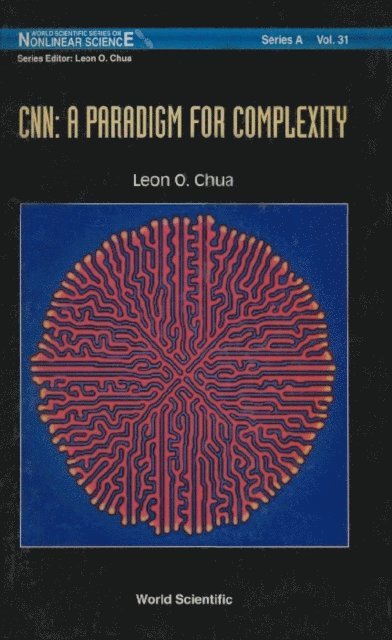
Revolutionary and original, this treatise presents a new paradigm of EMERGENCE and COMPLEXITY, with applications drawn from numerous disciplines, including artificial life, biology, chemistry, computation, physics, image processing, information science, etc.CNN is an acronym for Cellular Neural Networks when used in the context of brain science, or Cellular Nonlinear Networks, when used in the context of emergence and complexity. A CNN is modeled by cells and interactions: cells are defined as dynamical systems and interactions are defined via coupling laws. The CNN paradigm is a universal Turing machine and includes cellular automata and lattice dynamical systems as special cases.While the CNN paradigm is an example of REDUCTIONISM par excellence, the true origin of emergence and complexity is traced to a much deeper new concept called local activity. The numerous complex phenomena unified under this mathematically precise principle include self organization, dissipative structures, synergetics, order from disorder, far-from-thermodynamic equilibrium, collective behaviors, edge of chaos, etc.Written with a high level of exposition, this completely self-contained monograph is profusely illustrated with over 200 stunning color illustrations of emergent phenomena.
E-bok
PDF, Engelska, 1998727 kr
Läs direkt efter köp
Bifurcation and Chaos has dominated research in nonlinear dynamics for over two decades and numerous introductory and advanced books have been published on this subject. There remains, however, a dire need for a textbook which provides a pedagogically appealing yet rigorous mathematical bridge between these two disparate levels of exposition. This book is written to serve the above unfulfilled need.Following the footsteps of Poincaré, and the renowned Andronov school of nonlinear oscillations, this book focuses on the qualitative study of high-dimensional nonlinear dynamical systems. Many of the qualitative methods and tools presented in this book were developed only recently and have not yet appeared in a textbook form.In keeping with the self-contained nature of this book, all topics are developed with an introductory background and complete mathematical rigor. Generously illustrated and written with a high level of exposition, this book will appeal to both beginners and advanced students of nonlinear dynamics interested in learning a rigorous mathematical foundation of this fascinating subject.