Claude-Alain Pillet – författare
Visar alla böcker från författaren Claude-Alain Pillet. Handla med fri frakt och snabb leverans.
8 produkter
8 produkter
Del 54 - SpringerBriefs in Mathematical Physics
What is a Fluctuation Theorem?
Häftad, Engelska, 2026
809 kr
Skickas inom 5-8 vardagar
This book provides a modern review of Fluctuation Relations and Fluctuation Theorems in nonequilibrium statistical mechanics.
E-bok
Engelska, 2026993 kr
Läs direkt efter köp
This book provides a modern review of Fluctuation Relations and Fluctuation Theorems in nonequilibrium statistical mechanics. It focuses on the pioneering perspectives of Gallavotti and Cohen, according to which a fluctuation theorem describes the statistics of the deviations of entropy production from its expected value. For time-reversal invariant systems, these fluctuations obey a universal (i.e., model-independent) symmetry called the fluctuation relation.The probabilistic framework introduced in the first part of the book allows for a very general formulation of Fluctuation Relations and Theorems for both deterministic and stochastic dynamical systems. The authors further explore models of physical interest, illustrating this framework by concrete applications.The second part of the book focuses on chaotic dynamics. The formulation of two general Fluctuation Theorems, followed by the detailed study of a concrete example, provides the reader with an understanding of both the theoretical and practical aspects of the subject.Targeted at Ph.D. students and academic researchers in nonequilibrium statistical mechanics, dynamical systems, and stochastic processes,this book is also a valuable resource for mathematicians and theoretical physicists interested in the mathematical aspects of this growing field. Its accessible presentation of complex ideas makes it an essential read for anyone interested in the recent theoretical advances in the physics of nonequilibrium processes.Whether you are an experienced researcher or new to the field, this book offers insights and foundational knowledge crucialfor advancing your understanding of applied sciences.
Del 1880 - Lecture Notes in Mathematics
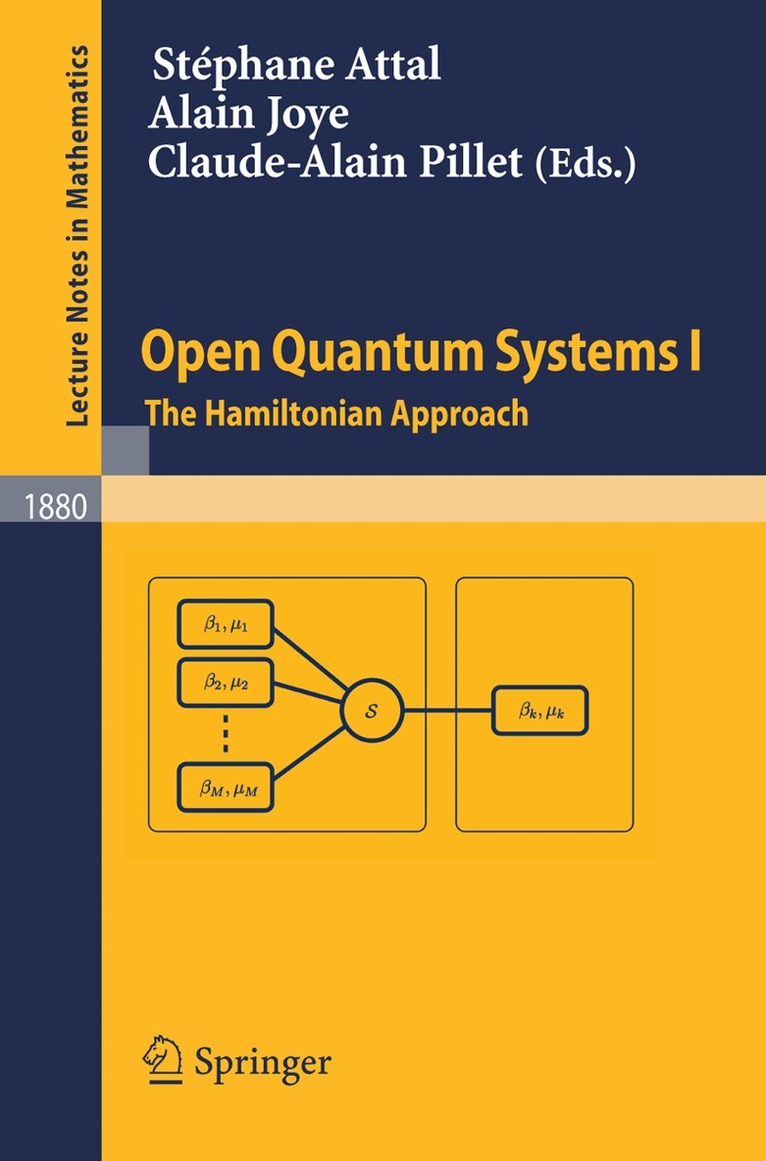
Open Quantum Systems I
The Hamiltonian Approach
Häftad, Engelska, 2006
706 kr
Skickas inom 10-15 vardagar
This is the ?rst in a series of three volumes dedicated to the lecture notes of the Summer School ”Open Quantum Systems” which took place at the Institut Fourier in Grenoble from June 16th to July 4th 2003. The contributions presented in these volumes are revised and expanded versions of the notes provided to the students during the School. Closed vs. Open Systems By de?nition, the time evolution of a closed physical systemS is deterministic. It is usually described by a differential equation x ? = X(x ) on the manifold M of t t possible con?gurations of the system. If the initial con?guration x ? M is known 0 then the solution of the corresponding initial value problem yields the con?guration x at any future time t. This applies to classical as well as to quantum systems. In the t classical case M is the phase space of the system and x describes the positions and t velocities of the various components (or degrees of freedom) ofS at time t. Inthe quantum case, according to the orthodoxinterpretation of quantum mechanics, M is a Hilbert space and x a unit vector – the wave function – describing the quantum t state of the system at time t. In both cases the knowledge of the state x allows t to predict the result of any measurement made onS at time t.
Häftad, Engelska, 2006
598 kr
Skickas inom 10-15 vardagar
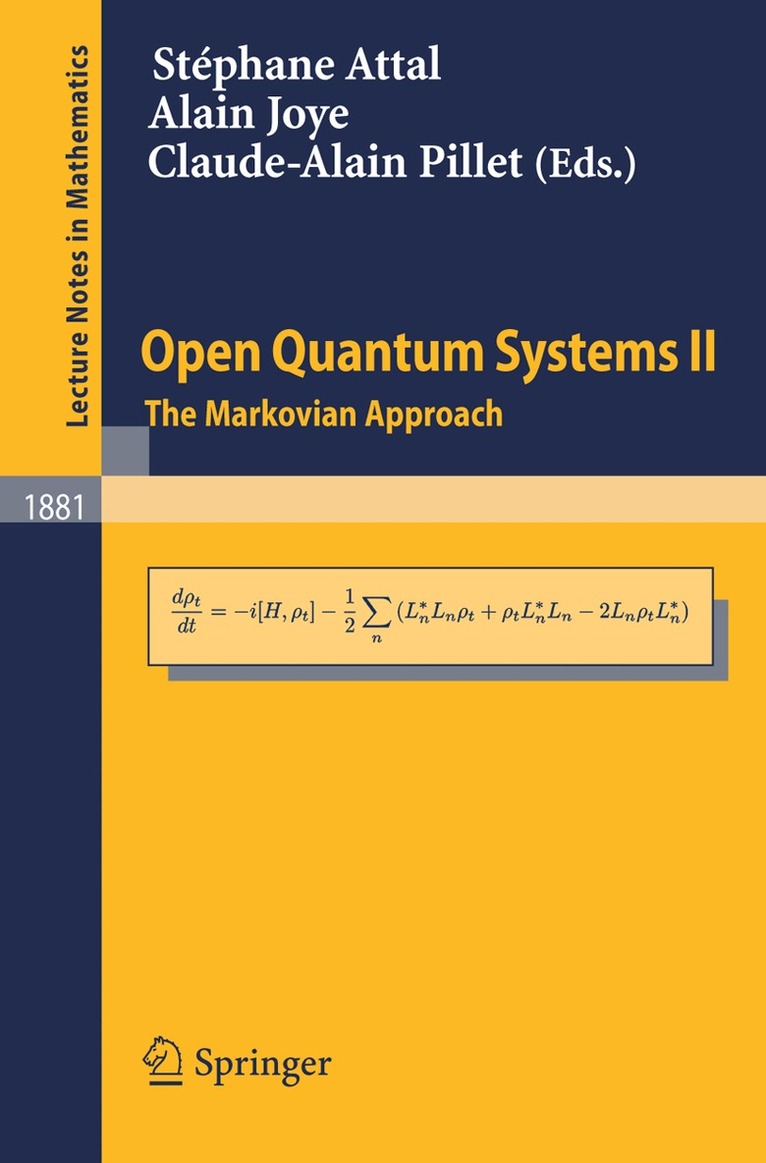
This volume is the second in a series of three volumes dedicated to the lecture notes of the summer school “Open Quantum Systems” which took place in the Institut Fourier in Grenoble, from June 16th to July 4th 2003. The contributions presented in thesevolumesarerevisedandexpandedversionsofthenotesprovidedtothestudents during the school. After the rst volume, developing the Hamiltonian approach of open quantum systems, this second volume is dedicated to the Markovian approach. The third volume presents both approaches, but at the recent research level. Open quantum systems A quantum open system is a quantum system which is interacting with another one. This is a general de nition, but in general, it is understood that one of the s- tems is rather “small” or “simple” compared to the other one which is supposed to be huge, to be the environment, a gas of particles, a beam of photons, a heat bath ... The aim of quantum open system theory is to study the behaviour of this coupled system and in particular the dissipation of the small system in favour of the large one.
Del 1882 - Lecture Notes in Mathematics
Open Quantum Systems III
Recent Developments
Häftad, Engelska, 2006
706 kr
Skickas inom 10-15 vardagar
This volume is the third and last of a series devoted to the lecture notes of the Grenoble Summer School on “Open Quantum Systems” which took place at the th th Institut Fourier from June 16 to July 4 2003. The contributions presented in this volumecorrespondtoexpanded versionsofthelecturenotesprovidedbytheauthors to the students of the Summer School. The corresponding lectures were scheduled in the last part of the School devoted to recent developments in the study of Open Quantum Systems. Whereas the rst two volumes were dedicated to a detailed exposition of the mathematical techniques and physical concepts relevant in the study of Open S- tems with noapriori pre-requisites, the contributions presented in this volume request from the reader some familiarity with these aspects. Indeed, the material presented here aims at leading the reader already acquainted with the basics in ? quantum statistical mechanics, spectral theory of linear operators,C -dynamical systems, and quantum stochastic differential equations to the front of the current research done on various aspects of Open Quantum Systems. Nevertheless, pe- gogical efforts have been made by the various authors of these notes so that this volume should be essentially self-contained for a reader with minimal previous - posure to the themes listed above. In any case, the reader in need of complements can always turn to these rst two volumes. The topics covered in these lectures notes start with an introduction to n- equilibrium quantum statistical mechanics.
E-bok
PDF, Engelska, 2006840 kr
Läs direkt efter köp
This is the ?rst in a series of three volumes dedicated to the lecture notes of the Summer School ”Open Quantum Systems” which took place at the Institut Fourier in Grenoble from June 16th to July 4th 2003. The contributions presented in these volumes are revised and expanded versions of the notes provided to the students during the School. Closed vs. Open Systems By de?nition, the time evolution of a closed physical systemS is deterministic. It is usually described by a differential equation x ? = X(x ) on the manifold M of t t possible con?gurations of the system. If the initial con?guration x ? M is known 0 then the solution of the corresponding initial value problem yields the con?guration x at any future time t. This applies to classical as well as to quantum systems. In the t classical case M is the phase space of the system and x describes the positions and t velocities of the various components (or degrees of freedom) ofS at time t. Inthe quantum case, according to the orthodoxinterpretation of quantum mechanics, M is a Hilbert space and x a unit vector – the wave function – describing the quantum t state of the system at time t. In both cases the knowledge of the state x allows t to predict the result of any measurement made onS at time t.
E-bok
PDF, Engelska, 2006764 kr
Läs direkt efter köp
This volume is the second in a series of three volumes dedicated to the lecture notes of the summer school “Open Quantum Systems” which took place in the Institut Fourier in Grenoble, from June 16th to July 4th 2003. The contributions presented in thesevolumesarerevisedandexpandedversionsofthenotesprovidedtothestudents during the school. After the rst volume, developing the Hamiltonian approach of open quantum systems, this second volume is dedicated to the Markovian approach. The third volume presents both approaches, but at the recent research level. Open quantum systems A quantum open system is a quantum system which is interacting with another one. This is a general de nition, but in general, it is understood that one of the s- tems is rather “small” or “simple” compared to the other one which is supposed to be huge, to be the environment, a gas of particles, a beam of photons, a heat bath ... The aim of quantum open system theory is to study the behaviour of this coupled system and in particular the dissipation of the small system in favour of the large one.
E-bok
PDF, Engelska, 2006847 kr
Läs direkt efter köp
This volume is the third and last of a series devoted to the lecture notes of the Grenoble Summer School on “Open Quantum Systems” which took place at the th th Institut Fourier from June 16 to July 4 2003. The contributions presented in this volumecorrespondtoexpanded versionsofthelecturenotesprovidedbytheauthors to the students of the Summer School. The corresponding lectures were scheduled in the last part of the School devoted to recent developments in the study of Open Quantum Systems. Whereas the rst two volumes were dedicated to a detailed exposition of the mathematical techniques and physical concepts relevant in the study of Open S- tems with noapriori pre-requisites, the contributions presented in this volume request from the reader some familiarity with these aspects. Indeed, the material presented here aims at leading the reader already acquainted with the basics in ? quantum statistical mechanics, spectral theory of linear operators,C -dynamical systems, and quantum stochastic differential equations to the front of the current research done on various aspects of Open Quantum Systems. Nevertheless, pe- gogical efforts have been made by the various authors of these notes so that this volume should be essentially self-contained for a reader with minimal previous - posure to the themes listed above. In any case, the reader in need of complements can always turn to these rst two volumes. The topics covered in these lectures notes start with an introduction to n- equilibrium quantum statistical mechanics.