Claude Eilers – författare
Visar alla böcker från författaren Claude Eilers. Handla med fri frakt och snabb leverans.
2 produkter
2 produkter
2 959 kr
Skickas inom 5-8 vardagar
Patronage has long been an important topic of interest to ancient historians. It remains unclear what patronage entailed, however, and how it worked. Is it a universal phenomenon embracing all, or most, relationships between unequals? Or is it an especially Roman practice? In previous discussions of patronage, one crucial body of evidence has been under-exploited: inscriptions from the Greek East that borrow the Latin term 'patron' and use it to honour their Roman officials. The fact that the Greeks borrow the term patron suggests that there was something uniquely Roman about the patron-client relationship. Moreover, this epigraphic evidence implies that patronage was not only a part of Rome's history, but had a history of its own. The rise and fall of city patrons in the Greek East is linked to the fundamental changes that took place during the fall of the Republic and the transition to the Principate. Senatorial patrons appear in the Greek inscriptions of the Roman province of Asia towards the end of the second century BC and are widely attested in the region and elsewhere for the following century. In the early principate, however, they become less common and soon more or less disappear. Eilers's discursive treatment of the origins, nature, and decline of this type of patronage, and its place in Roman practice as a whole, is supplemented by a reference catalogue of Roman patrons of Greek communities.
Del 304 - Mnemosyne, Supplements, History and Archaeology of Classical Antiquity
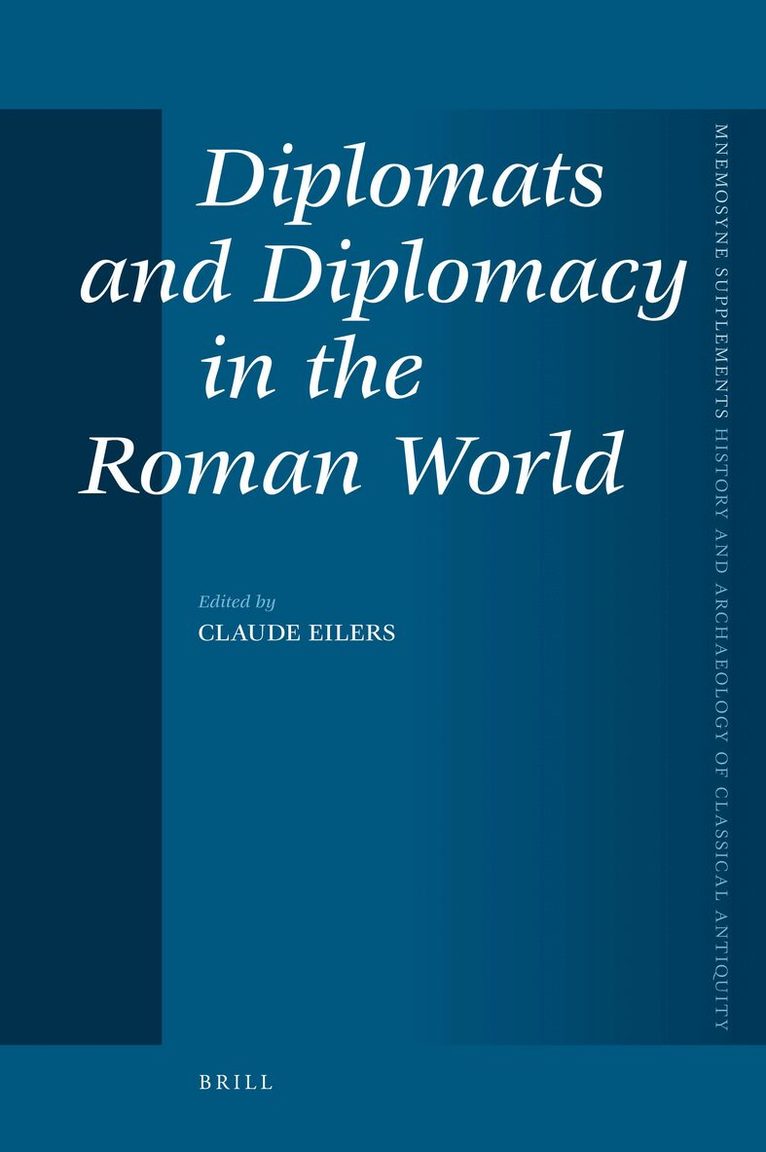
Diplomats and Diplomacy in the Roman World
Inbunden, Engelska, 2008
2 965 kr
Skickas inom 3-6 vardagar
The Roman world was fundamentally a face-to-face culture, where it was expected that communication and negotiations would be done in person. This can be seen in Rome’s contacts with other cities, states, and kingdoms — whether dependent, independent, friendly or hostile — and in the development of a diplomatic habit with its own rhythms and protocols that coalesced into a self-sustaining system of communication.This volume of papers offers ten perspectives on the way in which ambassadors, embassies, and the institutional apparatuses supporting them contributed to Roman rule. Understanding Roman diplomatic practices illuminates not only questions about Rome’s evolution as a Mediterranean power, but can also shed light on a wide variety of historical and cultural trends.Contributors are: Sheila L. Ager, Alexander Yakobson, Filippo Battistoni, James B. Rives, Jean-Louis Ferrary, Martin Jehne, T. Corey Brennan, Werner Eck, and Rudolf Haensch.