Claude Sammut – författare
Visar alla böcker från författaren Claude Sammut. Handla med fri frakt och snabb leverans.
8 produkter
8 produkter
11 853 kr
Skickas inom 10-15 vardagar
This authoritative, expanded and updated second edition of Encyclopedia of Machine Learning and Data Mining provides easy access to core information for those seeking entry into any aspect within the broad field of Machine Learning and Data Mining. A paramount work, its 800 entries - about 150 of them newly updated or added - are filled with valuable literature references, providing the reader with a portal to more detailed information on any given topic.Topics for the Encyclopedia of Machine Learning and Data Mining include Learning and Logic, Data Mining, Applications, Text Mining, Statistical Learning, Reinforcement Learning, Pattern Mining, Graph Mining, Relational Mining, Evolutionary Computation, Information Theory, Behavior Cloning, and many others. Topics were selected by a distinguished international advisory board. Each peer-reviewed, highly-structured entry includes a definition, key words, an illustration, applications, a bibliography, and links to related literature.The entries are expository and tutorial, making this reference a practical resource for students, academics, or professionals who employ machine learning and data mining methods in their projects. Machine learning and data mining techniques have countless applications, including data science applications, and this reference is essential for anyone seeking quick access to vital information on the topic.
E-bok
Engelska, 201712 213 kr
Läs direkt efter köp
This authoritative, expanded and updated second edition of Encyclopedia of Machine Learning and Data Mining provides easy access to core information for those seeking entry into any aspect within the broad field of Machine Learning and Data Mining. A paramount work, its 800 entries - about 150 of them newly updated or added - are filled with valuable literature references, providing the reader with a portal to more detailed information on any given topic.Topics for the Encyclopedia of Machine Learning and Data Mining include Learning and Logic, Data Mining, Applications, Text Mining, Statistical Learning, Reinforcement Learning, Pattern Mining, Graph Mining, Relational Mining, Evolutionary Computation, Information Theory, Behavior Cloning, and many others. Topics were selected by a distinguished international advisory board. Each peer-reviewed, highly-structured entry includes a definition, key words, an illustration, applications, a bibliography, and links to related literature.The entries are expository and tutorial, making this reference a practical resource for students, academics, or professionals who employ machine learning and data mining methods in their projects. Machine learning and data mining techniques have countless applications, including data science applications, and this reference is essential for anyone seeking quick access to vital information on the topic.
Del 11175 - Lecture Notes in Computer Science
RoboCup 2017: Robot World Cup XXI
Häftad, Engelska, 2018
565 kr
Skickas inom 10-15 vardagar
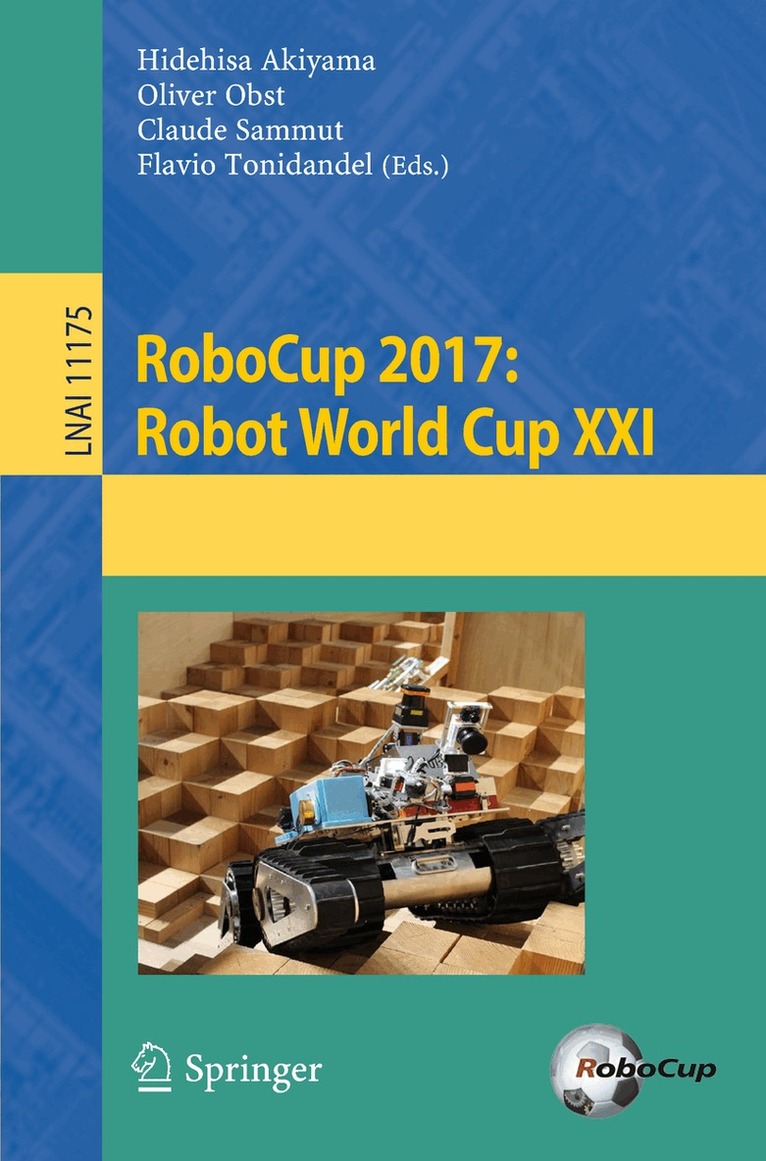
This book includes the post-conference proceedings of the 21st RoboCup International Symposium, held in Nagoya, Japan, in September 2017. The 33 full revised papers and 9 papers from the winning teams presented were carefully reviewed and selected from 58 submissions. The papers are orginazed on topical sections on Robotics, Artificial intelligence, Environment perception, State estimation and much more.
E-bok
Engelska, 2018708 kr
Läs direkt efter köp
This book includes the post-conference proceedings of the 21st RoboCup International Symposium, held in Nagoya, Japan, in September 2017. The 33 full revised papers and 9 papers from the winning teams presented were carefully reviewed and selected from 58 submissions. The papers are orginazed on topical sections on Robotics, Artificial intelligence, Environment perception, State estimation and much more.
Häftad, Engelska, 2003
565 kr
Skickas inom 10-15 vardagar
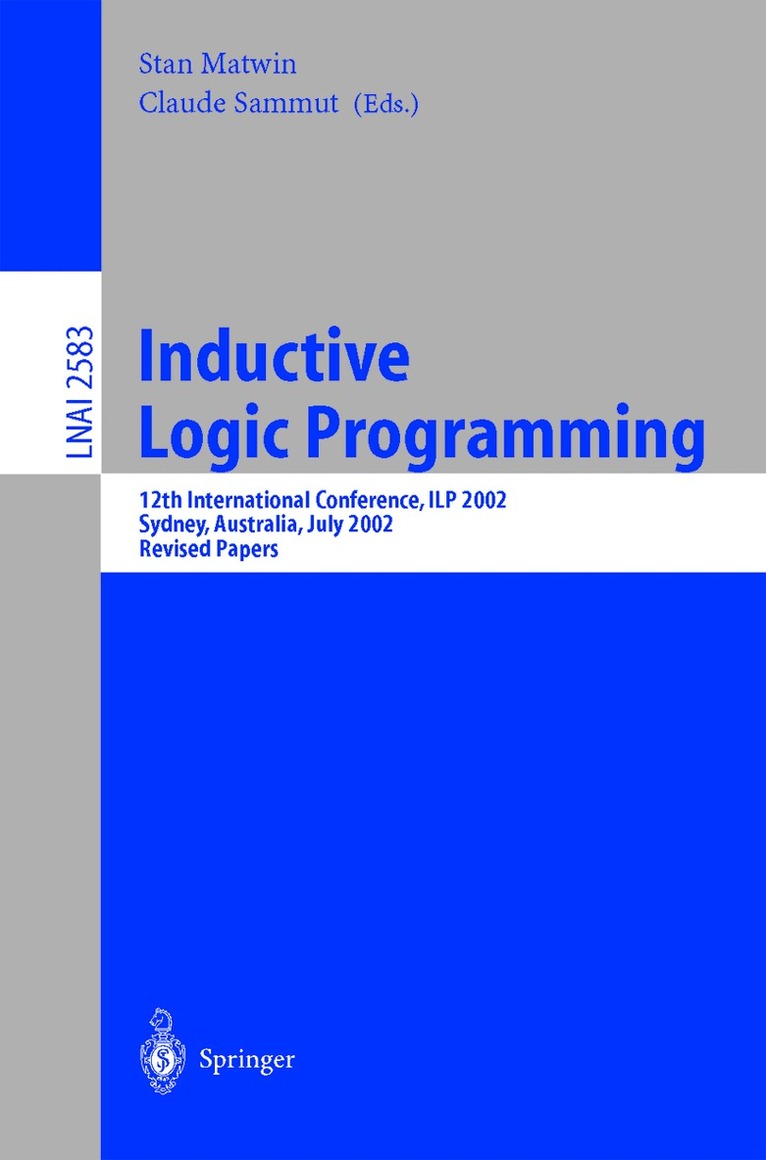
The Twelfth International Conference on Inductive Logic Programming was held in Sydney, Australia, July 9–11, 2002. The conference was colocated with two other events, the Nineteenth International Conference on Machine Learning (ICML2002) and the Fifteenth Annual Conference on Computational Learning Theory (COLT2002). Startedin1991,InductiveLogicProgrammingistheleadingannualforumfor researchers working in Inductive Logic Programming and Relational Learning. Continuing a series of international conferences devoted to Inductive Logic Programming and Relational Learning, ILP 2002 was the central event in 2002 for researchers interested in learning relational knowledge from examples. The Program Committee, following a resolution of the Community Me- ing in Strasbourg in September 2001, took upon itself the issue of the possible change of the name of the conference. Following an extended e-mail discussion, a number of proposed names were subjected to a vote. In the ?rst stage of the vote, two names were retained for the second vote. The two names were: Ind- tive Logic Programming, and Relational Learning. It had been decided that a 60% vote would be needed to change the name; the result of the vote was 57% in favor of the name Relational Learning. Consequently, the name Inductive Logic Programming was kept.
Häftad, Engelska, 2005
1 123 kr
Skickas inom 10-15 vardagar
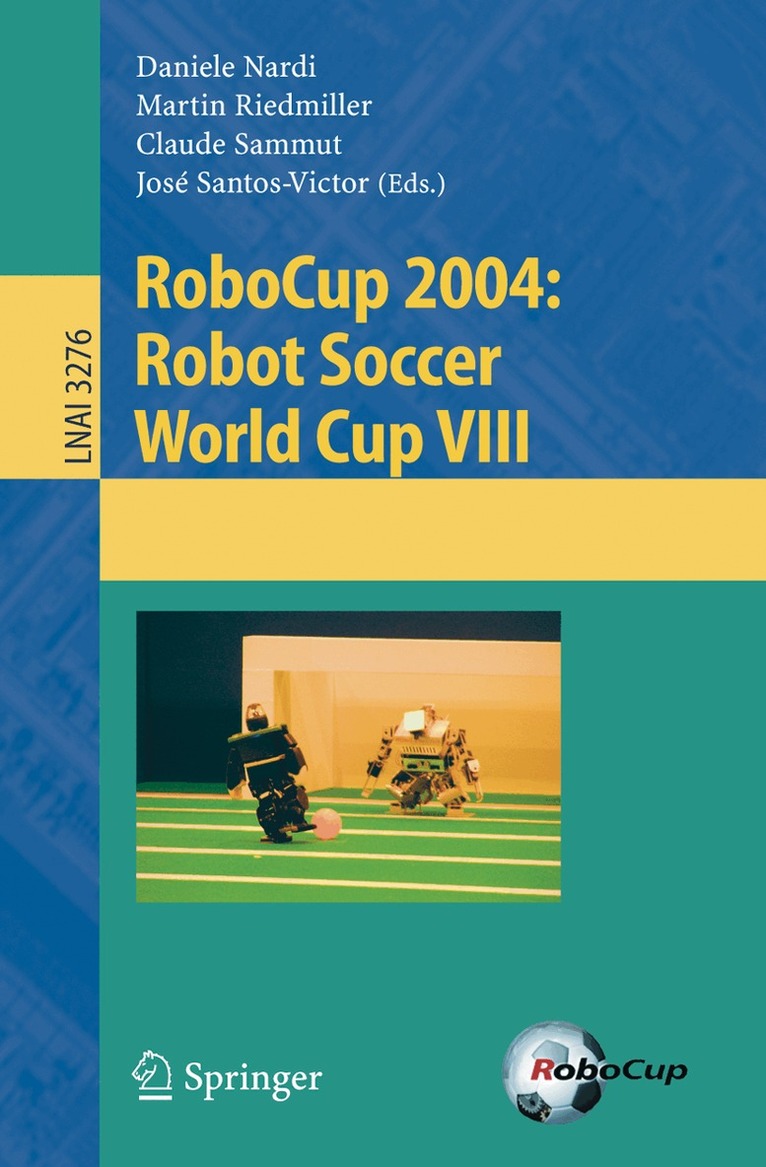
ThesearetheproceedingsoftheRoboCup2004Symposium,heldattheInstituto Superior T´ ecnico, in Lisbon, Portugal in conjunction with the RoboCup c- petition. The papers presented here document the many innovations in robotics that result from RoboCup. A problem in any branch of science or engineering is how to devise tests that can provide objective comparisons between alt- native methods. In recent years, competitive engineering challenges have been established to motivate researchers to tackle di?cult problems while providing a framework for the comparison of results. RoboCup was one of the ?rst such competitions and has been a model for the organization of challenges foll- ing sound scienti?c principles. In addition to the competition, the associated symposium provides a forum for researchers to present refereed papers. But, for RoboCup, the symposium has the greater goal of encouraging the exchange of ideas between teams so that the competition, as a whole, progresses from year to year and strengthens its contribution to robotics. One hundred and eighteen papers were submitted to the Symposium. Each paper was reviewed by at least two international referees; 30 papers were - cepted for presentation at the Symposium as full papers and a further 38 were accepted for poster presentation. The quality of the Symposium could not be maintained without the support of the authors and the generous assistance of the referees.
E-bok
PDF, Engelska, 20051 367 kr
Läs direkt efter köp
ThesearetheproceedingsoftheRoboCup2004Symposium,heldattheInstituto Superior T´ ecnico, in Lisbon, Portugal in conjunction with the RoboCup c- petition. The papers presented here document the many innovations in robotics that result from RoboCup. A problem in any branch of science or engineering is how to devise tests that can provide objective comparisons between alt- native methods. In recent years, competitive engineering challenges have been established to motivate researchers to tackle di?cult problems while providing a framework for the comparison of results. RoboCup was one of the ?rst such competitions and has been a model for the organization of challenges foll- ing sound scienti?c principles. In addition to the competition, the associated symposium provides a forum for researchers to present refereed papers. But, for RoboCup, the symposium has the greater goal of encouraging the exchange of ideas between teams so that the competition, as a whole, progresses from year to year and strengthens its contribution to robotics. One hundred and eighteen papers were submitted to the Symposium. Each paper was reviewed by at least two international referees; 30 papers were - cepted for presentation at the Symposium as full papers and a further 38 were accepted for poster presentation. The quality of the Symposium could not be maintained without the support of the authors and the generous assistance of the referees.
E-bok
PDF, Engelska, 2003708 kr
Läs direkt efter köp
The Twelfth International Conference on Inductive Logic Programming was held in Sydney, Australia, July 9–11, 2002. The conference was colocated with two other events, the Nineteenth International Conference on Machine Learning (ICML2002) and the Fifteenth Annual Conference on Computational Learning Theory (COLT2002). Startedin1991,InductiveLogicProgrammingistheleadingannualforumfor researchers working in Inductive Logic Programming and Relational Learning. Continuing a series of international conferences devoted to Inductive Logic Programming and Relational Learning, ILP 2002 was the central event in 2002 for researchers interested in learning relational knowledge from examples. The Program Committee, following a resolution of the Community Me- ing in Strasbourg in September 2001, took upon itself the issue of the possible change of the name of the conference. Following an extended e-mail discussion, a number of proposed names were subjected to a vote. In the ?rst stage of the vote, two names were retained for the second vote. The two names were: Ind- tive Logic Programming, and Relational Learning. It had been decided that a 60% vote would be needed to change the name; the result of the vote was 57% in favor of the name Relational Learning. Consequently, the name Inductive Logic Programming was kept.