Claudine Verheggen - Böcker
Visar alla böcker från författaren Claudine Verheggen. Handla med fri frakt och snabb leverans.
8 produkter
8 produkter
2 238 kr
Skickas inom 10-15 vardagar
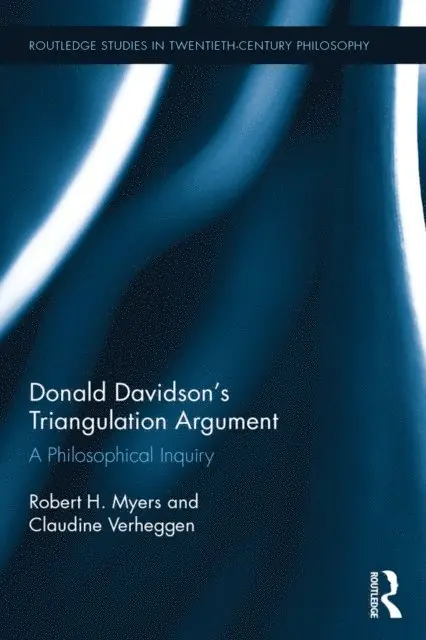
According to many commentators, Davidson’s earlier work on philosophy of action and truth-theoretic semantics is the basis for his reputation, and his later forays into broader metaphysical and epistemological issues, and eventually into what became known as the triangulation argument, are much less successful. This book by two of his former students aims to change that perception. In Part One, Verheggen begins by providing an explanation and defense of the triangulation argument, then explores its implications for questions concerning semantic normativity and reductionism, the social character of language and thought, and skepticism about the external world. In Part Two, Myers considers what the argument can tell us about reasons for action, and whether it can overcome skeptical worries based on claims about the nature of motivation, the sources of normativity and the demands of morality. The book reveals Davidson’s later writings to be full of innovative and important ideas that deserve much more attention than they are currently receiving.
322 kr
Skickas inom 7-10 vardagar
Saul Kripke's Wittgenstein on Rules and Private Language is one of the most celebrated and important books in philosophy of language and mind of the past forty years. It generated an avalanche of responses from the moment it was published and has revolutionized the way in which we think about meaning, intentionality, and the work of Ludwig Wittgenstein. It introduced a series of questions that had never been raised before concerning, most prominently, the normativity of meaning and the prospects for a reductionist account of meaning. This volume of new essays reassesses the continuing influence of Kripke's book and demonstrates that many of the issues first raised by Kripke, both exegetical and philosophical, remain as thought-provoking and as relevant as they were when he first introduced them.
1 159 kr
Skickas inom 7-10 vardagar
Saul Kripke's Wittgenstein on Rules and Private Language is one of the most celebrated and important books in philosophy of language and mind of the past forty years. It generated an avalanche of responses from the moment it was published and has revolutionized the way in which we think about meaning, intentionality, and the work of Ludwig Wittgenstein. It introduced a series of questions that had never been raised before concerning, most prominently, the normativity of meaning and the prospects for a reductionist account of meaning. This volume of new essays reassesses the continuing influence of Kripke's book and demonstrates that many of the issues first raised by Kripke, both exegetical and philosophical, remain as thought-provoking and as relevant as they were when he first introduced them.
1 231 kr
Skickas inom 7-10 vardagar
Wittgenstein and Davidson are two of the most influential and controversial figures of twentieth-century philosophy. However, whereas Wittgenstein is often regarded as a deflationary philosopher, Davidson is considered to be a theory builder and systematic philosopher par excellence. Consequently, little work has been devoted to comparing their philosophies with each other. In this volume of new essays, leading scholars show that in fact there is much that the two share. By focusing on the similarities between Wittgenstein and Davidson, the essays present compelling defences of their views and develop more coherent and convincing approaches than either philosopher was able to propose on his own. They show how philosophically fruitful and constructive reflection on Wittgenstein and Davidson continues to be, and how relevant the writings of both philosophers are to current debates in philosophy of mind, language, and action.
428 kr
Skickas inom 7-10 vardagar
Wittgenstein and Davidson are two of the most influential and controversial figures of twentieth-century philosophy. However, whereas Wittgenstein is often regarded as a deflationary philosopher, Davidson is considered to be a theory builder and systematic philosopher par excellence. Consequently, little work has been devoted to comparing their philosophies with each other. In this volume of new essays, leading scholars show that in fact there is much that the two share. By focusing on the similarities between Wittgenstein and Davidson, the essays present compelling defences of their views and develop more coherent and convincing approaches than either philosopher was able to propose on his own. They show how philosophically fruitful and constructive reflection on Wittgenstein and Davidson continues to be, and how relevant the writings of both philosophers are to current debates in philosophy of mind, language, and action.
683 kr
Skickas inom 10-15 vardagar
According to many commentators, Davidson’s earlier work on philosophy of action and truth-theoretic semantics is the basis for his reputation, and his later forays into broader metaphysical and epistemological issues, and eventually into what became known as the triangulation argument, are much less successful. This book by two of his former students aims to change that perception. In Part One, Verheggen begins by providing an explanation and defense of the triangulation argument, then explores its implications for questions concerning semantic normativity and reductionism, the social character of language and thought, and skepticism about the external world. In Part Two, Myers considers what the argument can tell us about reasons for action, and whether it can overcome skeptical worries based on claims about the nature of motivation, the sources of normativity and the demands of morality. The book reveals Davidson’s later writings to be full of innovative and important ideas that deserve much more attention than they are currently receiving.
685 kr
Kommande
Language is a major part of what makes us human. We effortlessly attach meaning to sounds and marks, in themselves meaningless, to convey to one another our beliefs, desires, intentions, and other states of mind. How is this amazing feat possible?Claudine Verheggen introduces readers to the fascinating study of language from a philosophical perspective. She sheds light on the nature of linguistic meaning by investigating two broad categories of questions: one concerns the relation between meaning and the extra-linguistic reality language users talk about, the other concerns the relation between meaning and facts about language users themselves. Verheggen explores the views of prominent philosophers and lays the foundations that help us to address questions in an array of other subdisciplines to which philosophy of language is relevant, from psychology to political theory. Throughout, she pays special attention to the many different ways in which words are used, asking whether language is fundamentally a social phenomenon and whether conventions are essential to it.Lively and accessible, built on a strong narrative structure, What is Philosophy of Language? is a key resource for any philosophy student or philosophically minded person with a passion for language.
210 kr
Kommande
Language is a major part of what makes us human. We effortlessly attach meaning to sounds and marks, in themselves meaningless, to convey to one another our beliefs, desires, intentions, and other states of mind. How is this amazing feat possible?Claudine Verheggen introduces readers to the fascinating study of language from a philosophical perspective. She sheds light on the nature of linguistic meaning by investigating two broad categories of questions: one concerns the relation between meaning and the extra-linguistic reality language users talk about, the other concerns the relation between meaning and facts about language users themselves. Verheggen explores the views of prominent philosophers and lays the foundations that help us to address questions in an array of other subdisciplines to which philosophy of language is relevant, from psychology to political theory. Throughout, she pays special attention to the many different ways in which words are used, asking whether language is fundamentally a social phenomenon and whether conventions are essential to it.Lively and accessible, built on a strong narrative structure, What is Philosophy of Language? is a key resource for any philosophy student or philosophically minded person with a passion for language.