Claus Weiland – författare
1 622 kr
Skickas inom 10-15 vardagar
2 049 kr
Läs direkt efter köp
The mechanics of similarity encompasses the analysis of dimensions, performed by various procedures, the gasdynamic similarity and the model technology. The analysis of dimensions delivers the dimensionless numbers by which specific physical challenges can be described with a reduced number of variables. Thereby the assessment of physical problems is facilitated. For fluid dynamics and all sorts of heat transfer the discipline of the mechanics of similarity was so important in the past, that the historical background is highlighted of all the persons who have contributed to the development of this discipline.
The goal of the classical gasdynamic similarity was to find rules, which enables the aerodynamic engineer to perform transformations from existing flow fields to others, which meet geometrical and other specific flow field parameters. Most of these rules and findings do no longer play a role today, because a lot of potent experimental and theoretical/numerical methods are now available. This problem is addressed in the book.
A recent investigation regarding the longitudinal aerodynamics of space vehicles has revealed, that there exist other astonishing similarities for hypersonic and supersonic flight Mach numbers. It seems, that obviously most of the longitudinal aerodynamics is independent from the geometrical configurations of the space vehicle considered, if a simple transformation is applied. A section of this book is devoted to these new findings.

1 622 kr
Skickas inom 10-15 vardagar
Hierarchy of Fluid Dynamic Equations
Foundations of the Second Mathematization Wave of Fluid Dynamics
1 945 kr
Skickas inom 10-15 vardagar
Hierarchy of Fluid Dynamic Equations
Foundations of the Second Mathematization Wave of Fluid Dynamics
2 524 kr
Läs direkt efter köp
This book is devoted to the most general governing equations of the fluid mechanics, namely the Navier-Stokes equations and their derivatives. These equations are presented in various manners: for several coordinate systems, for laminar and turbulent flows, for different thermodynamic states of gases, in dimensional and non-dimensional forms, and in an incompressible situation. All that is valid also for the different versions of the Navier-Stokes equations, where appropriate.
The only way to solve the fluid dynamic equations for complex three-dimensional problems consists in the use of numerical integration methods. To deal with this request it is very helpful to formulate the complete set of governing equations in vector or vector-matrix form. This is true also for two equations turbulence models as well as for the description of non-equilibrium effects of thermodynamics. These requirements are fully addressed in this book.
Graduate and doctoral students, who are concerned with the numerical solutions of the fluid dynamic equations for specific problems, may find in this book the suggestions regarding the degree of approximation which could be adequate for the task they consider. Further, persons who are interested in the evolution of the mathematical description of fluid dynamic issues, both from the scientific and also the historical side, may discover suggestions, advices and motivations in this book.
Hierarchy of Fluid Dynamic Equations
Foundations of the Second Mathematization Wave of Fluid Dynamics
1 945 kr
Skickas inom 10-15 vardagar
1 622 kr
Skickas inom 10-15 vardagar
2 049 kr
Läs direkt efter köp
1 084 kr
Skickas inom 10-15 vardagar
1 416 kr
Läs direkt efter köp
1 084 kr
Skickas inom 10-15 vardagar
1 622 kr
Skickas inom 10-15 vardagar
2 160 kr
Skickas inom 10-15 vardagar
2 680 kr
Läs direkt efter köp
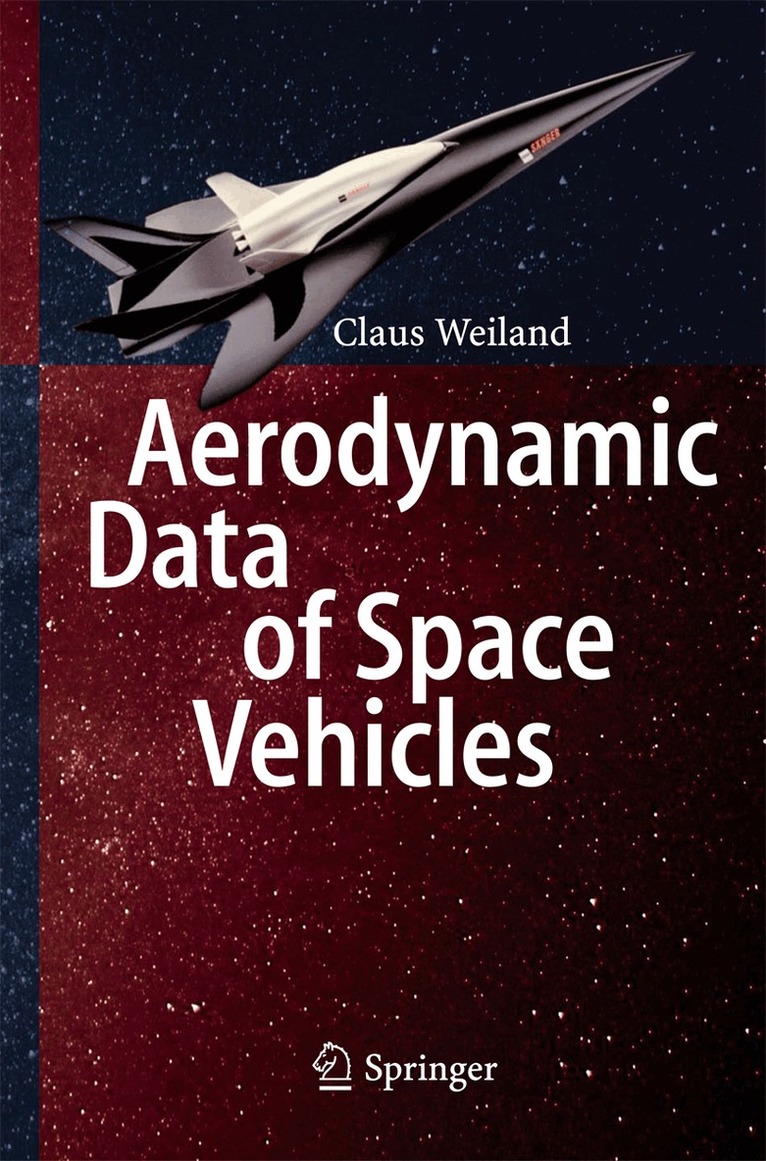
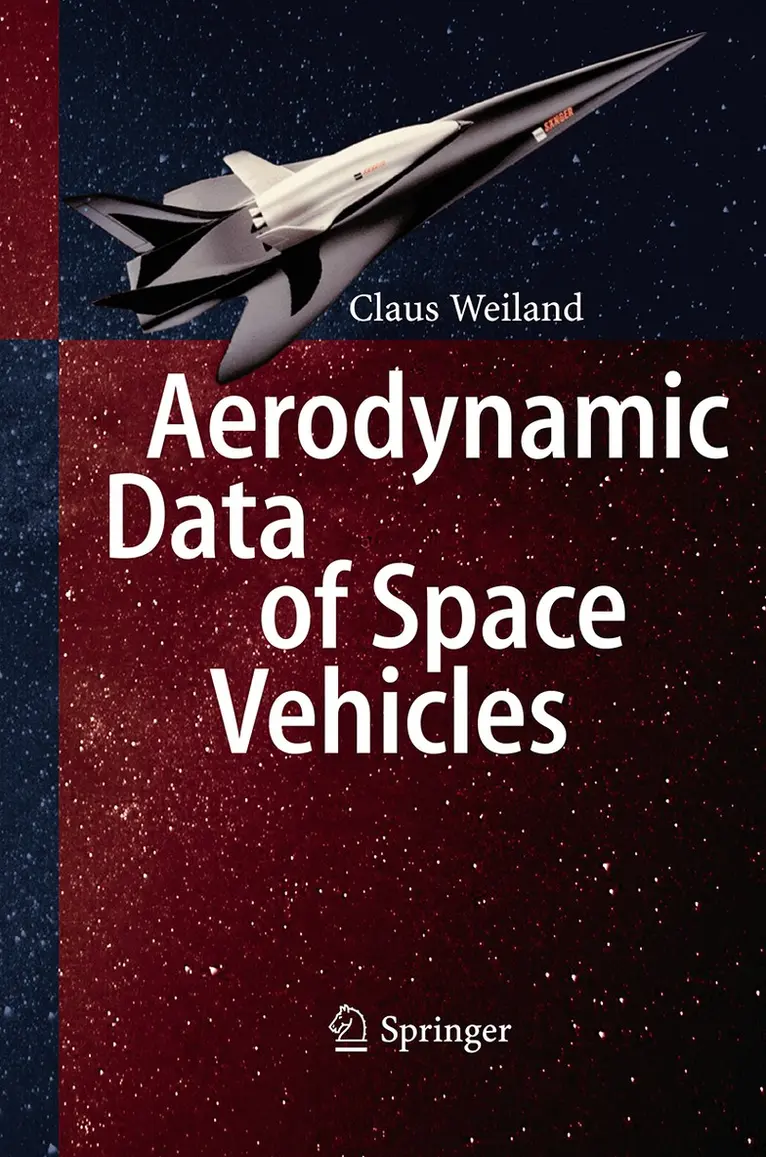
The capacity and quality of the atmospheric flight performance of space flight vehicles is characterized by their aerodynamic data bases. A complete aerodynamic data base would encompass the coefficients of the static longitudinal and lateral motions and the related dynamic coefficients.
In this book the aerodynamics of 27 vehicles are considered. Only a few of them did really fly. Therefore the aerodynamic data bases are often not complete, in particular when the projects or programs were more or less abruptly stopped, often due to political decisions. Configurational design studies or the development of demonstratorsusually happen with reduced or incomplete aerodynamic data sets. Therefore some data sets base just on the application of one of the following tools: semi-empirical design methods, wind tunnel tests, numerical simulations. In so far a high percentage of the data presented is incomplete and would have to be verified.
Flight mechanics needs the aerodynamic coefficients as function of a lot of variables. The allocation of the aerodynamic coefficients for a particular flight operation at a specific trajectory point is conducted by an aerodynamic model. The establishment of such models is described in this book.
This book is written for graduate and doctoral students to give them insight into the aerodynamics of the various flight configurations. Further for design and development engineers in industry and at research institutes (including universities) searching for an appropriate vehicle shape, as well as for non-specialists, who may be interested inthis subject. The book will be helpful, too, in the case that system studies require in their concept phases the selection of suitable vehicle shapes.
2 160 kr
Skickas inom 10-15 vardagar