Committee on Acute Exposure Guideline Levels – författare
836 kr
Läs direkt efter köp
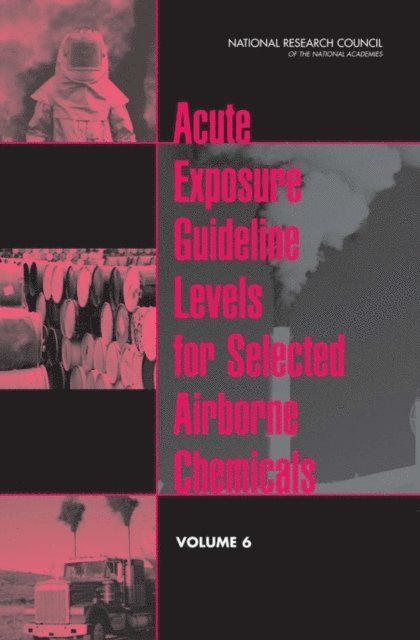
This book is the sixth volume in the series Acute Exposure Guideline Levels for Selected Airborne Chemicals, and includes AEGLs for chemicals such as ammonia, nickel carbonyl and phosphine, among others.
At the request of the Department of Defense, the National Research Council has reviewed the relevant scientific literature compiled by an expert panel and established Acute Exposure Guideline Levels (AEGLs) for 12 new chemicals. AEGLs represent exposure levels below which adverse health effects are not likely to occur and are useful in responding to emergencies such as accidental or intentional chemical releases in the community, the workplace, transportation, the military, and for the remediation of contaminated sites.
Three AEGLs are approved for each chemical, representing exposure levels that result in: 1) notable but reversible discomfort; 2) long-lasting health effects; and 3) life-threatening health impacts.
666 kr
Läs direkt efter köp
This book is the seventh volume in the series Acute Exposure Guideline Levels for Selected Airborne Chemicals, and includes AEGLs for acetone cyanohydrin, carbon disulfide, monochloroacetic acid, and phenol.
At the request of the Department of Defense, the National Research Council has reviewed the relevant scientific literature compiled by an expert panel and established Acute Exposure Guideline Levels (AEGLs) for 12 new chemicals. AEGLs represent exposure levels below which adverse health effects are not likely to occur and are useful in responding to emergencies such as accidental or intentional chemical releases in the community, the workplace, transportation, the military, and for the remediation of contaminated sites.
Three AEGLs are approved for each chemical, representing exposure levels that result in: 1) notable but reversible discomfort; 2) long-lasting health effects; and 3) life-threatening health impacts.
974 kr
Läs direkt efter köp
This book is the seventh volume in the series Acute Exposure Guideline Levels for Selected Airborne Chemicals, and includes AEGLs for acetone cyanohydrin, carbon disulfide, monochloroacetic acid, and phenol.
At the request of the Department of Defense, the National Research Council has reviewed the relevant scientific literature compiled by an expert panel and established Acute Exposure Guideline Levels (AEGLs) for 12 new chemicals. AEGLs represent exposure levels below which adverse health effects are not likely to occur and are useful in responding to emergencies such as accidental or intentional chemical releases in the community, the workplace, transportation, the military, and for the remediation of contaminated sites.
Three AEGLs are approved for each chemical, representing exposure levels that result in: 1) notable but reversible discomfort; 2) long-lasting health effects; and 3) life-threatening health impacts.
1 145 kr
Läs direkt efter köp
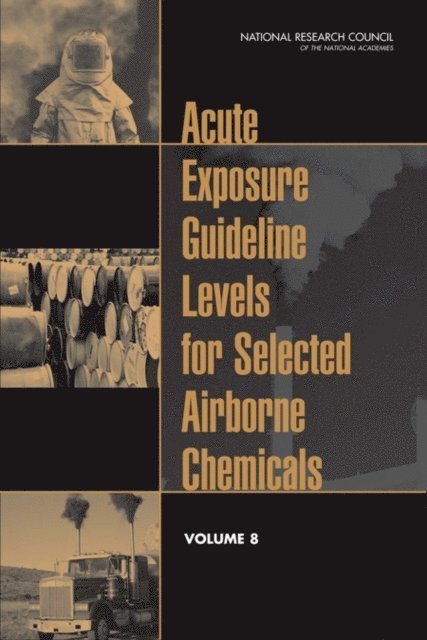
This book is the eighth volume in the series Acute Exposure Guideline Levels for Selected Airborne Chemicals, and reviews AEGLs for acrolein, carbon monoxide, 1,2-dichloroethene, ethylenimine, fluorine, hydrazine, peracetic acid, propylenimine, and sulfur dioxide for scientific accuracy, completeness, and consistency with the NRC guideline reports.
1 170 kr
Läs direkt efter köp
This book is the eighth volume in the series Acute Exposure Guideline Levels for Selected Airborne Chemicals, and reviews AEGLs for acrolein, carbon monoxide, 1,2-dichloroethene, ethylenimine, fluorine, hydrazine, peracetic acid, propylenimine, and sulfur dioxide for scientific accuracy, completeness, and consistency with the NRC guideline reports.
1 112 kr
Läs direkt efter köp
This book is the ninth volume in the series Acute Exposure Guideline Levels for Selected Airborne Chemicals, and reviews AEGLs for bromine, ethylene oxide, furan, hydrogen sulfide, propylene oxide, and xylenes.
1 136 kr
Läs direkt efter köp
This book is the ninth volume in the series Acute Exposure Guideline Levels for Selected Airborne Chemicals, and reviews AEGLs for bromine, ethylene oxide, furan, hydrogen sulfide, propylene oxide, and xylenes.
1 170 kr
Läs direkt efter köp
This book is the sixth volume in the series Acute Exposure Guideline Levels for Selected Airborne Chemicals, and includes AEGLs for chemicals such as ammonia, nickel carbonyl and phosphine, among others.
At the request of the Department of Defense, the National Research Council has reviewed the relevant scientific literature compiled by an expert panel and established Acute Exposure Guideline Levels (AEGLs) for 12 new chemicals. AEGLs represent exposure levels below which adverse health effects are not likely to occur and are useful in responding to emergencies such as accidental or intentional chemical releases in the community, the workplace, transportation, the military, and for the remediation of contaminated sites.
Three AEGLs are approved for each chemical, representing exposure levels that result in: 1) notable but reversible discomfort; 2) long-lasting health effects; and 3) life-threatening health impacts.
1 055 kr
Läs direkt efter köp
In 1993, the National Research Council''s Committee on Toxicology developed criteria and methods for EPA and the Agency for Toxic Substances and Disease Registry (ATSDR) to develop community emergency exposure levels for extremely hazardous substances for the general population. A few years later, the National Advisory Committee for Acute Exposure Guideline Levels for Hazardous Substances (NAC)—composed of members of EPA, DOD, other federal and state agencies, industry, academia, and other organizations—was established to identify, review, and interpret toxicologic and other scientific data to develop acute exposure guidelines (AEGLs) for high-priority, acutely toxic chemicals. Three levels—AEGL-1, AEGL-2, and AEGL-3 are developed for each of five exposure periods (10 min, 30 min, 1 hr, 4 hr, and 8 hr) and are distinguished by varying degrees of severity of toxic effects. This current report reviews the NAC reports for their scientific validity, completeness, and consistency with the NRC guideline reports developed in 1993 and 2001. This report is the fifth volume in the series and covers AEGLs for chlorine dioxide, chlorine trifluoride, cyclohexylamine, ethylenediamine, hydrofluoroether-7100, and tetranitromethane. It concludes that the AEGLs developed by NAC are scientifically valid and consistent with the NRC guideline reports. AEGLs are needed for a wide range of planning, response, and prevention applications. These values provide data critical to evacuation decisions and discussions between community leaders and industries as they seek ways to minimize the health impact should the chemical release occur. Some of the finalized AEGLs have been officially adopted by the Department of the Army, FEMA, and the Department of Transportation as the official levels for use by those agencies.
811 kr
Läs direkt efter köp
Extremely hazardous substances (EHSs)² can be released accidentally as a result of chemical spills, industrial explosions, fires, or accidents involving railroad cars and trucks transporting EHSs. Workers and residents in communities surrounding industrial facilities where EHSs are manufactured, used, or stored and in communities along the nation''s railways and highways are potentially at risk of being exposed to airborne EHSs during accidental releases or intentional releases by terrorists. Pursuant to the Superfund Amendments and Reauthorization Act of 1986, the U.S. Environmental Protection Agency (EPA) has identified approximately 400 EHSs on the basis of acute lethality data in rodents.
As part of its efforts to develop acute exposure guideline levels for EHSs, EPA and the Agency for Toxic Substances and Disease Registry (ATSDR) in 1991 requested that the National Research Council (NRC) develop guidelines for establishing such levels. In response to that request, the NRC published Guidelines for Developing Community Emergency Exposure Levels for Hazardous Substances in 1993. Subsequently, Standard Operating Procedures for Developing Acute Exposure Guideline Levels for Hazardous Substances was published in 2001, providing updated procedures, methodologies, and other guidelines used by the National Advisory Committee (NAC) on Acute Exposure Guideline Levels for Hazardous Substances and the Committee on Acute Exposure Guideline Levels (AEGLs) in developing the AEGL values. In 1998, EPA and DOD requested that the NRC independently review the AEGLs developed by NAC. In response to that request, the NRC organized within its Committee on Toxicology (COT) the Committee on Acute Exposure Guideline Levels, which prepared this report.
Acute Exposure Guideline Levels for Selected Airborne Chemicals is the tenth volume of the series and documents for N,N-dimethylformamide, jet propellant fuels 5 and 8, methyl ethyl ketone, perchloromethyl mercaptan, phosphorus oxychloride, phosphorus trichloride, and sulfuryl chloride.
892 kr
Läs direkt efter köp
Extremely hazardous substances (EHSs)² can be released accidentally as a result of chemical spills, industrial explosions, fires, or accidents involving railroad cars and trucks transporting EHSs. Workers and residents in communities surrounding industrial facilities where EHSs are manufactured, used, or stored and in communities along the nation''s railways and highways are potentially at risk of being exposed to airborne EHSs during accidental releases or intentional releases by terrorists. Pursuant to the Superfund Amendments and Reauthorization Act of 1986, the U.S. Environmental Protection Agency (EPA) has identified approximately 400 EHSs on the basis of acute lethality data in rodents.
As part of its efforts to develop acute exposure guideline levels for EHSs, EPA and the Agency for Toxic Substances and Disease Registry (ATSDR) in 1991 requested that the National Research Council (NRC) develop guidelines for establishing such levels. In response to that request, the NRC published Guidelines for Developing Community Emergency Exposure Levels for Hazardous Substances in 1993. Subsequently, Standard Operating Procedures for Developing Acute Exposure Guideline Levels for Hazardous Substances was published in 2001, providing updated procedures, methodologies, and other guidelines used by the National Advisory Committee (NAC) on Acute Exposure Guideline Levels for Hazardous Substances and the Committee on Acute Exposure Guideline Levels (AEGLs) in developing the AEGL values. In 1998, EPA and DOD requested that the NRC independently review the AEGLs developed by NAC. In response to that request, the NRC organized within its Committee on Toxicology (COT) the Committee on Acute Exposure Guideline Levels, which prepared this report.
Acute Exposure Guideline Levels for Selected Airborne Chemicals is the tenth volume of the series and documents for N,N-dimethylformamide, jet propellant fuels 5 and 8, methyl ethyl ketone, perchloromethyl mercaptan, phosphorus oxychloride, phosphorus trichloride, and sulfuryl chloride.
714 kr
Läs direkt efter köp
At the request of the Department of Defense and the Environmental Protection Agency, the National Research Council has reviewed the relevant scientific literature compiled by an expert panel and established Acute Exposure Guideline Levels (AEGLs) for several chemicals. AEGLs represent exposure levels below which adverse health effects are not likely to occur and are useful in responding to emergencies, such as accidental or intentional chemical releases in community, workplace, transportation, and military settings, and for the remediation of contaminated sites.
Three AEGLs are approved for each chemical, representing exposure levels that result in: 1) notable but reversible discomfort; 2) long-lasting health effects; and 3) life-threatening health impacts. Acute Exposure Guideline Levels for Selected Airborne Chemicals: Volume 13 includes AEGLs for boron trifluoride, bromoacetone, chloroacetone, hexafluoroacetone, perchloryl fluoride, piperidine, propargyl alcohol, trimethoxysilane and tetramethoxysilane, and trimethylbenzenes.
714 kr
Läs direkt efter köp
Acute Exposure Guideline Levels for Selected Airborne Chemicals, Volume 15 identifies, reviews, and interprets relevant toxicologic and other scientific data for ethyl mercaptan, methyl mercaptan, phenyl mercaptan, tert-octyl mercaptan, lewisite, methyl isothiocyanate, and selected monoisocyanates in order to develop acute exposure guideline levels (AEGLs) for these high-priority, acutely toxic chemicals.
AEGLs represent threshold exposure limits (exposure levels below which adverse health effects are not likely to occur) for the general public and are applicable to emergency exposures ranging from 10 minutes (min) to 8 h. Three level—AEGL-1, AEGL-2, and AEGL-3—are developed for each of five exposure periods (10 min, 30 min, 1 h, 4 h, and 8 h) and are distinguished by varying degrees of severity of toxic effects. This report will inform planning, response, and prevention in the community, the workplace, transportation, the military, and the remediation of Superfund sites.
974 kr
Läs direkt efter köp
Extremely hazardous substances can be released accidentally as a result of chemical spills, industrial explosions, fires, or accidents involving railroad cars and trucks transporting EHSs. Workers and residents in communities surrounding industrial facilities where these substances are manufactured, used, or stored and in communities along the nation''s railways and highways are potentially at risk of being exposed to airborne extremely hazardous substances during accidental releases or intentional releases by terrorists. Pursuant to the Superfund Amendments and Reauthorization Act of 1986, the U.S. Environmental Protection Agency has identified approximately 400 extremely hazardous substances on the basis of acute lethality data in rodents.
Acute Exposure Guideline Levels for Selected Airborne Chemicals, Volume 16 identifies, reviews, and interprets relevant toxicologic and other scientific data for selected aliphatic nitriles, benzonitrile, methacrylonitrile, allyl alcohol, hydrogen selenide, ketene, and tear gasin order to develop acute exposure guideline levels (AEGLs) for these high-priority, acutely toxic chemicals.
AEGLs represent threshold exposure limits (exposure levels below which adverse health effects are not likely to occur) for the general public and are applicable to emergency exposures ranging from 10 minutes (min) to 8 h. Three levels - AEGL-1, AEGL-2, and AEGL-3 - are developed for each of five exposure periods (10 min, 30 min, 1 h, 4 h, and 8 h) and are distinguished by varying degrees of severity of toxic effects. This report will inform planning, response, and prevention in the community, the workplace, transportation, the military, and the remediation of Superfund sites.
1 136 kr
Läs direkt efter köp
Extremely hazardous substances can be released accidentally as a result of chemical spills, industrial explosions, fires, or accidents involving railroad cars and trucks transporting EHSs. Workers and residents in communities surrounding industrial facilities where these substances are manufactured, used, or stored and in communities along the nation''s railways and highways are potentially at risk of being exposed to airborne EHSs during accidental releases or intentional releases by terrorists. Pursuant to the Superfund Amendments and Reauthorization Act of 1986, the U.S. Environmental Protection Agency (EPA) has identified approximately 400 EHSs on the basis of acute lethality data in rodents.
Acute Exposure Guideline Levels for Selected Airborne Chemicals, Volume 17 identifies, reviews, and interprets relevant toxicologic and other scientific data for selected AEGL documents for acrylonitrile, carbon tetrachloride, cyanogen, epichlorohydrin, ethylene chlorohydrin, toluene, trimethylacetyl chloride, hydrogen bromide, and boron tribromide in order to develop acute exposure guideline levels (AEGLs) for these high-priority, acutely toxic chemicals.
AEGLs represent threshold exposure limits (exposure levels below which adverse health effects are not likely to occur) for the general public and are applicable to emergency exposures ranging from 10 minutes (min) to 8 h. Three levels - AEGL-1, AEGL-2, and AEGL-3 - are developed for each of five exposure periods (10 min, 30 min, 1 h, 4 h, and 8 h) and are distinguished by varying degrees of severity of toxic effects. This report will inform planning, response, and prevention in the community, the workplace, transportation, the military, and the remediation of Superfund sites.
730 kr
Läs direkt efter köp
Extremely hazardous substances can be released accidentally as a result of chemical spills, industrial explosions, fires, or accidents involving railroad cars and trucks transporting EHSs. Workers and residents in communities surrounding industrial facilities where these substances are manufactured, used, or stored and in communities along the nation''s railways and highways are potentially at risk of being exposed to airborne EHSs during accidental releases or intentional releases by terrorists. Pursuant to the Superfund Amendments and Reauthorization Act of 1986, the U.S. Environmental Protection Agency (EPA) has identified approximately 400 EHSs on the basis of acute lethality data in rodents.
Acute Exposure Guideline Levels for Selected Airborne Chemicals, Volume 18 identifies, reviews, and interprets relevant toxicologic and other scientific data for selected AEGL documents for bromine chloride, carbonyl fluoride, selected halogen fluorides, and oxygen difluoride in order to develop acute exposure guideline levels (AEGLs) for these high-priority, acutely toxic chemicals.
AEGLs represent threshold exposure limits (exposure levels below which adverse health effects are not likely to occur) for the general public and are applicable to emergency exposures ranging from 10 minutes (min) to 8 h. Three levels - AEGL-1, AEGL-2, and AEGL-3 - are developed for each of five exposure periods (10 min, 30 min, 1 h, 4 h, and 8 h) and are distinguished by varying degrees of severity of toxic effects. This report will inform planning, response, and prevention in the community, the workplace, transportation, the military, and the remediation of Superfund sites.
730 kr
Läs direkt efter köp
Extremely hazardous substances can be released accidentally as a result of chemical spills, industrial explosions, fires, or accidents involving railroad cars and trucks transporting EHSs. Workers and residents in communities surrounding industrial facilities where these substances are manufactured, used, or stored and in communities along the nation''s railways and highways are potentially at risk of being exposed to airborne EHSs during accidental releases or intentional releases by terrorists. Pursuant to the Superfund Amendments and Reauthorization Act of 1986, the U.S. Environmental Protection Agency (EPA) has identified approximately 400 EHSs on the basis of acute lethality data in rodents.
Acute Exposure Guideline Levels for Selected Airborne Chemicals, Volume 19 identifies, reviews, and interprets relevant toxicologic and other scientific data for selected AEGL documents for cyanide salts, diketene, methacrylaldehyde, pentaborane, tellurium hexafluoride, and tetrafluoroethylene in order to develop acute exposure guideline levels (AEGLs) for these high-priority, acutely toxic chemicals.
AEGLs represent threshold exposure limits (exposure levels below which adverse health effects are not likely to occur) for the general public and are applicable to emergency exposures ranging from 10 minutes (min) to 8 h. Three levels - AEGL-1, AEGL-2, and AEGL-3 - are developed for each of five exposure periods (10 min, 30 min, 1 h, 4 h, and 8 h) and are distinguished by varying degrees of severity of toxic effects. This report will inform planning, response, and prevention in the community, the workplace, transportation, the military, and the remediation of Superfund sites.
795 kr
Läs direkt efter köp
Extremely hazardous substances can be released accidentally as a result of chemical spills, industrial explosions, fires, or accidents involving railroad cars and trucks transporting EHSs. Workers and residents in communities surrounding industrial facilities where these substances are manufactured, used, or stored and in communities along the nation''s railways and highways are potentially at risk of being exposed to airborne EHSs during accidental releases or intentional releases by terrorists. Pursuant to the Superfund Amendments and Reauthorization Act of 1986, the U.S. Environmental Protection Agency (EPA) has identified approximately 400 EHSs on the basis of acute lethality data in rodents.
Acute Exposure Guideline Levels for Selected Airborne Chemicals, Volume 20 reviews and updates the technical support document on acute exposure guideline levels (AEGLs) for selected chloroformates. This update focuses on establishing AEGL-3 values for n-propyl chloroformate and isopropyl chloroformate, but will also consider whether any new data are available that would affect the proposed values for the other 10 chloroformates.
AEGLs represent threshold exposure limits (exposure levels below which adverse health effects are not likely to occur) for the general public and are applicable to emergency exposures ranging from 10 minutes (min) to 8 h. Three levels - AEGL-1, AEGL-2, and AEGL-3 - are developed for each of five exposure periods (10 min, 30 min, 1 h, 4 h, and 8 h) and are distinguished by varying degrees of severity of toxic effects. This report will inform planning, response, and prevention in the community, the workplace, transportation, the military, and the remediation of Superfund sites.
755 kr
Läs direkt efter köp
In 1993, the National Research Council''s Committee on Toxicology developed criteria and methods for EPA and the Agency for Toxic Substances and Disease Registry (ATSDR) to develop community emergency exposure levels for extremely hazardous substances for the general population. A few years later, the National Advisory Committee for Acute Exposure Guideline Levels for Hazardous Substances (NAC)—composed of members of EPA, DOD, other federal and state agencies, industry, academia, and other organizations—was established to identify, review, and interpret toxicologic and other scientific data to develop acute exposure guidelines (AEGLs) for high-priority, acutely toxic chemicals. Three levels—AEGL-1, AEGL-2, and AEGL-3 are developed for each of five exposure periods (10 min, 30 min, 1 hr, 4 hr, and 8 hr) and are distinguished by varying degrees of severity of toxic effects. This current report reviews the NAC reports for their scientific validity, completeness, and consistency with the NRC guideline reports developed in 1993 and 2001. This report is the fifth volume in the series and covers AEGLs for chlorine dioxide, chlorine trifluoride, cyclohexylamine, ethylenediamine, hydrofluoroether-7100, and tetranitromethane. It concludes that the AEGLs developed by NAC are scientifically valid and consistent with the NRC guideline reports. AEGLs are needed for a wide range of planning, response, and prevention applications. These values provide data critical to evacuation decisions and discussions between community leaders and industries as they seek ways to minimize the health impact should the chemical release occur. Some of the finalized AEGLs have been officially adopted by the Department of the Army, FEMA, and the Department of Transportation as the official levels for use by those agencies.
935 kr
Tillfälligt slut
992 kr
Tillfälligt slut
854 kr
Tillfälligt slut
1 003 kr
Tillfälligt slut
1 003 kr
Tillfälligt slut
597 kr
Tillfälligt slut
419 kr
Tillfälligt slut
550 kr
Tillfälligt slut
504 kr
Tillfälligt slut
488 kr
Tillfälligt slut
503 kr
Tillfälligt slut