Costantino Thanos – författare
Visar alla böcker från författaren Costantino Thanos. Handla med fri frakt och snabb leverans.
10 produkter
10 produkter
Häftad, Engelska, 2002
1 116 kr
Skickas inom 10-15 vardagar
ECDL 2002 was the 6th conference in the series of European Conferences on Research and Advanced Technologies for Digital Libraries. Following previous events in Pisa (1997), Heraklion (1998), Paris (1999), Lisbon (2000), and Da- stadt (2001), this year ECDL was held in Rome. ECDL 2002 contributed, - gether with the previous conferences, to establishing ECDL as the major - ropean forum focusing on digital libraries and associated technical, practical, and social issues. ECDL 2002 continued the tradition already established by the previous conferences in meeting the needs of a large and diverse constituency, which includes researchers, practitioners, educators, policy makers, and users. The focus of ECDL 2002 was on underlying principles, methods, systems, and tools to build and make available e?ective digital libraries to end users. Architecture, metadata, collection building, web archiving, web technologies,- books, OAI applications, preservation, navigation, query languages, audio video retrieval, multimedia-mixed media, user studies and evaluation, humanities, and digital libraries were some of the key issues addressed. An international Program Committee was set up composed of 61 members, with representatives from 25 countries. A total of 145 paper submissions, 15 poster submissions, and 18 proposals for demos were received. Each paper was evaluated by 3 referees and 42 full papers and 6 short papers of high quality were selected for presentation.
E-bok
PDF, Engelska, 20031 459 kr
Läs direkt efter köp
ECDL 2002 was the 6th conference in the series of European Conferences on Research and Advanced Technologies for Digital Libraries. Following previous events in Pisa (1997), Heraklion (1998), Paris (1999), Lisbon (2000), and Da- stadt (2001), this year ECDL was held in Rome. ECDL 2002 contributed, - gether with the previous conferences, to establishing ECDL as the major - ropean forum focusing on digital libraries and associated technical, practical, and social issues. ECDL 2002 continued the tradition already established by the previous conferences in meeting the needs of a large and diverse constituency, which includes researchers, practitioners, educators, policy makers, and users. The focus of ECDL 2002 was on underlying principles, methods, systems, and tools to build and make available e?ective digital libraries to end users. Architecture, metadata, collection building, web archiving, web technologies,- books, OAI applications, preservation, navigation, query languages, audio video retrieval, multimedia-mixed media, user studies and evaluation, humanities, and digital libraries were some of the key issues addressed. An international Program Committee was set up composed of 61 members, with representatives from 25 countries. A total of 145 paper submissions, 15 poster submissions, and 18 proposals for demos were received. Each paper was evaluated by 3 referees and 42 full papers and 6 short papers of high quality were selected for presentation.
Häftad, Engelska, 1990
562 kr
Skickas inom 10-15 vardagar
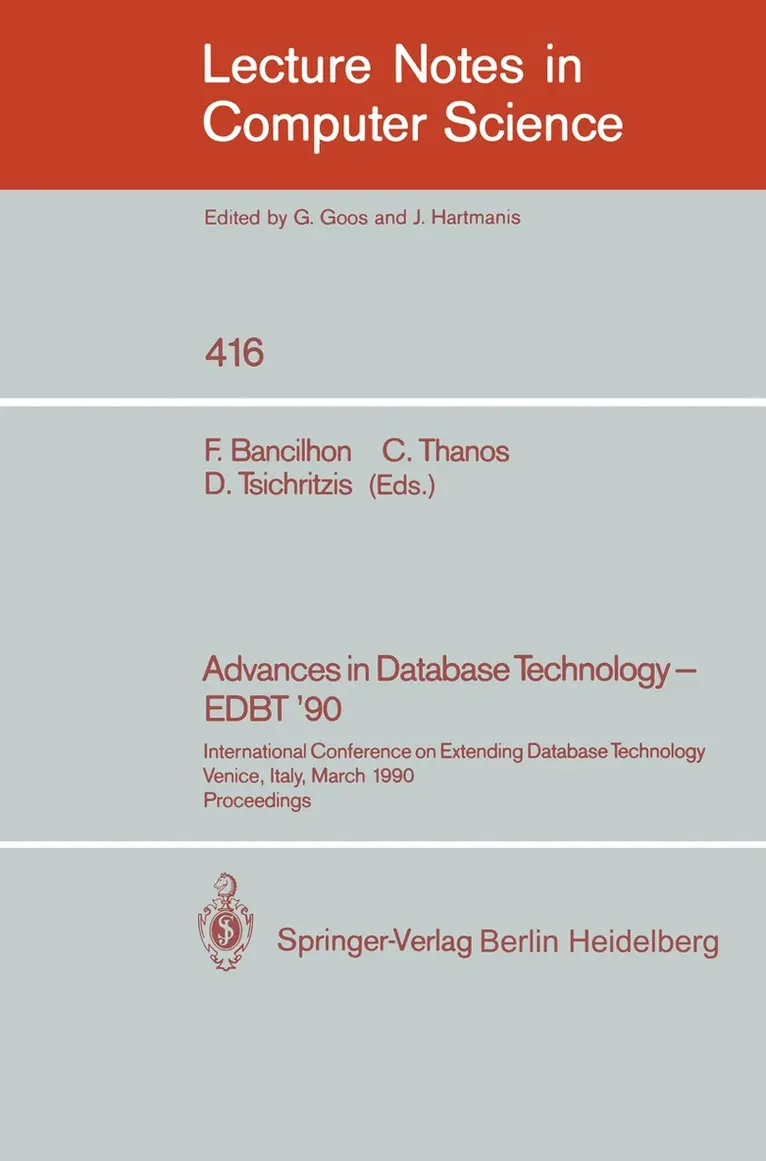
Database technology is currently being pushed by the needs of new applications and pulled by the oppor- tunities of novel developments in hardware and systems architecture. The invited paper, two panel sessions and 27 papers in this volume report on how the technology is currently extending. One broad area covered is extended database semantics, including data models and data types, databases and logic, complex objects, and expert system approaches to databases. The other area covered is raw architectures and increased database systems support, including novel transaction models, data distribution and replication, database administration, and access efficiency.
Häftad, Engelska, 1997
562 kr
Skickas inom 10-15 vardagar
This book constitutes the refereed proceedings of the First European Conference on Research and Advanced Technology for Digital Libraries held in Pisa, Italy, in September 1997.The volume presents 23 revised full papers selected from 77 submissions. Also included are two invited contributions. The papers are organized in topical sections on supporting user interfaces, metadata, information retrieval, DL architectures, multilingual information retrieval, structured documents, and case studies.
Häftad, Engelska, 2007
537 kr
Skickas inom 10-15 vardagar
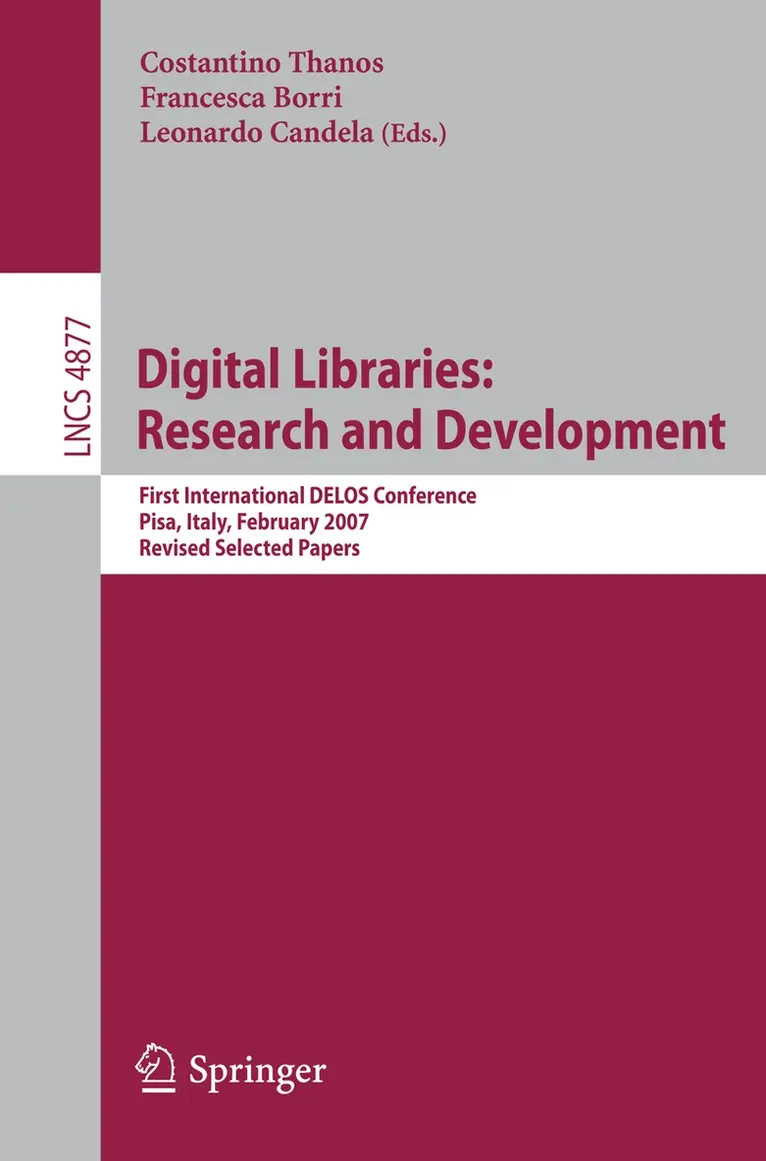
This book constitutes the thoroughly refereed post-proceedings of the First International Conference on Digital Libraries, DELOS 2007, held in Pisa, Italy, in February 2007. The 33 revised full papers presented were carefully reviewed and selected for inclusion in the book. The papers are organized in topical sections on similarity search, architectures, personalization, interoperability, evaluation, miscellaneous, preservation, video data management, 3D objects, and peer to peer.
E-bok
PDF, Engelska, 2007734 kr
Läs direkt efter köp
Häftad, Engelska, 2010
562 kr
Skickas inom 10-15 vardagar
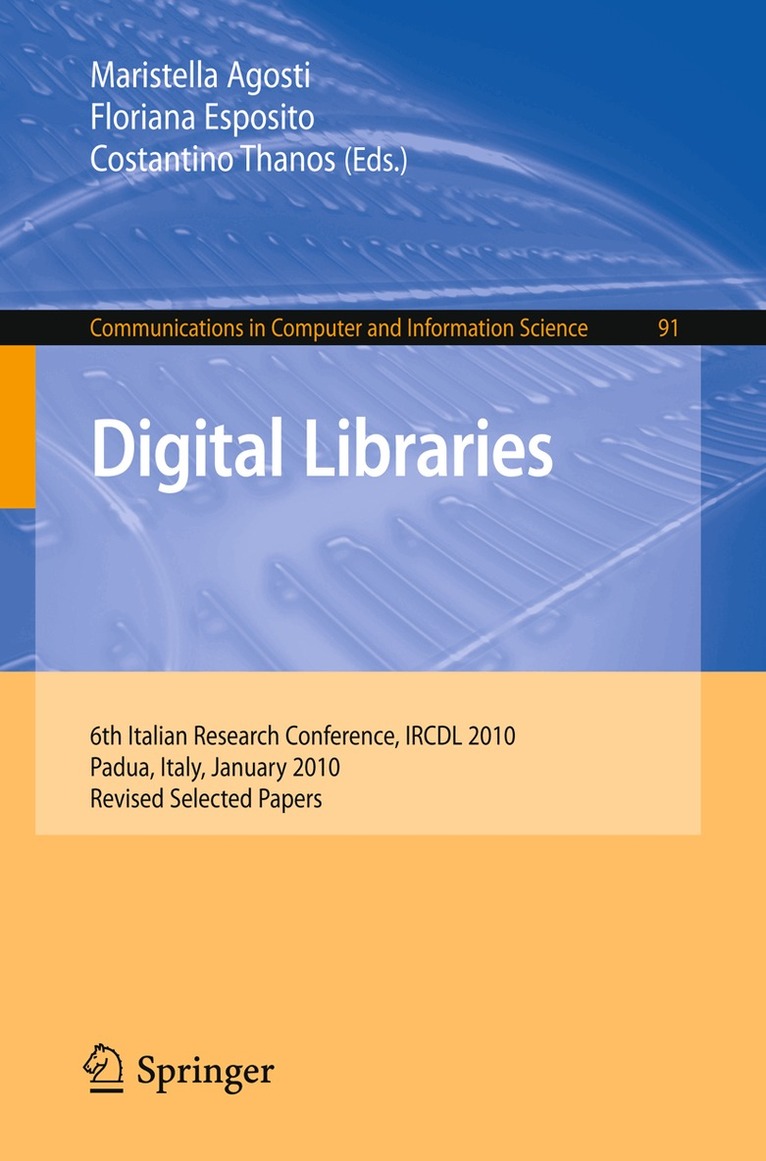
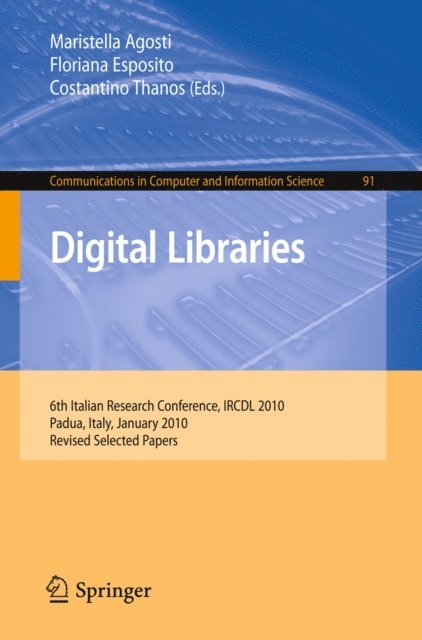
Thisvolumecontainstherevisedacceptedpapersfromamongthosepresentedat the 6th Italian Research Conference on Digital Libraries (IRCDL 2010), which was held in the Department of Information Engineering of the University of Padua, Italy, during January 28-29, 2010. The well-established aim of IRCDL is to bring together Italian researchers interested in the di?erent methods and techniques that allow the building and operation of Digital Libraries. A national Program Committee was set up c- posed of 15 members, with representatives of the most active Italian research groups on Digital Libraries. Seventeen of the papers presented at the conference were accepted for - clusion in this volume. Selected authors submitted expanded versions of their workshoppapers. Those papers were reviewed again and the results of the sel- tion arethe papers appearingin these proceedings.The coveredtopics testifying to the bright interests of the community are: - System Interoperability and Data Integration including emerging interop- ability issues and technologies promoting interoperability - Infrastructures, Metadata Creation and Content Management for Digital Libraries, such as methods and techniques for text summarization and key phraseextraction,ontology-basedannotation,event-centricprovenancem- els, semantic relatedness - Information Access and Search for Digital Library Systems from mat- matical symbol indexing to term-based text retrieval and disambiguation techniques, from audio-based information retrieval to video content-based identi?cation, classi?cation and retrieval - User Interfaces for Digital Libraries including interactive visual represen- tions, collaborativeuser interfaces,multimodal user interface for multimedia Digital Libraries, personalization models The volume also contains the reports on the two keynote addresses and a communication on a relevant national project.
E-bok
PDF, Engelska, 2010734 kr
Läs direkt efter köp
E-bok
PDF, Engelska, 20121 459 kr
Läs direkt efter köp
In the past, applied artificial intelligence systems were built with particular emphasis on general reasoning methods intended to function efficiently, even when only relatively little domain-specific knowledge was available. In other words, AI technology aimed at the processing of knowledge stored under comparatively general representation schemes. Nowadays, the focus has been redirected to the role played by specific and detailed knowledge, rather than to the reasoning methods themselves. Many new application systems are centered around knowledge bases, i. e. , they are based on large collections offacts, rules, and heuristics that cap ture knowledge about a specific domain of applications. Experience has shown that when used in combination with rich knowledge bases, even simple reasoning methods can be extremely effective in a wide variety of problem domains. Knowledge base construction and management will thus become the key factor in the development of viable knowledge-based ap plications. Knowledge Base Management Systems (KBMSs) are being proposed that provide user-friendly environments for the construction, retrieval, and manipUlation of large shared knowledge bases. In addition to deductive reasoning, KBMSs require operational characteristics such as concurrent access, integrity maintenance, error recovery, security, and perhaps distribution. For the development ofKBMSs, the need to integrate concepts and technologies from different areas, such as Artificial Intel ligence, Databases, and Logic, has been widely recognized. One of the central issues for KBMSs is the framework used for knowledge representation-semantic networks, frames, rules, and logics are proposed by the AI and logic communities.
Häftad, Engelska, 2012
1 116 kr
Skickas inom 10-15 vardagar
In the past, applied artificial intelligence systems were built with particular emphasis on general reasoning methods intended to function efficiently, even when only relatively little domain-specific knowledge was available. In other words, AI technology aimed at the processing of knowledge stored under comparatively general representation schemes. Nowadays, the focus has been redirected to the role played by specific and detailed knowledge, rather than to the reasoning methods themselves. Many new application systems are centered around knowledge bases, i. e. , they are based on large collections offacts, rules, and heuristics that cap ture knowledge about a specific domain of applications. Experience has shown that when used in combination with rich knowledge bases, even simple reasoning methods can be extremely effective in a wide variety of problem domains. Knowledge base construction and management will thus become the key factor in the development of viable knowledge-based ap plications. Knowledge Base Management Systems (KBMSs) are being proposed that provide user-friendly environments for the construction, retrieval, and manipUlation of large shared knowledge bases. In addition to deductive reasoning, KBMSs require operational characteristics such as concurrent access, integrity maintenance, error recovery, security, and perhaps distribution. For the development ofKBMSs, the need to integrate concepts and technologies from different areas, such as Artificial Intel ligence, Databases, and Logic, has been widely recognized. One of the central issues for KBMSs is the framework used for knowledge representation-semantic networks, frames, rules, and logics are proposed by the AI and logic communities.