Craig Murray - Böcker
Visar alla böcker från författaren Craig Murray. Handla med fri frakt och snabb leverans.
4 produkter
4 produkter
Amputation, Prosthesis Use, and Phantom Limb Pain
An Interdisciplinary Perspective
Inbunden, Engelska, 2009
876 kr
Skickas inom 10-15 vardagar
The main objective in the rehabilitation of people following amputation is to restore or improve their functioning, which includes their return to work. Full-time employment leads to beneficial health effects and being healthy leads to increased chances of full-time employment (Ross and Mirowskay 1995). Employment of disabled people enhances their self-esteem and reduces social isolation (Dougherty 1999). The importance of returning to work for people following amputation the- fore has to be considered. Perhaps the first article about reemployment and problems people may have at work after amputation was published in 1955 (Boynton 1955). In later years, there have been sporadic studies on this topic. Greater interest and more studies about returning to work and problems people have at work following amputation arose in the 1990s and has continued in recent years (Burger and Marinc ?ek 2007). These studies were conducted in different countries on all the five continents, the greatest number being carried out in Europe, mainly in the Netherlands and the UK (Burger and Marinc ?ek 2007). Owing to the different functions of our lower and upper limbs, people with lower limb amputations have different activity limitations and participation restrictions compared to people with upper limb amputations. Both have problems with driving and carrying objects. People with lower limb amputations also have problems standing, walking, running, kicking, turning and stamping, whereas people with upper limb amputations have problems grasping, lifting, pushing, pulling, writing, typing, and pounding (Giridhar et al. 2001).
Pockets of Resistance
British News Media, War and Theory in the 2003 Invasion of Iraq
Inbunden, Engelska, 2010
1 068 kr
Tillfälligt slut
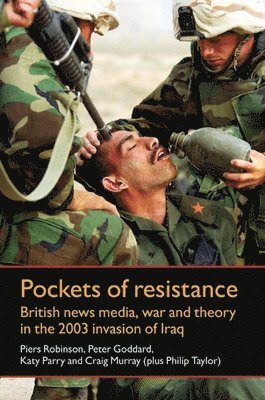
For scholars of media and war, the 2003 invasion of Iraq is a compelling case to study. As part of President Bush’s ‘war on terror’, the invasion was the most controversial British foreign policy decision since Suez, and its ramifications and aftermath have rarely been far from the news. In the many political and public debates regarding this conflict, arguments over the role of the media have been omnipresent. For some, media coverage was biased against the war, for others it became a cheerleader for the invasion. Where does the truth lie? Drawing upon a uniquely-detailed and rich content and framing analysis of television and press coverage, and on interviews with some of the journalists involved, Pockets of Resistance provides an authoritative assessment of how British news media reported the 2003 Iraq invasion and also of the theoretical implications of this case for our understanding of wartime media-state relations. Pockets of Resistance examines the successes and failures of British television news as it sought to attain independence under the difficult circumstances of war, and describes and explains the emergence of some surprisingly vociferous anti-war voices within a diverse national press.
Pockets of resistance
British news media, war and theory in the 2003 invasion of Iraq
Häftad, Engelska, 2010
354 kr
Skickas inom 5-8 vardagar
For scholars of media and war, the 2003 invasion of Iraq is a compelling case to study. As part of President Bush’s ‘war on terror’, the invasion was the most controversial British foreign policy decision since Suez, and its ramifications and aftermath have rarely been far from the news. In the many political and public debates regarding this conflict, arguments over the role of the media have been omnipresent. For some, media coverage was biased against the war, for others it became a cheerleader for the invasion. Where does the truth lie? Drawing upon a uniquely-detailed and rich content and framing analysis of television and press coverage, and on interviews with some of the journalists involved, Pockets of Resistance provides an authoritative assessment of how British news media reported the 2003 Iraq invasion and also of the theoretical implications of this case for our understanding of wartime media-state relations. Pockets of Resistance examines the successes and failures of British television news as it sought to attain independence under the difficult circumstances of war, and describes and explains the emergence of some surprisingly vociferous anti-war voices within a diverse national press.
Dirty Diplomacy: The Rough-And-Tumble Adventures of a Scotch-Drinking, Skirt-Chasing, Dictator-Busting and Thoroughly Unrepentant Ambassador Stuck on
Häftad, Engelska, 2011
324 kr
Skickas inom 3-6 vardagar