Csaba Szabo - Böcker
Visar alla böcker från författaren Csaba Szabo. Handla med fri frakt och snabb leverans.
9 produkter
9 produkter
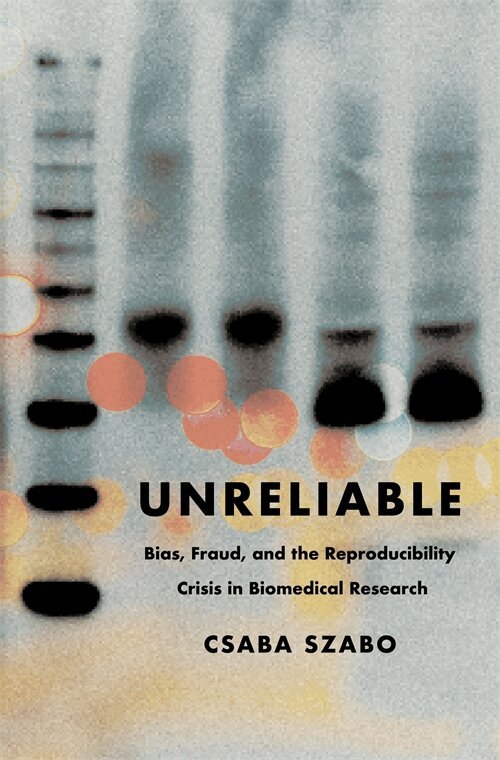
Unreliable
Bias, Fraud, and the Reproducibility Crisis in Biomedical Research
Inbunden, Engelska, 2025
978 kr
Skickas inom 7-10 vardagar
Reproducibility is fundamental to the scientific method. After reading a paper describing research findings, a scientist should be able to repeat the experiment and obtain the same results. Yet an alarming number—perhaps as high as 90 percent—of published biomedical research papers face challenges in independent replication. Such issues range from honest mistakes to outright fraud. The scope of this crisis, however, underscores deeper systemic issues within the scientific community: its culture, incentives, and institutions.In Unreliable, the distinguished scientist Csaba Szabo examines the causes and consequences of the reproducibility crisis in biomedical research, showing why the factors that encourage misconduct stem from flaws in real-world science. There are many culprits, including commonplace research methods and dubious statistical techniques. Academic career incentives, hypercompetition for grant funding, and a bias toward publishing positive results have exacerbated the problem. Deliberate data manipulation and fabricated findings churned out by “paper mills” are disturbingly common. Academic institutions and publishers, for their part, have perpetuated a culture of impunity.Szabo explores how these failures have hindered scientific progress and impeded the development of new treatments, and he introduces readers to the “science sleuths” who tirelessly uncover misconduct. He proposes comprehensive reforms, from scientific training to the grant system through the publication process, to address the root causes of the crisis. Written in clear language and leavened with a keen sense of irony, Unreliable is an essential account of the reproducibility crisis that gives readers an inside look at how science is actually done.
351 kr
Skickas inom 7-10 vardagar
Reproducibility is fundamental to the scientific method. After reading a paper describing research findings, a scientist should be able to repeat the experiment and obtain the same results. Yet an alarming number—perhaps as high as 90 percent—of published biomedical research papers face challenges in independent replication. Such issues range from honest mistakes to outright fraud. The scope of this crisis, however, underscores deeper systemic issues within the scientific community: its culture, incentives, and institutions.In Unreliable, the distinguished scientist Csaba Szabo examines the causes and consequences of the reproducibility crisis in biomedical research, showing why the factors that encourage misconduct stem from flaws in real-world science. There are many culprits, including commonplace research methods and dubious statistical techniques. Academic career incentives, hypercompetition for grant funding, and a bias toward publishing positive results have exacerbated the problem. Deliberate data manipulation and fabricated findings churned out by “paper mills” are disturbingly common. Academic institutions and publishers, for their part, have perpetuated a culture of impunity.Szabo explores how these failures have hindered scientific progress and impeded the development of new treatments, and he introduces readers to the “science sleuths” who tirelessly uncover misconduct. He proposes comprehensive reforms, from scientific training to the grant system through the publication process, to address the root causes of the crisis. Written in clear language and leavened with a keen sense of irony, Unreliable is an essential account of the reproducibility crisis that gives readers an inside look at how science is actually done.
1 138 kr
Tillfälligt slut
Access to the Internet is an increasing problem in many areas of the world. As the popularity and usefulness of the Internet increases on a daily basis, lack of access to the technology is putting many groups at a disadvantage in terms of better education, better jobs and even in terms of higher levels of civic participation. However, creating a network infrastructure to serve outlying communities and sectors of the population is not straight-forward. This book brings together all the aspects of the problem – technical, regulatory and economic - into one volume to provide a comprehensive resource. It describes the latest technological advances that allow cost-effective network infrastructures to be built, and places them in the context of the applications and services that the infrastructure will deliver. A section on business models and case studies from North American and Europe demonstrate that the solutions are economically and practically viable.This book is essential for anyone looking to gain an understanding of the issues and technology surrounding the access debate. It will be of particular relevance to network engineers/designers/planners at the incumbent operator companies charged with delivering broadband access to as yet unconnected regions. Governments and regulatory bodies will also find this a useful guide to the problems that they may face.
3 812 kr
Skickas inom 7-10 vardagar
After a century of research, several lines of evidence now indicate that the ability of adenosine to directly control inflammatory cells has a major impact on the functions of the inflammatory and immune systems. Consequently, many promising therapeutic approaches are beginning to emerge that focus on the modulation of adenosine, including the development of compounds that interfere with the breakdown of adenosine, as well as specific agonists and antagonists of various adenosine subtypes. Some of these compounds have already entered clinical trials. While information on the role of adenosine is growing rapidly, until now it has remained scattered in the literature.Edited by three pioneering researchers in the field, Adenosine Receptors: Therapeutic Aspects for Inflammatory and Immune Diseases presents the first single volume compilation of reviews on how adenosine, acting on its cellular receptors, regulates immune responses. The book is organized to provide the reader with a general overview of adenosine receptors, delving into molecular biology, cell biology, and pharmacology. Separate chapters focus on the role of adenosine receptors in regulating the function of the various cell types that are involved in immune responses. Further chapters delineate the role of purinergic signaling in the pathophysiology of a variety of disease states associated with an overzealous or insufficient immune response. These include autoimmune diseases, asthma, atherosclerosis, ischemia-reperfusion injury, and cancer. Much of the methodology and findings documented in this text may well lead to new therapeutic modalities for pathologies such as ischemia and reperfusion, heart disease, wound healing, tumors, pain, and a variety of central nervous system diseases including Parkinson’s, Alzheimer’s, and epilepsy, as well as mood and sleep disorders. This resource provides background and direction for those researchers entering the field of adenosine and inflammatory disease, and provides a comprehensive reference for experienced investigators.
Roman Religion in the Danubian Provinces
Space Sacralisation and Religious Communication during the Principate (1st–3rd century AD)
Häftad, Engelska, 2022
523 kr
Skickas
The Danubian provinces represent one of the largest macro-units within the Roman Empire, with a large and rich heritage of Roman material evidence. Although the notion itself is a modern 18th-century creation, this region represents a unique area, where the dominant, pre-Roman cultures (Celtic, Illyrian, Hellenistic, Thracian) are interconnected within the new administrative, economic and cultural units of Roman cities, provinces and extra-provincial networks. This book presents the material evidence of Roman religion in the Danubian provinces through a new, paradigmatic methodology, focusing not only on the traditional urban and provincial units of the Roman Empire, but on a new space taxonomy. Roman religion and its sacralised places are presented in macro-, meso- and micro-spaces of a dynamic empire, which shaped Roman religion in the 1st-3rd centuries AD and created a large number of religious glocalizations and appropriations in Raetia, Noricum, Pannonia Superior, Pannonia Inferior, Moesia Superior, Moesia Inferior and Dacia. Combining the methodological approaches of Roman provincial archaeology and religious studies, this work intends to provoke a dialogue between disciplines rarely used together in central-east Europe and beyond. The material evidence of Roman religion is interpreted here as a dynamic agent in religious communication, shaped by macro-spaces, extra-provincial routes, commercial networks, but also by the formation and constant dynamics of small group religions interconnected within this region through human and material mobilities. The book also presents for the first time a comprehensive list of sacralised spaces and divinities in the Danubian provinces.
Del 49 - Archaeopress Roman Archaeology
Sanctuaries in Roman Dacia
Materiality and Religious Experience
Häftad, Engelska, 2018
606 kr
Skickas
This book is the first comprehensive work focusing on lived ancient religious communication in Roman Dacia. Testing for the first time the ‘Lived Ancient Religion’ approach in terms of a peripheral province from the Danubian area, this work looks at the role of ‘sacralised’ spaces, known commonly as sanctuaries in the religious communication of the province. The author analyses the role of space sacralisation, religious appropriation, embodiment and the social impact of religious communication in urban contexts (Apulum), military contexts (Porolissum and Mehadia), and numerous examples from rural (non-urban) environments (Ampelum, Germisara, Ad Mediam, and many others). The book concentrates not only on the creation and maintenance of sacralised spaces in public and secondary locations, but also on their role at the micro-level of objects, semi-micro level of spaces (settlements), and the macro-level of the province and the Danubian region as a whole. Innovatively as regards provincial archaeological research, this book emphasises the spatial aspects of lived ancient religion by analysing for the first time the sanctuaries as spaces of religious communication in Dacia. The work also contains a significant chapter on the so-called ‘small-group’ religions (the Bacchic, Mithraic and Dolichenian groups of the province), which are approached for the first time in detail. The study also gives the first comprehensive list of archaeologicallyepigraphically- attested, and presumed sacralised spaces within Dacia.
András Bodor and the History of Classical Studies in Transylvania in the 20th century
Häftad, Engelska, 2020
381 kr
Skickas
András Bodor and the history of classical studies in Transylvania in the 20th century is the first comprehensive work focusing on the life of a classicist from Transylvania, presenting in detail the life and academic heritage of András Bodor (1915-1999). Based on 1348 newly identified letters, 209 photographs (including 25 portraits), András Bodor’s complete bibliography and his unpublished memoir from 1915-1959, the work offers also the first publication of Bodor’s academic correspondence (107 letters) and also extracts from his unpublished journal. Based on a large number of unpublished documents and the major works of Bodor, the book tries to reconstruct the life and academic heritage of a classicist from the periphery of Europe, a region that changed so many times over the long course of the 20th century. András Bodor appears as a student torn between theology and classical studies, a Transylvanian Hungarian who ended up at Oxford, a lecturer at the Hungarian University of Cluj, a researcher who had the idea of establishing a new school of classics, marginalised and compromising, a quiet teacher of the newly established Babeș-Bolyai University and also a senior professor engaged in education policy. The personality and work of Bodor is presented through the short history of classics in Transylvania, Romania, reflecting on the European and global changes of the discipline.
2 793 kr
Kommande
Hydrogen sulfide (H2S) was first reported in the biomedical literature as a toxicant/pollutant and for decades it remained an agent solely of toxicological interest. More recently, H2S was shown to be produced by mammalian tissues. The present book summarizes the basic principles of H2S chemistry and biology and extends to the most recent breakthroughs in the field, bringing the reader up to date with developments on this gasotransmitter. The chapters from expert contributors are organised into 4 themed parts: biochemistry, signaling and physiological roles of H2S, targeting H2S in the central and peripheral nervous systems, cardiac, renal and vascular actions of H2S, and biological roles and translational potential of H2S in other systems. This book will appeal to researchers and scholars of biochemistry, physiology and pharmacology, as well as general readers with an interest in the biological actions of gaseous mediators.The chapter "The Role of H2S in Atherosclerosis and Associated Cardiometabolic Comorbidities" is available open access under the Creative Commons AttributionNonCommercial-NoDerivatives 4.0 International License via link.springer.com.
Del 9 - Debrecener Studien Zur Literatur
Entdeckungen
Ueber Jean Paul, Robert Walser, Konrad Bayer Und Anderes
Häftad, Tyska, 2002
499 kr
Tillfälligt slut