Cyprian Blamires – författare
Visar alla böcker från författaren Cyprian Blamires. Handla med fri frakt och snabb leverans.
4 produkter
4 produkter
Inbunden, Engelska, 1999
3 818 kr
Skickas inom 5-8 vardagar
Political Tactics, composed for the Estates General in the months just prior to the outbreak of the French Revolution, is one of Bentham's most original works. It contains the earliest and perhaps most important theoretical analysis of parliamentary procedure ever written. It was subsequently translated into many languages and has had a far-reaching influence -- for instance, it provided the basis for the regulations adopted in the 1820s governing the procedures of the Buenos Aires assembly, and as recently as the early 1990s it was reprinted by the Spanish Cortes. With typical thoroughness and insight, Bentham discusses such central themes as the publicity of procedings, the rules of debate, the conduct of deputies, and the proper steps to be taken in composing, proposing, and voting on a motion. Even such relatively minor points as the size of the assembly-room and the costume of the deputies are not overlooked. All along Bentham illustrates his points by reference to the actual practice of both the British Houses of Parliament and the French provincial assemblies.

Inbunden, Engelska, 2002
3 729 kr
Skickas inom 5-8 vardagar
The French Revolution provided Bentham with what appeared to him to be an exciting opportunity to influence the reconstruction of the French state. Drawing on his knowledge of English political and constitutional practice, as well as the theoretical resources he had developed in his own work, he suggested imaginative and innovative measures to achieve the peaceful and constitutional reform in France. In discussing the nature of representation he produced the earliest utilitarian justification of political equality and representative democracy, even recommending women's suffrage. Moreover, he provided a major critique of the dominant constitutional theory of the division of power, including both the doctrine of the balance of powers and that of the separation of powers. Turning his attention to Britain, for a time he advocated measures of parlimentary reform, but becoming disenchanted with the course of the Revolution he produced the celebrated 'Nonsense upon Stilts' (hitherto known as 'Anarchical Fallacies'), the most devastating attack on the theory of natural rights ever written, in which he argued that natural rights provided an unsuitable basis for stable legal and political arrangements. All the essays published in this volume, with the exception of Emancipate your Colonies!, an important early critique of colony-holding, are based on the original manuscript sources, many of which have not been previously published in any form.
Häftad, Engelska, 2010
244 kr
Skickas inom 5-8 vardagar
E-bok
PDF, Engelska, 20062 295 kr
Läs direkt efter köp
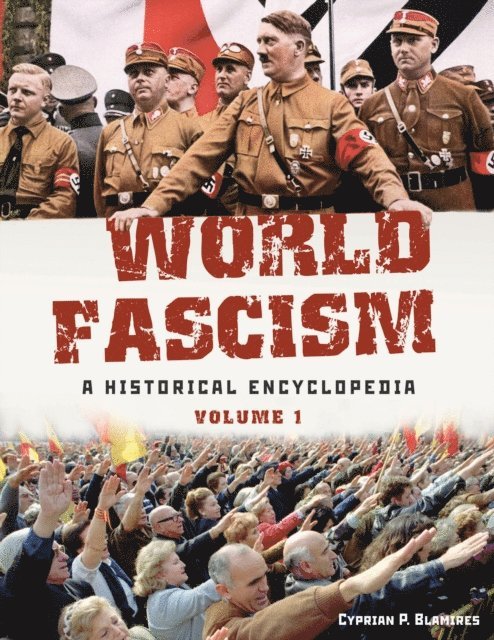
This book shows how, during the 20th century, evils such as totalitarianism, tyranny, war, and genocide became indelibly linked to the fascist cause, and examines the enduring and popular appeal of an ideology that has counted princes, poets, and war heroes among its most fervent adherents.From the followers of Hajj Amin Al-Husseini, the Arab leader who met with Adolf Hitler in November 1942 to the murderous death squads of the Croatian Ustasha to certain members of the British Establishment, fascism's heady brew of extreme nationalism and revolutionary violence has attracted followers from across all religions, races, and classes. Now widely reviled, fascism became an immensely powerful political force in Western Europe throughout the 1930s and into the 1940s. How did civilized nations like Italy, Germany, Austria, and others succumb to an ideology now regarded by the political mainstream as barbarous and beyond the pale?World Fascism: A Historical Encyclopedia covers all the key personalities and movements throughout the history of fascism and brings to light some of the ideology's lesser-known aspects, from Hindu extremists in India to the influential role of certain women in fascist movements. How did an ideology which was openly boastful of its belief in violence come to seduce the elites of some of the most civilized nations on earth? What can explain fascism''s enduring appeal?