Cyril Ponnamperuma – författare
Visar alla böcker från författaren Cyril Ponnamperuma. Handla med fri frakt och snabb leverans.
16 produkter
16 produkter
Inbunden, Engelska, 1995
2 174 kr
Skickas inom 10-15 vardagar
This interdisciplinary book consists of the proceedings of the Alexander Ivanovich Oparin lOOth Anniversary Conference, The Third Trieste Conference on Chemical Evolution, which took place at the International Centre for Theoretical Physics from 29 August till 2 September, 1994. A general overview of Oparin's life and work is followed by a review of Alfonso Herera, another pioneer in the studies of the origin of life. The subject matter is organized in ten sections corresponding to various aspects of our current understanding of the subject that was initiated by Oparin. These subjects were covered by fifty three speakers. There were sixty seven participants from a wide geographical distribution; twenty seven countries were represented. We have included the invited lecture of Professor Igor Kulaev, who was unable to be present at the conference for reasons beyond his control. The conference was generously supported by the International Centre for Theoretical Physics, the Commission of the European Communities, the International Centre for Genetic Engineering and Biotechnology, the International Centre for Science and High Technology, and UNESCO. Cyril Ponnamperuma, University of Maryland, U.S.A. Julian Chela-Flores, ICTP, Italy, and IDEA, Venezuela. xi FOREWORD As this volume was going to press we learnt of the untimely death of Cyril Ponnamperuma who died of cardiac arrest on December 20, 1994.
E-bok
PDF, Engelska, 2013756 kr
Läs direkt efter köp
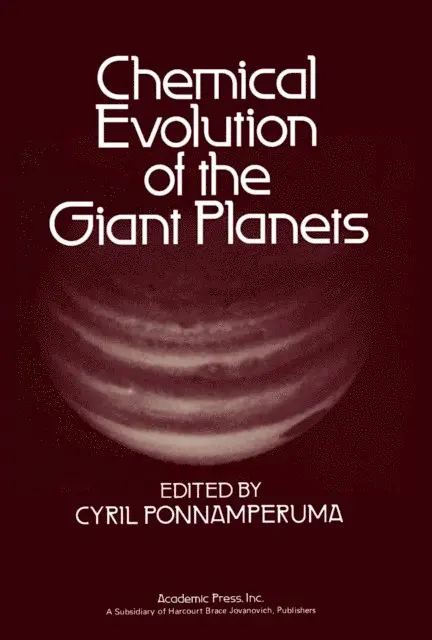
Chemical Evolution of the Giant Planets is a compilation of papers on the chemical evolution of giant planets, presented at a colloquium sponsored by the Laboratory of Chemical Evolution in October, 1974. The compendium focuses on the interpretation of data provided by the Pioneer 10 and 11 missions, which conducted explorations of the outer planets. Scientists from various disciplines tackle the various aspects of the study of the chemical environment of the giant planets and their satellites. Subjects such as the atmosphere of Jupiter and Saturn; chemical abundances in the atmospheres of the giant planets and their satellites; possibility of growth of airborne microbes in outer planetary atmospheres; and the biology on the outer planets are covered in the book. Astronomers, chemists, geologists, and biologists will find the book interesting.
E-bok
PDF, Engelska, 2013756 kr
Läs direkt efter köp
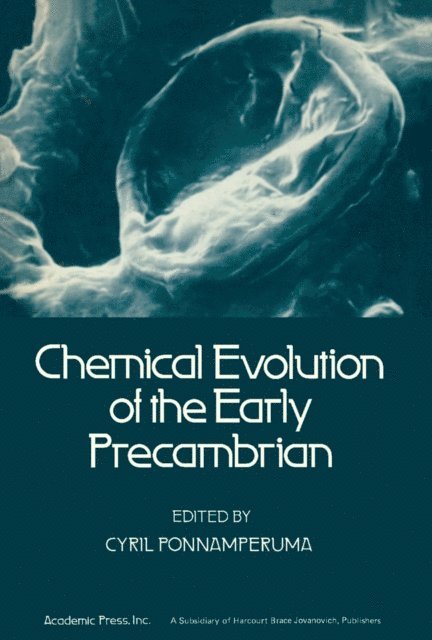
Chemical Evolution of the Early Precambrian is a collection of papers presented at the Second College Park Colloquium on Chemical Evolution, held at the University of Maryland in October 1975. The book presents the discussions on the processes that led to the beginning of life on earth based on information gathered from the study of the Early Precambrian period. Topics on the origin of the atmosphere; early Precambrian weathering and sedimentation; carbon contents of early Precambrian rocks; and the establishment of the earliest date in the Precambrian period at which unambiguous living forms existed are expounded in the text. Geologists, biologists, chemists, paleobiologists, and students will find the book insightful and interesting.
E-bok
PDF, Engelska, 2013756 kr
Läs direkt efter köp
Comparative Planetology discusses the results of data obtained from the Viking mission to Mars along with other data from other planetary missions. The book considers the many aspects of the evolution of the solar system in a comparative fashion. The interiors of planets, crustal evolution, the origin of planetary atmospheres, and the question of the origin of life are discussed using the gathered information. Astronomers, geologists, chemists, and biologists will find the book an interesting read.
1 635 kr
Skickas inom 10-15 vardagar
Proceedings of the Fourth International Conference on the Origin of Life and the First Meeting of the International Society for the Study of the Origin of Life (ISSOL), Barcelona, June 25-28, 1973. Vol. II: Contributed Papers
Del 5 - Proceedings of the College Park Colloquia
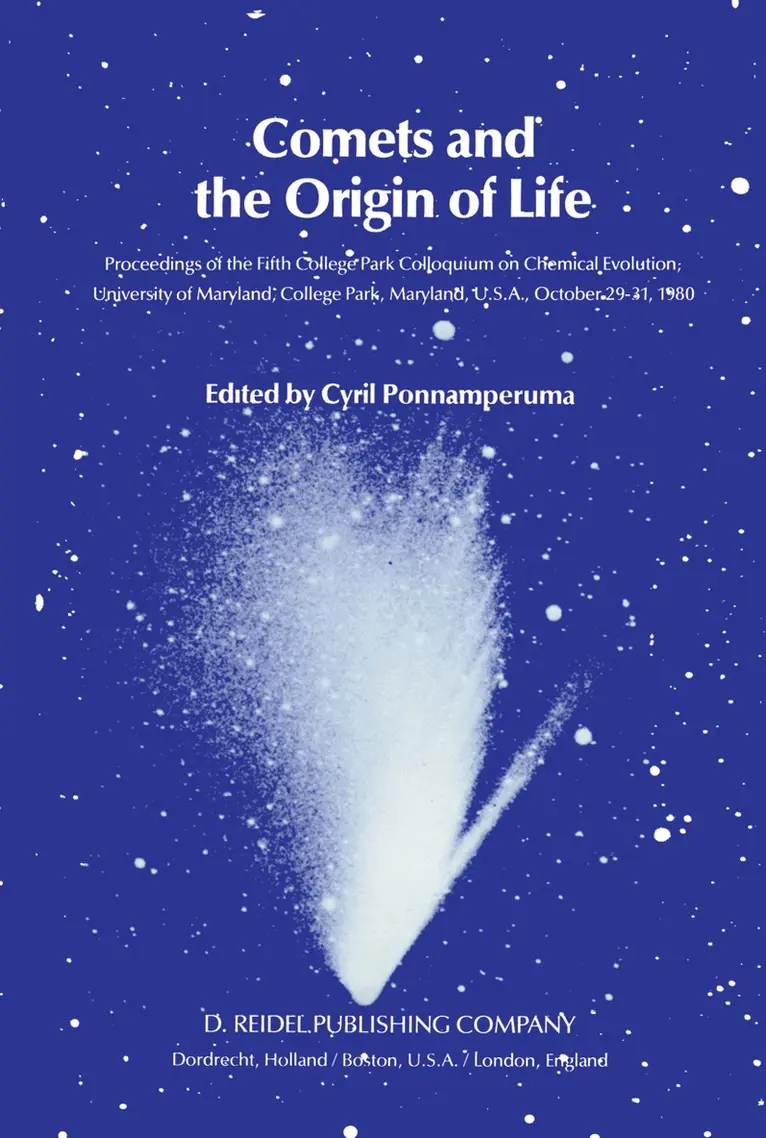
Comets and the Origin of Life
Proceedings of the Fifth College Park Colloquium on Chemical Evolution, University of Maryland, College Park, Maryland, U.S.A., October 29th to 31st, 1980
Inbunden, Engelska, 1981
1 635 kr
Skickas inom 10-15 vardagar
The return of Halley's Cornet in 1986 has generated much ex citement in the scientific community with preparations already afoot for an International Cornet Watch and a cornet launch by the European Space Community, the Japanese and Soviet Space Scientists. The meet ing held at the University of Maryland in October 1980 was primarily stimulated by the preparations for further study of this cornet and by one of the most important unanswered questions related to comets, name ly, whether they may have made a eontribution to the origin of life on earth. Our un"derstanding of the role of comets in the origin of life must necessarily come from our studies of the astronomy and the chem istry of comets. Some clues to the processes which led to the for mation of organic molecules and eventually to the appearance of life have come from these studies of comets, perhaps the most ancient of all objects in our solar system. Whether there is, however, a biology of comets still remains to be seen, although some claims have been made that perhaps comets might themselves provide an environment for even the beginnings of life. Scientists with the latest available information on comets and differing opinions as to the role of comets in the origin of life attended this symposium. The formal papers presented are now being made available to the students of chemical evolution within the pages of this volume.
Inbunden, Engelska, 1983
2 178 kr
Skickas inom 10-15 vardagar
For the first time in human history, developments in many branches of science provide us with an opportunity of formula ting a comprehensive picture of the universe from its beginning to the present time. It is an awesome reflection that the carbon in our bodies is the very carbon which was generated during the birth of a star. There is a perceptible continuum through the billions of years which can be revealed by the study of chemistry. Studies in nucleosynthesis have related the origin of the elements to the life history of the stars. The chemical elements we find on earth, HYdrogen, Carbon, Oxygen, and Nitrogen, were created in astronomical processes that took place in the past, and these elements are not spread throughout space in the form of stars and galaxies. Radioastronomers have discovered a vast array of organic molecules in the interstellar medium which have a bearing on prebiological chemical processes. Many of the molecules found so far contain the four elements, C, N, 0, H. Except for the chem ically unreactive He, these four elements are the most abundant in the galaxy. The origin of polyatomic interstellar molecules is an unresolved problem. While we can explain the formation of some diatomic molecules as due to two atom collisions, it is much more difficult to form polyatomic molecules by collisions between diatomic molecules and atoms. There may be other produc tion mechanisms at work such as reactions taking place on the surface of interstellar dust grains.
E-bok
PDF, Engelska, 20122 741 kr
Läs direkt efter köp
For the first time in human history, developments in many branches of science provide us with an opportunity of formula ting a comprehensive picture of the universe from its beginning to the present time. It is an awesome reflection that the carbon in our bodies is the very carbon which was generated during the birth of a star. There is a perceptible continuum through the billions of years which can be revealed by the study of chemistry. Studies in nucleosynthesis have related the origin of the elements to the life history of the stars. The chemical elements we find on earth, HYdrogen, Carbon, Oxygen, and Nitrogen, were created in astronomical processes that took place in the past, and these elements are not spread throughout space in the form of stars and galaxies. Radioastronomers have discovered a vast array of organic molecules in the interstellar medium which have a bearing on prebiological chemical processes. Many of the molecules found so far contain the four elements, C, N, 0, H. Except for the chem ically unreactive He, these four elements are the most abundant in the galaxy. The origin of polyatomic interstellar molecules is an unresolved problem. While we can explain the formation of some diatomic molecules as due to two atom collisions, it is much more difficult to form polyatomic molecules by collisions between diatomic molecules and atoms. There may be other produc tion mechanisms at work such as reactions taking place on the surface of interstellar dust grains.
Häftad, Engelska, 2011
2 178 kr
Skickas inom 10-15 vardagar
For the first time in human history, developments in many branches of science provide us with an opportunity of formula ting a comprehensive picture of the universe from its beginning to the present time. It is an awesome reflection that the carbon in our bodies is the very carbon which was generated during the birth of a star. There is a perceptible continuum through the billions of years which can be revealed by the study of chemistry. Studies in nucleosynthesis have related the origin of the elements to the life history of the stars. The chemical elements we find on earth, HYdrogen, Carbon, Oxygen, and Nitrogen, were created in astronomical processes that took place in the past, and these elements are not spread throughout space in the form of stars and galaxies. Radioastronomers have discovered a vast array of organic molecules in the interstellar medium which have a bearing on prebiological chemical processes. Many of the molecules found so far contain the four elements, C, N, 0, H. Except for the chem ically unreactive He, these four elements are the most abundant in the galaxy. The origin of polyatomic interstellar molecules is an unresolved problem. While we can explain the formation of some diatomic molecules as due to two atom collisions, it is much more difficult to form polyatomic molecules by collisions between diatomic molecules and atoms. There may be other produc tion mechanisms at work such as reactions taking place on the surface of interstellar dust grains.
E-bok
PDF, Engelska, 20122 049 kr
Läs direkt efter köp
The return of Halley''s Cornet in 1986 has generated much ex citement in the scientific community with preparations already afoot for an International Cornet Watch and a cornet launch by the European Space Community, the Japanese and Soviet Space Scientists. The meet ing held at the University of Maryland in October 1980 was primarily stimulated by the preparations for further study of this cornet and by one of the most important unanswered questions related to comets, name ly, whether they may have made a eontribution to the origin of life on earth. Our un"derstanding of the role of comets in the origin of life must necessarily come from our studies of the astronomy and the chem istry of comets. Some clues to the processes which led to the for mation of organic molecules and eventually to the appearance of life have come from these studies of comets, perhaps the most ancient of all objects in our solar system. Whether there is, however, a biology of comets still remains to be seen, although some claims have been made that perhaps comets might themselves provide an environment for even the beginnings of life. Scientists with the latest available information on comets and differing opinions as to the role of comets in the origin of life attended this symposium. The formal papers presented are now being made available to the students of chemical evolution within the pages of this volume.
Häftad, Engelska, 2011
1 635 kr
Skickas inom 10-15 vardagar
The return of Halley's Cornet in 1986 has generated much ex citement in the scientific community with preparations already afoot for an International Cornet Watch and a cornet launch by the European Space Community, the Japanese and Soviet Space Scientists. The meet ing held at the University of Maryland in October 1980 was primarily stimulated by the preparations for further study of this cornet and by one of the most important unanswered questions related to comets, name ly, whether they may have made a eontribution to the origin of life on earth. Our un"derstanding of the role of comets in the origin of life must necessarily come from our studies of the astronomy and the chem istry of comets. Some clues to the processes which led to the for mation of organic molecules and eventually to the appearance of life have come from these studies of comets, perhaps the most ancient of all objects in our solar system. Whether there is, however, a biology of comets still remains to be seen, although some claims have been made that perhaps comets might themselves provide an environment for even the beginnings of life. Scientists with the latest available information on comets and differing opinions as to the role of comets in the origin of life attended this symposium. The formal papers presented are now being made available to the students of chemical evolution within the pages of this volume.
E-bok
PDF, Engelska, 20121 367 kr
Läs direkt efter köp
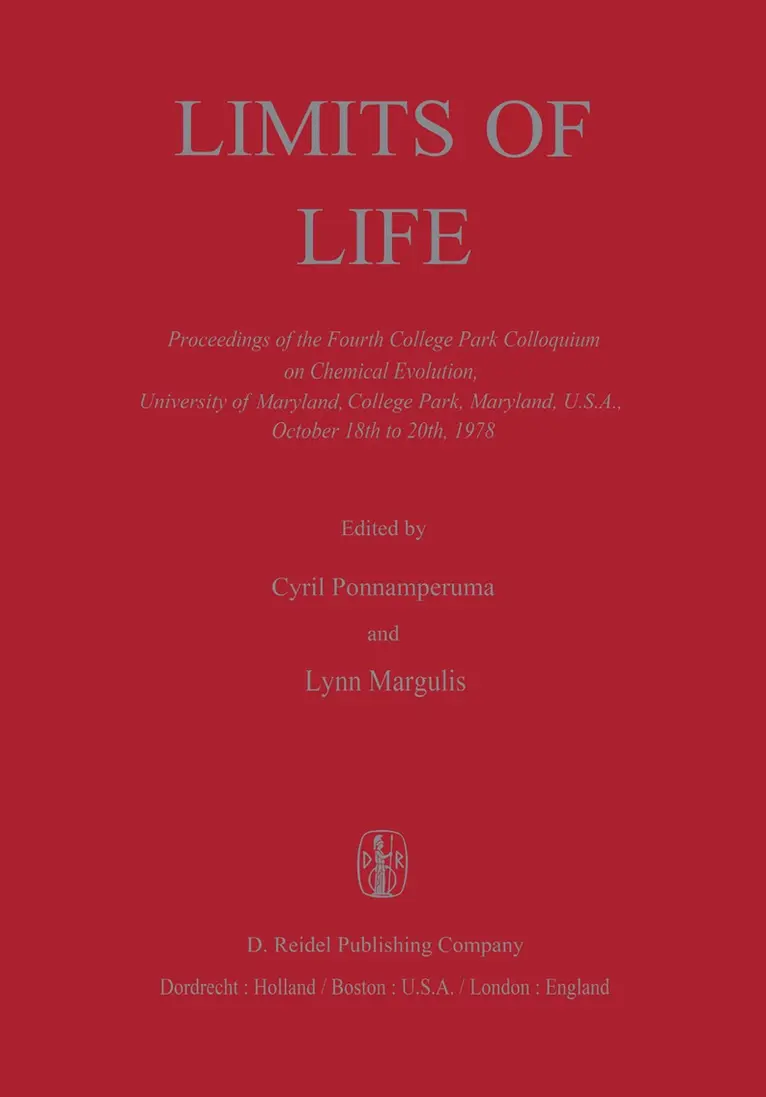
This volume is the fourth in the series of the Proceedings of the College Park Colloquia on Chemical Evolution. These Colloquia, and the resulting Proceedings, are presented in the interest of fostering the impact of the interdisciplinary nature of chemical evolu tion on contemporary scientific thought. vii EDITORS''INTRODUCTION The Fourth College Park Colloquium on Chemical Evolution was held on October 18 - 20, 1978 at the University of Maryland. The meeting, supported by the National Aero nautics and Space Administration and the National Science Foundation, centered on the variable environments, both past and present, in which living organisms have survived, grown, and evolved - the limits of life. Previous colloquia had emphasized the Giant Planets (1974) 1, Early Life during the Precambrian (1975)2 and Comparative Planetology (1976)3. The College Park Colloquia have been noted for the broad interdisciplinary nature of the training and interests of the participants. The fourth meeting was no ex ception with the participation of approximately 85 researchers, representing many academic fields. As with previous meetings, the interdisciplinary approach to the question of the limits of life encouraged the exchange of knowledge and information. A major scientific aspiration is to understand why living systems are restricted to certain environments.
Häftad, Engelska, 2011
1 092 kr
Skickas inom 10-15 vardagar
This volume is the fourth in the series of the Proceedings of the College Park Colloquia on Chemical Evolution. These Colloquia, and the resulting Proceedings, are presented in the interest of fostering the impact of the interdisciplinary nature of chemical evolu tion on contemporary scientific thought. vii EDITORS'INTRODUCTION The Fourth College Park Colloquium on Chemical Evolution was held on October 18 - 20, 1978 at the University of Maryland. The meeting, supported by the National Aero nautics and Space Administration and the National Science Foundation, centered on the variable environments, both past and present, in which living organisms have survived, grown, and evolved - the limits of life. Previous colloquia had emphasized the Giant Planets (1974) 1, Early Life during the Precambrian (1975)2 and Comparative Planetology (1976)3. The College Park Colloquia have been noted for the broad interdisciplinary nature of the training and interests of the participants. The fourth meeting was no ex ception with the participation of approximately 85 researchers, representing many academic fields. As with previous meetings, the interdisciplinary approach to the question of the limits of life encouraged the exchange of knowledge and information. A major scientific aspiration is to understand why living systems are restricted to certain environments.
1 977 kr
Läs direkt efter köp
1 635 kr
Skickas inom 10-15 vardagar
Proceedings of the Fourth International Conference on the Origin of Life and the First Meeting of the International Society for the Study of the Origin of Life (ISSOL), Barcelona, June 25-28, 1973. Vol. II: Contributed Papers
Häftad, Engelska, 2012
2 178 kr
Skickas inom 10-15 vardagar
This interdisciplinary book consists of the proceedings of the Alexander Ivanovich Oparin lOOth Anniversary Conference, The Third Trieste Conference on Chemical Evolution, which took place at the International Centre for Theoretical Physics from 29 August till 2 September, 1994. A general overview of Oparin's life and work is followed by a review of Alfonso Herera, another pioneer in the studies of the origin of life. The subject matter is organized in ten sections corresponding to various aspects of our current understanding of the subject that was initiated by Oparin. These subjects were covered by fifty three speakers. There were sixty seven participants from a wide geographical distribution; twenty seven countries were represented. We have included the invited lecture of Professor Igor Kulaev, who was unable to be present at the conference for reasons beyond his control. The conference was generously supported by the International Centre for Theoretical Physics, the Commission of the European Communities, the International Centre for Genetic Engineering and Biotechnology, the International Centre for Science and High Technology, and UNESCO. Cyril Ponnamperuma, University of Maryland, U.S.A. Julian Chela-Flores, ICTP, Italy, and IDEA, Venezuela. xi FOREWORD As this volume was going to press we learnt of the untimely death of Cyril Ponnamperuma who died of cardiac arrest on December 20, 1994.