D. Blair Gibson - Böcker
Visar alla böcker från författaren D. Blair Gibson. Handla med fri frakt och snabb leverans.
4 produkter
4 produkter
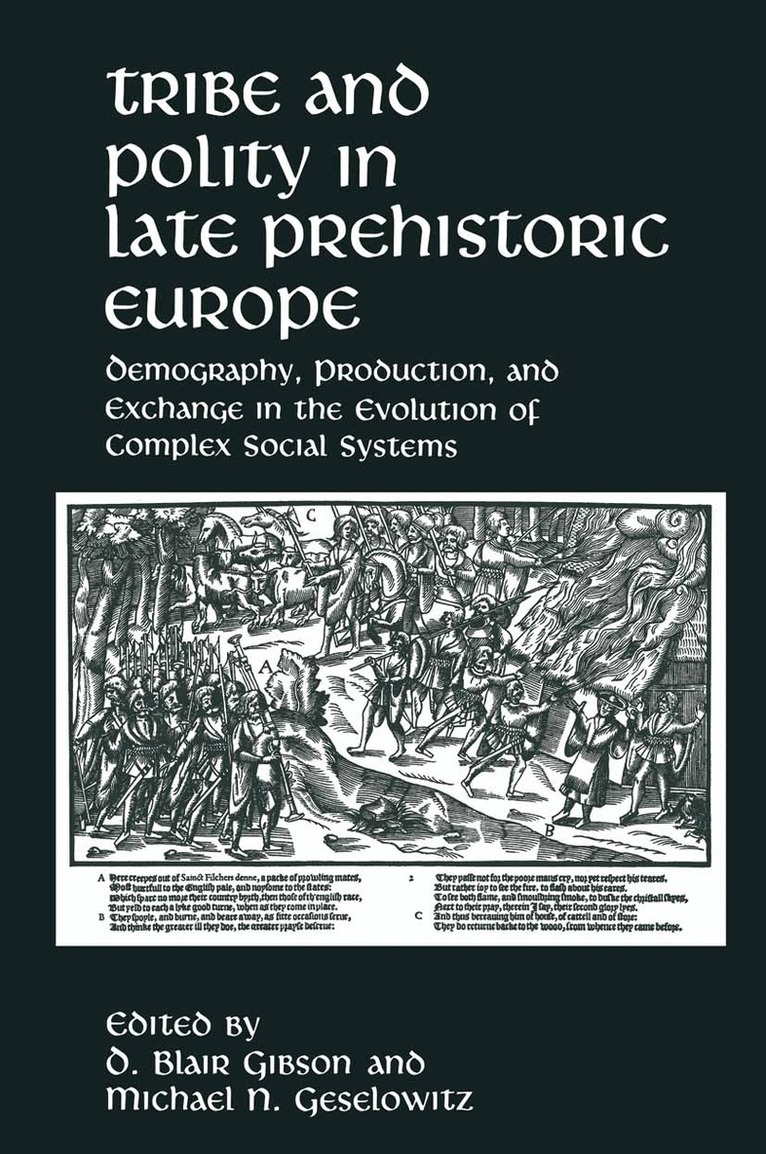
Tribe and Polity in Late Prehistoric Europe
Demography, Production, and Exchange in the Evolution of Complex Social Systems
Inbunden, Engelska, 1988
1 095 kr
Skickas inom 10-15 vardagar
During HaA-HaB, many settlements were established in Silesia and in the central part of Poland, and their stability seems to be confirmed by the existence of regional groups and subgroups, by long-lasting colonies, and by long-used burial grounds, located at large settlements. At the end of HaB, many pre-Scythian elements occurred in this area, only partly influenced by the Cimmerians . During that period the peoples living north of the Carpathian and Sudeten Mountains remained very dependent on the productive and cultural circle south of the Carpathians, with which they maintained strong connections . The Lusatian settlement zone , apart from its increasing internal stability, also tended to extend its range . A partition of the Lusatian Culture, which had appeared earlier , became more pronounced under the strong influence of the East Hallstatt cultural and productive center in the eastern Alpine region , and the so-called amber route . The eastern zone of the Lusatian Culture remained under the influence of the Carpathian center, while the western zone was strongly influenced by the pre-Celtic (Bylanska or Horakowska) and northern Illyrian (Calon denberian) cultures. In HaD2' ca. 520-500 B.C., this latter area was the site of an armed incursion of Scythian groups coming from the east through the Karpacka Valley. The most characteristic features of the western zone include its own varieties of more general Hallstatt traits , such as fortified settlements (which date from HaA in the Lusatian Culture) , production of iron (done domestically since HaD), and decorated pottery.
Celtic Chiefdom, Celtic State
The Evolution of Complex Social Systems in Prehistoric Europe
Häftad, Engelska, 1998
482 kr
Skickas inom 7-10 vardagar
In this collection, archaeologists, historians, geographers and language specialists re-examine the structure and political development of Celtic states scattered across present-day Europe. The main theoretical focus is on whether and when state-level complexity was attained in the different Celtic settlements. The contributors also discuss and evaluate the various methods for studying Celtic social systems: the historical textual studies, as opposed to the analysis of the archaeological record, and the use of regional comparisons. Interweaving archaeological and textual evidence, the result is an interdisciplinary study of state formation never before attempted on such a wide scale which contributes to our understanding of social complexity in Celtic Europe, and, more generally, to the processes underlying social transformation.
1 282 kr
Skickas inom 7-10 vardagar
This book tracks the development of social complexity in Ireland from the late prehistoric period on into the Middle Ages. Using a range of methods and techniques, particularly data from settlement patterns, Blair Gibson demonstrates how Ireland evolved from constellations of chiefdoms into a political entity bearing the characteristics of a rudimentary state. This book argues that early medieval Ireland's highly complex political systems should be viewed as amalgams of chiefdoms with democratic procedures for choosing leaders rather than kingdoms. Gibson explores how these chiefdom confederacies eventually transformed into recognizable states over a period of 1,400 years.
Tribe and Polity in Late Prehistoric Europe
Demography, Production, and Exchange in the Evolution of Complex Social Systems
Häftad, Engelska, 2013
1 095 kr
Skickas inom 10-15 vardagar
A partition of the Lusatian Culture, which had appeared earlier , became more pronounced under the strong influence of the East Hallstatt cultural and productive center in the eastern Alpine region , and the so-called amber route .