D. Chandrasekharam – författare
Visar alla böcker från författaren D. Chandrasekharam. Handla med fri frakt och snabb leverans.
23 produkter
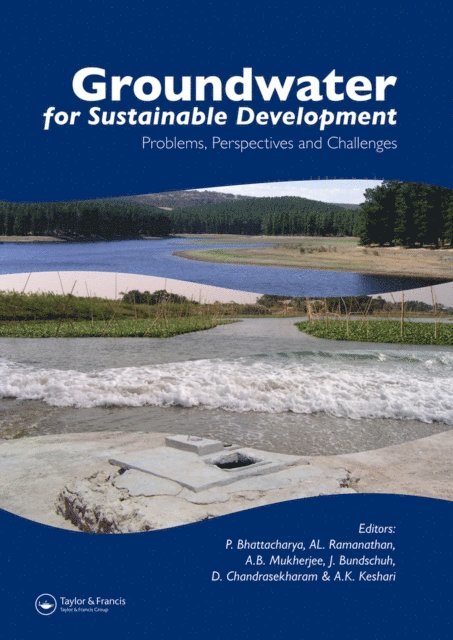
Groundwater for Sustainable Development
Problems, Perspectives and Challenges
Av A.K. Keshari, D. Chandrasekharam m. fl.
E-bok, 2008
4415 kr
Lägg i varukorg
Groundwater is the most important source of domestic, industrial, and agricultural water and also a finite resource. Population growth has created an unprecedented demand for water, with the situation most critical in the developing world, where several million people depend on contaminated …
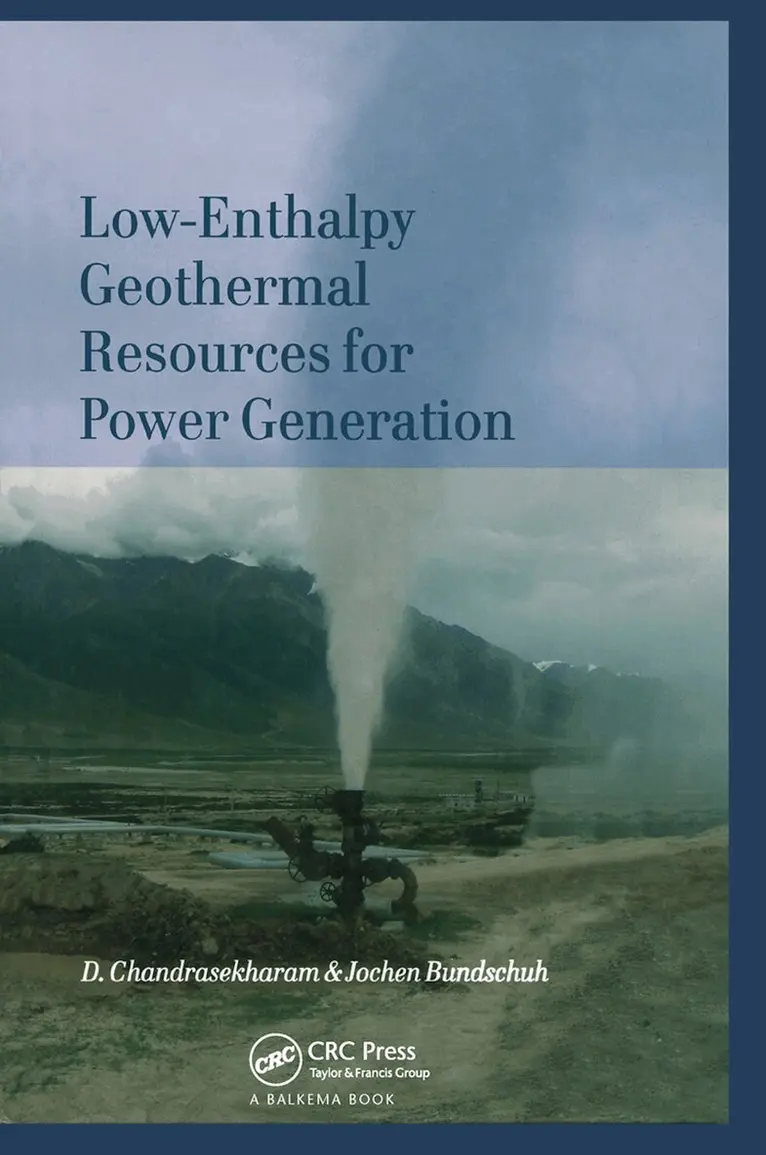
Low-Enthalpy Geothermal Resources for Power Generation
Av D. Chandrasekharam, Jochen Bundschuh
Häftad, 2019
1028 kr
Lägg i varukorg
In many developing countries the exponentially growing electricity demand can be covered by using locally available, sustainable low-enthalpy geothermal resources (80-150 °C). Such low-enthalpy sources can make electricity generation more independent from oil imports or from the over-dependence on …
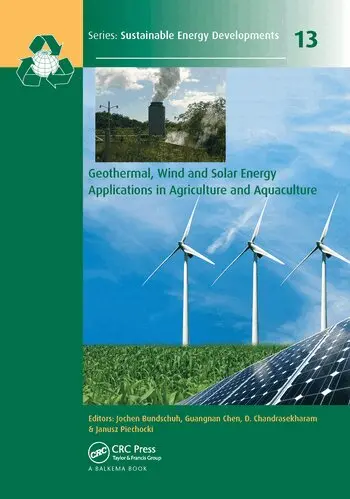
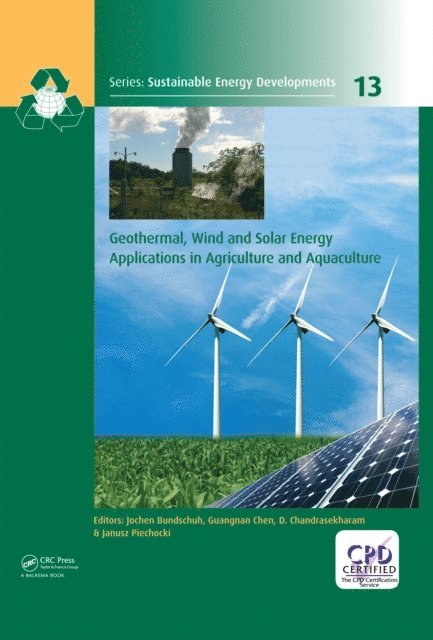
Geothermal, Wind and Solar Energy Applications in Agriculture and Aquaculture
Av Jochen Bundschuh, Guangnan Chen m. fl.
Häftad, 2020
806 kr
Lägg i varukorg
The agri-food chain consumes about one third of the world’s energy production with about 12% of it for crop production and nearly 80% for processing, distribution, retail, preparation and cooking. The agri-food chain also accounts for 80-90% of total global freshwater use where 70% alone is for …
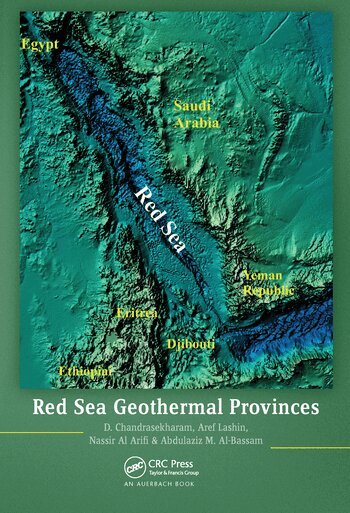
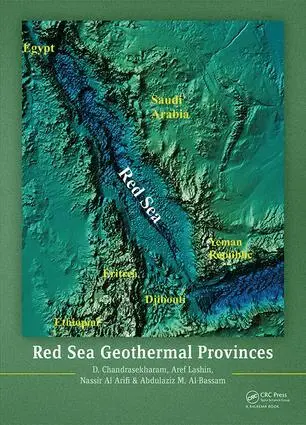
Red Sea Geothermal Provinces
Av D. Chandrasekharam, Aref Lashin m. fl.
Häftad, 2020
806 kr
Lägg i varukorg
“Today, over two billion people in developing countries live without any electricity. They lead lives of misery, walking miles every day for water and firewood, just to survive. What if there was an existing, viable technology, that when developed to its highest potential could increase everyone’s …
Natural Arsenic in Groundwater
Proceedings of the Pre-Congress Workshop "Natural Arsenic in Groundwater", 32nd International Geological Congress, Florence, Italy, 18-19 August 2004
Av J. Bundschuh, P. Bhattacharya m. fl.
Inbunden, 2005
3070 kr
Lägg i varukorg
Arsenic contamination has become a global phenomenon. With the development of advanced technological detection tools, more geographical areas have been identified. The people most affected are those in the poorer socio-economic groups. The research articles in this book have been contributed by …
Low-Enthalpy Geothermal Resources for Power Generation
Av D. Chandrasekharam, Jochen Bundschuh
Inbunden, 2008
1830 kr
Lägg i varukorg
In many developing countries the exponentially growing electricity demand can be covered by using locally available, sustainable low-enthalpy geothermal resources (80-150 °C). Such low-enthalpy sources can make electricity generation more independent from oil imports or from the over-dependence on …
Groundwater for Sustainable Development
Problems, Perspectives and Challenges
Av Prosun Bhattacharya, AL Ramanathan m. fl.
Inbunden, 2008
4781 kr
Lägg i varukorg
Groundwater is the most important source of domestic, industrial, and agricultural water and also a finite resource. Population growth has created an unprecedented demand for water, with the situation most critical in the developing world, where several million people depend on contaminated …
Groundwater for Sustainable Development
Problems, Perspectives and Challenges
Av A.K. Keshari, D. Chandrasekharam m. fl.
E-bok, 2008
4415 kr
Lägg i varukorg
Groundwater is the most important source of domestic, industrial, and agricultural water and also a finite resource. Population growth has created an unprecedented demand for water, with the situation most critical in the developing world, where several million people depend on contaminated …
Low-Enthalpy Geothermal Resources for Power Generation
Av Jochen Bundschuh, D. Chandrasekharam
E-bok, 2008
1186 kr
Lägg i varukorg
In many developing countries the exponentially growing electricity demand can be covered by using locally available, sustainable low-enthalpy geothermal resources (80-150 °C). Such low-enthalpy sources can make electricity generation more independent from oil imports or from the over-dependence on …
Low-Enthalpy Geothermal Resources for Power Generation
Av Jochen Bundschuh, D. Chandrasekharam
E-bok, 2008
1212 kr
Lägg i varukorg
In many developing countries the exponentially growing electricity demand can be covered by using locally available, sustainable low-enthalpy geothermal resources (80-150 °C). Such low-enthalpy sources can make electricity generation more independent from oil imports or from the over-dependence on …
Natural Arsenic in Groundwater
Proceedings of the Pre-Congress Workshop "e;Natural Arsenic in Groundwater"e;, 32nd International Geological Congress, Florence, Italy, 18-19 August 2004
Av D. Chandrasekharam, P. Bhattacharya m. fl.
E-bok, 2005
3354 kr
Lägg i varukorg
Arsenic contamination has become a global phenomenon. With the development of advanced technological detection tools, more geographical areas have been identified. The people most affected are those in the poorer socio-economic groups. The research articles in this book have been contributed by …
Natural Arsenic in Groundwater
Proceedings of the Pre-Congress Workshop "e;Natural Arsenic in Groundwater"e;, 32nd International Geological Congress, Florence, Italy, 18-19 August 2004
Av D. Chandrasekharam, P. Bhattacharya m. fl.
E-bok, 2005
3354 kr
Lägg i varukorg
Arsenic contamination has become a global phenomenon. With the development of advanced technological detection tools, more geographical areas have been identified. The people most affected are those in the poorer socio-economic groups. The research articles in this book have been contributed by …
Red Sea Geothermal Provinces
Av D. Chandrasekharam, Aref Lashin m. fl.
Inbunden, 2016
2106 kr
Lägg i varukorg
“Today, over two billion people in developing countries live without any electricity. They lead lives of misery, walking miles every day for water and firewood, just to survive. What if there was an existing, viable technology, that when developed to its highest potential could increase everyone’s …
Geothermal, Wind and Solar Energy Applications in Agriculture and Aquaculture
Av Jochen Bundschuh, Guangnan Chen m. fl.
Inbunden, 2017
3434 kr
Lägg i varukorg
The agri-food chain consumes about one third of the world’s energy production with about 12% of it for crop production and nearly 80% for processing, distribution, retail, preparation and cooking. The agri-food chain also accounts for 80-90% of total global freshwater use where 70% alone is for …
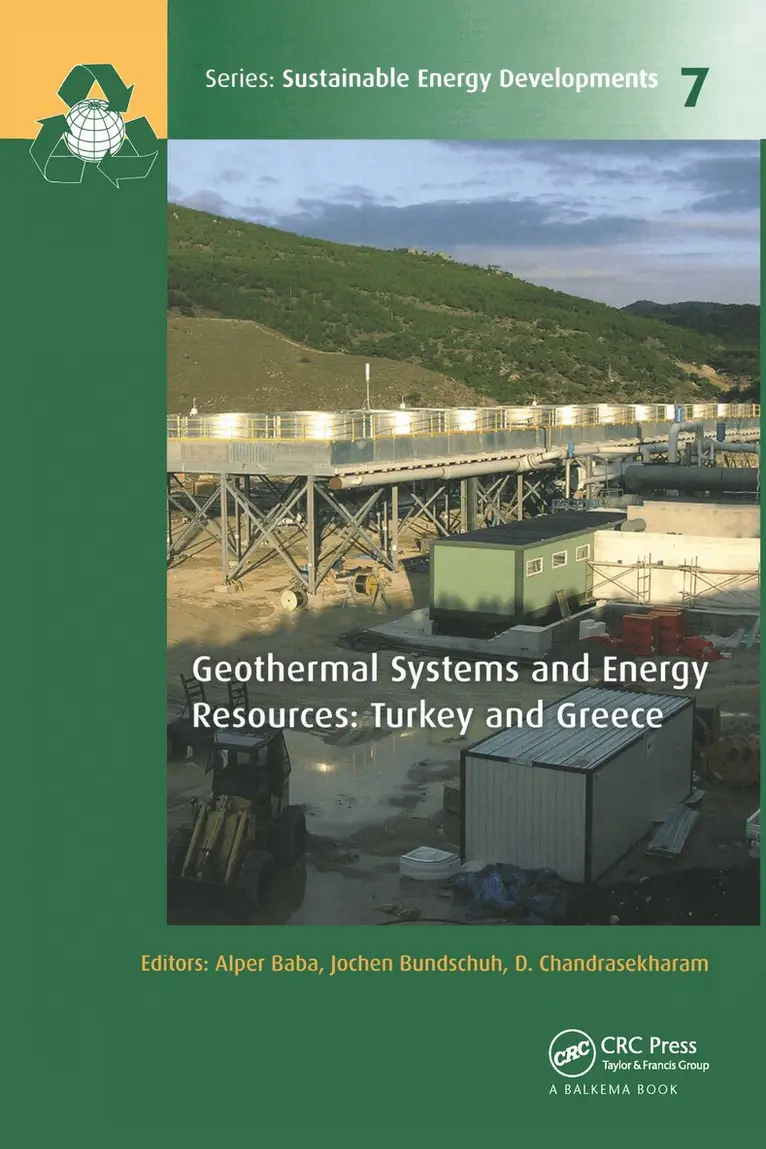
Geothermal Systems and Energy Resources
Turkey and Greece
Av Alper Baba, Jochen Bundschuh m. fl.
Häftad, 2019
1480 kr
Lägg i varukorg
In the region comprising Turkey and Greece, people have been using water from geothermal sources for bathing and washing of clothes since ancient times. This region falls within the Alpine-Himalayan orogenic belt and hence is a locus of active volcanism and tectonism and experiences frequent …
Geothermal Systems and Energy Resources
Turkey and Greece
Av D. Chandrasekharam, Jochen Bundschuh m. fl.
E-bok, 2014
1749 kr
Lägg i varukorg
In the region comprising Turkey and Greece, people have been using water from geothermal sources for bathing and washing of clothes since ancient times. This region falls within the Alpine-Himalayan orogenic belt and hence is a locus of active volcanism and tectonism and experiences frequent …
Red Sea Geothermal Provinces
Av Abdulaziz M Al-Bassam, Nassir Al Arifi m. fl.
E-bok, 2016
953 kr
Lägg i varukorg
“Today, over two billion people in developing countries live without any electricity. They lead lives of misery, walking miles every day for water and firewood, just to survive. What if there was an existing, viable technology, that when developed to its highest potential could increase …
Red Sea Geothermal Provinces
Av Abdulaziz M Al-Bassam, Nassir Al Arifi m. fl.
E-bok, 2016
932 kr
Lägg i varukorg
“Today, over two billion people in developing countries live without any electricity. They lead lives of misery, walking miles every day for water and firewood, just to survive. What if there was an existing, viable technology, that when developed to its highest potential could increase …
Geothermal Systems and Energy Resources
Turkey and Greece
Av D. Chandrasekharam, Jochen Bundschuh m. fl.
E-bok, 2014
1749 kr
Lägg i varukorg
In the region comprising Turkey and Greece, people have been using water from geothermal sources for bathing and washing of clothes since ancient times. This region falls within the Alpine-Himalayan orogenic belt and hence is a locus of active volcanism and tectonism and experiences frequent …
Geothermal, Wind and Solar Energy Applications in Agriculture and Aquaculture
Av Janusz Piechocki, D. Chandrasekharam m. fl.
E-bok, 2017
925 kr
Lägg i varukorg
The agri-food chain consumes about one third of the world’s energy production with about 12% of it for crop production and nearly 80% for processing, distribution, retail, preparation and cooking. The agri-food chain also accounts for 80-90% of total global freshwater use where 70% alone is for …
Geothermal, Wind and Solar Energy Applications in Agriculture and Aquaculture
Av Janusz Piechocki, D. Chandrasekharam m. fl.
E-bok, 2017
953 kr
Lägg i varukorg
The agri-food chain consumes about one third of the world’s energy production with about 12% of it for crop production and nearly 80% for processing, distribution, retail, preparation and cooking. The agri-food chain also accounts for 80-90% of total global freshwater use where 70% alone is for …
Geothermal Energy Resources for Developing Countries
Av D. Chandrasekharam, J. Bundschuh
Inbunden, 2002
2749 kr
Lägg i varukorg
This text aims to be a driving force for an economically sound and sustainable development of developing countries. It looks at the provision of geothermal energy within the framework of sustainable energy development for power generation, rural electrification and so forth.
Geothermal Systems and Energy Resources
Turkey and Greece
Av Alper Baba, Jochen Bundschuh m. fl.
Inbunden, 2014
2739 kr
Tillfälligt slut
In the region comprising Turkey and Greece, people have been using water from geothermal sources for bathing and washing of clothes since ancient times. This region falls within the Alpine-Himalayan orogenic belt and hence is a locus of active volcanism and tectonism and experiences frequent …