D. M. Goodfellow – författare
Visar alla böcker från författaren D. M. Goodfellow. Handla med fri frakt och snabb leverans.
4 produkter
4 produkter
1 406 kr
Skickas inom 10-15 vardagar
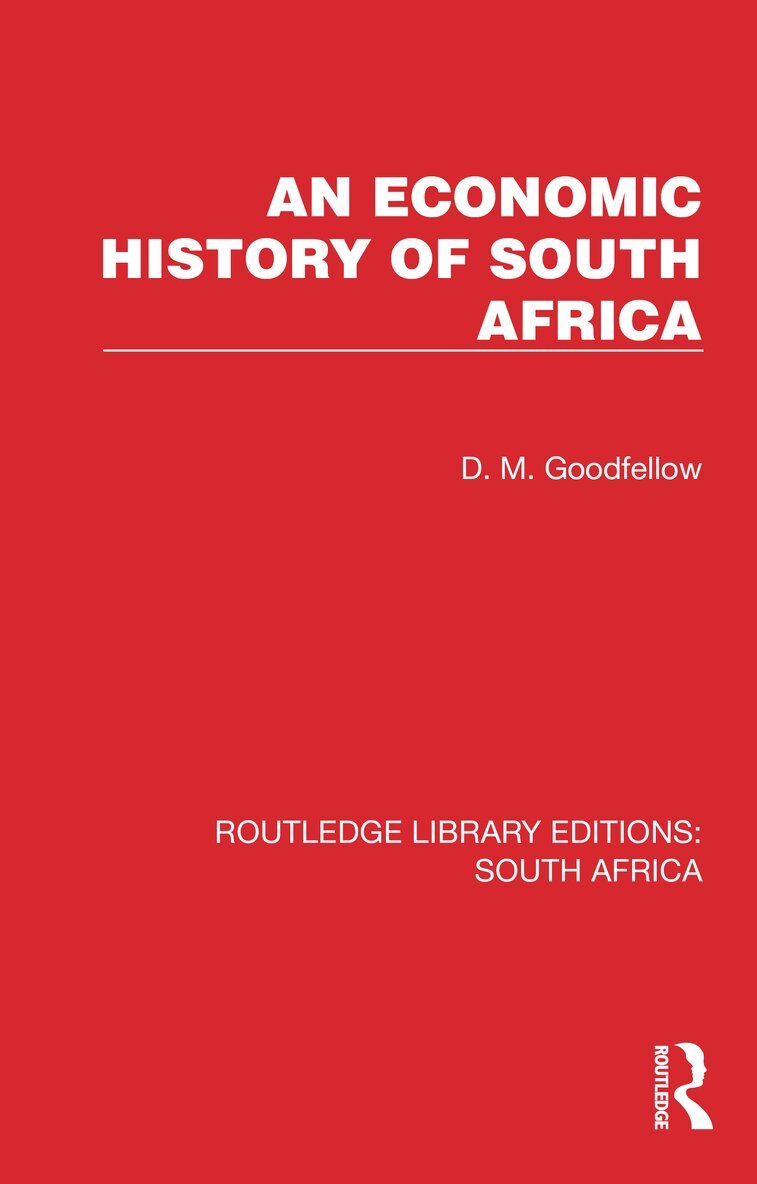
Originally published in 1931, A Modern Economic History of South Africa describes the state of Southern Africa in its early days. Its early expansion, the agriculture of the Trek Boers, the difficulties of communication over vast stretches of uncultivated land are woven by the author into a concrete picture of the economic life of the then undeveloped country. The development of the gold and diamond mining industries is discussed, as is their effect on the economy, and the development of infrastructure which followed such as the railways. The challenges of development are also analysed: the customs problems, the increased contact of European with Bantu populations and the ultimate unification of the sub-continent of South Africa.
455 kr
Skickas inom 10-15 vardagar
Originally published in 1931, A Modern Economic History of South Africa describes the state of Southern Africa in its early days. Its early expansion, the agriculture of the Trek Boers, the difficulties of communication over vast stretches of uncultivated land are woven by the author into a concrete picture of the economic life of the then undeveloped country. The development of the gold and diamond mining industries is discussed, as is their effect on the economy, and the development of infrastructure which followed such as the railways. The challenges of development are also analysed: the customs problems, the increased contact of European with Bantu populations and the ultimate unification of the sub-continent of South Africa.
Principles of Economic Sociology
The Economics of Primitive Life as Illustrated from the Bantu Peoples...
Inbunden, Engelska, 2024
1 569 kr
Skickas inom 10-15 vardagar
First published in 1939, Principles of Economic Sociology has a two-fold object: first, to develop an economic theory of primitive life, secondly, to show the social principles behind the making of economic decisions, whether among primitive or advanced peoples. Economic theory was first developed with regard to Western exchange economics. Since then, it has been explored among the activities of totalitarian states. Here the process is carried a step further, by tracing economic theory in the lives of primitive peoples. It shows how the Bantu of Africa make economic choices, dispose of their resources, and apply capital to the meeting of future needs, always in a manner dictated by their own culture, yet fundamentally on principles similar to those of advanced peoples.The importance of groups in the making of economic decisions is stressed. Economics is enriched by a study of the structure of groups, since this plays a fundamental part in the forming of decisions. The author hopes that his work will encourage economists to use a knowledge of primitive peoples to test their theories and help to coordinate the two major branches of social science, economics and sociology. This is an important historical reference work for scholars of African economics, economic sociology, and economic history.
Principles of Economic Sociology
The Economics of Primitive Life as Illustrated from the Bantu Peoples...
Häftad, Engelska, 2026
442 kr
Skickas inom 10-15 vardagar
First published in 1939, Principles of Economic Sociology has a two-fold object: first, to develop an economic theory of primitive life, secondly, to show the social principles behind the making of economic decisions, whether among primitive or advanced peoples. Economic theory was first developed with regard to Western exchange economics. Since then, it has been explored among the activities of totalitarian states. Here the process is carried a step further, by tracing economic theory in the lives of primitive peoples. It shows how the Bantu of Africa make economic choices, dispose of their resources, and apply capital to the meeting of future needs, always in a manner dictated by their own culture, yet fundamentally on principles similar to those of advanced peoples.The importance of groups in the making of economic decisions is stressed. Economics is enriched by a study of the structure of groups, since this plays a fundamental part in the forming of decisions. The author hopes that his work will encourage economists to use a knowledge of primitive peoples to test their theories and help to coordinate the two major branches of social science, economics and sociology. This is an important historical reference work for scholars of African economics, economic sociology, and economic history.